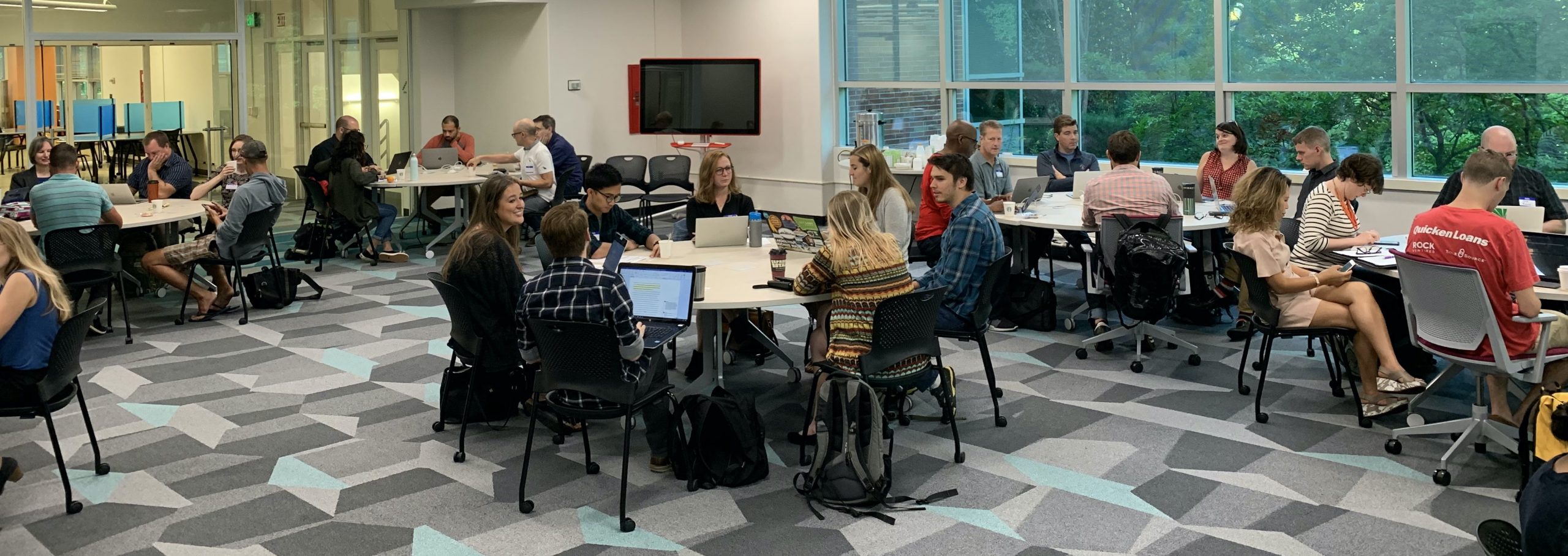
Join us for the 2026 DH End of Year Celebration on Thursday 4/23/26 in the LEADR Lab (112 Old Horticulture!
We’ll have presentations from those who were awarded Professional Development funding, those awarded Seed Grant Funding, the CAL/DSL Graduate Arts Fellows, as well as the DH Project Incubator projects 2025-2026! Shedule is below!
3PM – 3:10PM: Welcome, reflect on the year.
3:10 – 3:20PM: Presentations from those who received Professional Development funding
3:10 – 3:13PM: Max Evjen, Digital Humanities/Arts, Cultural Management & Museum Studies, “Where is the #musetech community online?” MCN2025 Session, Minneapolis, MN
3:14 – 3:17PM: Nonoka Koga, graduate student, History, funding to attend the AHA conference in Chicago in January
3:18PM – 3:30PM: Questions/Social Time
3:30PM-3:35PM: Presentations from those who received Seed Funding
Aayat Ismail – Cinematic Counter-Cartographies: Formal Refusal in Palestinian Cinema
Zou Yun – People’s Letters: A Digital Archive of Mao-Era China
Harry Foster – Badman Digital Archive
3:35PM – 4PM: Questions/Social Time
4PM-4:10PM: Presentation from the Graduate Arts Fellows
Shelby Frehiling: Connections Through Water
Jameson Reid: This Exact Dream
4:10PM – 4:20PM: Questions/Social Time
4:20PM – 4:55PM: Presentations from the Project Incubator Program
4:20 – 4:25: Micheal Laney and Kasey Wilson – Putting WKZO on the Map: Exploring WKZO’s ‘Western Michigan at Work’ Through Geography
4:25 – 4:30: Rose Fisher – Corpus of Spoken Pennsylvania Dutch
4:30- 4:35: Kathryn Genoa-Obradovich – (video) Immersive and Interactive Simulation for Graduate Speech-Language Pathology Student Pre-Clinical Orientation
4:35 – 4:50: Questions/Social Time
4:50 – 4:55 PM: Ning Xie – Employee Communication through Human-embodied AI Agent Versus Chatbot: Effects of Empathetic Leadership Communication on Employee Well-being
4:55 – 5PM: Questions/Social Time/Wrap Up
Please register here to let us know if you can make it!
While at MSU, my most significant engagement with DH has been in the creation and sharing of 3D models, particularly using the online tool SketchUp. I have built models of Sheffield’s John Walsh 1899 department store, Stonehenge, and Cologne Cathedral and 3D printed versions of Stonehenge and Cologne Cathedral. I have also taught two classes of undergraduate students the basics of 3D modeling in SketchUp. I have also worked with mapping, Omeka Classic, and scrolly telling tools.
Marissa is now Assistant Professor of History at MSU!
When Kendyl looks back on her career path, one thing particularly stands out: her work has always been about connecting with people. Now, as an E-Commerce Marketing Manager at Baker Publishing Group, she gets to do that every day by helping readers discover and engage with Baker Book House online. Whether she’s launching something new like TikTok Shop, building product visibility on Pinterest, or refining social ad strategies, she’s constantly testing, learning, and adjusting. At the end of the day, her goal is simple: grow the brand while creating real, meaningful connections with her audience.
That focus on people really started during her time at Michigan State University, where she minored in Digital Humanities. The program changed how she thinks about marketing. It taught her how to take human experiences and bring them into digital spaces in a way that feels authentic. Even now, working in such a data-driven industry, she always comes back to the same question: who is on the other side of the screen? That perspective shapes everything she does, from messaging to platform strategy.
One of her most memorable experiences in the program was a project where she analyzed mission statements across MSU’s colleges and compared them to gender distribution in those programs. It showed her how something as simple as language can influence someone’s decision on whether or not to participate in a program. That really stuck with her. It made her more intentional about the words she uses and more aware of how messaging can be inclusive or exclusive. It’s something she still carries with her in her work today.
During her studies, she didn’t fully realize how relevant Digital Humanities would be when it comes to navigating newer technologies like AI. But looking back, it gave her a mindset she relies on all the time. For Kendyl, Technology is just a tool, it’s not the focus. The focus is the person she’s trying to connect with through authentic storytelling.
Another thing she took from her experience is the ability to simplify complex ideas. A lot of her projects in school involved taking something big or abstract and turning it into something people could actually understand and engage with. That skill shows up in her work every day, whether she’s building a campaign or launching a new program. She’s always thinking about how to make things clear, accessible, and meaningful.
Her study abroad experience in London also played a big role in shaping how she sees storytelling. Spending time in museums and watching live performances helped her understand how powerful a well-designed experience can be. It also showed her that storytelling isn’t limited to digital spaces; it exists everywhere, and the way it’s presented really matters.
In addition to her study abroad experience, some of her favorite memories from MSU are the simpler ones. Walking along the Red Cedar River, sitting outside with friends, and just enjoying campus are the moments that made it feel like home. She still remembers visiting for the first time as a high school sophomore and instantly feeling like she belonged, and that feeling stuck with her long after graduation.
If she could advise current students on one thing, it would be this: don’t underestimate what you’re learning. Even if something feels specific to that course or project, the way you’re learning to think and solve problems will stay with you. Stay curious, try new things, and trust that it will all come together in ways you might not yet be able to see.
In February 2026, the Digital Scholarship Lab (DSL) collaborated with Dr. Jisun Lee’s course, PDC 491 – Special Topics in Planning, Design and Construction: Virtual Reality Application in Interior Design, to integrate immersive storytelling and 360 media production into student learning.
This partnership was supported by a Catalyst Grant the DSL received from the Center for Teaching and Learning Innovation (CTLI), which funds innovative digital learning experiences across campus. Through this grant, the DSL purchased ten Insta 360 X5 camera kits, including selfie sticks and cases, to expand opportunities for students to create immersive media for the 360 Room or Virtual Reality.
With access to this equipment and tailored technical support, PDC 491 students explored how 360 videos can convey meaning about environments through atmosphere and perspective. Responding to the prompt, “A Place That Represents Me,” students produced short 360 videos featuring locations within the MSU Main Library that held personal significance. Sharing why the location mattered to them, what emotions or spatial qualities it embodied, and how immersive viewing reshapes spatial understanding, students explored how 360 video functions as an experiential form of design communication.
The DSL continues to expand its support for immersive media creation across campus. Instructors interested in incorporating immersive digital storytelling into future courses are encouraged to reach out for a consultation.
Honestly, perhaps the most-cited thing I’ve ever published is a chapter in Debates in the Digital Humanities, in which I quoted an old ProfHacker blog post, in which I offered a provisional definition of DH. The blog post is now 16 years old — old enough to drive! — but it’s a definition I’d mostly stand by today:
“a nexus of fields within which scholars use computing technologies to investigate the kinds of questions that are traditional to the humanities, or, as is more true of my own work, who ask traditional kinds of humanities-oriented questions about computing technologies.”
The only part I’d retreat from is the “as is more true of my own work,” as I haven’t been doing the kind of writing of late in which I interrogate computing technologies. If anything, I’ve been doing a third kind of work: building a platform on which the widest possible range of researchers can do their own work digitally. Knowledge Commons is in many ways the key project of my career, not least in its capacity for helping others collaborate, communicate, share, and preserve their work — openly, without regard for institutional affiliation, title, geographic location, or ability to pay. We are community governed, values enacted, shared infrastructure for the future of scholarship, and those commitments are for me where the ethical heart of the digital humanities lies.
Margaux Malek Smith currently works as a Teaching Assistant in Normandy, France, participating in the TAPIF program. Her path to this role was shaped by her experiences in Digital Humanities (DH) at MSU, which connected to her discipline in unexpected ways. Initially, she considered studying abroad with a friend who had joined a program, but when her friend dropped out, Margaux decided to go alone, and the rest is history.
Some of her standout experiences at MSU include working at the Digital Scholarship Lab and studying abroad in London and Edinburgh, where she explored how technology shapes culture and creative practice. These opportunities taught her to think critically about digital media, collaborate across disciplines, and approach research projects with intention.
Margaux also credits internships, multiple on-campus jobs, and her second study abroad in Tours, France, for helping her grow. They pushed her beyond what she thought possible and gave her a foundation for teaching and research today.
Her favorite MSU memories aren’t all academic. She hosted the Spartan Awards, a mock ceremony for friends, and fondly remembers “second dinner” moments with her group. Mentors like Dr. Jena Whitaker, Matt Kanfesky, Patricia Walters, and Julie Koholer, along with friends such as Christie Ward and Kinsey Skjold, made her time at MSU unforgettable.
DH 340 introduces students to the fundamentals of large language models and AI through concept‑building, and model testing. The class pairs technical exploration with a site visit to MSU’s own data center to ground discussions about the environmental impact of AI. Students work collaboratively to build a public‑facing GitHub Pages website that explains AI concepts to fellow Spartans in clear and accessible language.
For Michael, Michigan State University became a place not of certainty, but of discovery. He started college as a Chemical Engineering major, but it didn’t take long for him to realize that engineering wasn’t where he saw himself long term. What did stick, though, were the moments spent working with people, especially through his roles as a Resident Assistant and campus tour guide which slowly pointed him toward higher education and student support.
The Digital Studies (DS) minor ended up being a turning point in ways Michael didn’t expect. While it helped him build creative and ethical approaches to working with data, it also gave him something just as important: connection. When it came time to apply to graduate school, Michael realized he didn’t feel as closely connected to professors in his major as he did to those he worked with through Digital Studies. Those relationships mattered, and they made all the difference.
Michael is quick to credit the people who helped him get where he is today. Kristen Mapes introduced him to Digital Studies and helped him see how creativity, data, and storytelling could come together. Kate Topham encouraged him to take the leap toward graduate school and supported him through the application process. Allysa Johnson helped Michael see that Student Affairs could be a real option for him, one that meant he didn’t have to force himself into a career path that never quite felt right.
Through Digital Studies, Michael also had the chance to work on projects that felt meaningful beyond the classroom. One standout experience was collaborating with a group of students, the MSU Library, and the Monuments Men and Women Foundation to create a visualization highlighting artwork lost during World War II. Projects like this, along with lessons from Data Feminism, pushed him to think more deeply about how data is used and who it serves.
Now, Michael is a master’s student in Student Affairs Administration at MSU and works as an Assistant Community Director in Residence Education and Housing Services, where he supports Resident Assistants and students during some of their most important moments. Looking back, he sees the Digital Studies minor as more than a minor, it was the place where things finally clicked. It gave him room to explore, people who believed in him, and the confidence to follow a path that felt true to who he is.
Digital Humanities, for me, is an interdisciplinary practice that aims to build a more holistic view of the world and the experiences that shape it. I often frame my work as public digital humanities because I see DH not simply as a set of tools, but as a critical framework that bolsters our ability to understand identity and community through researching, teaching, and practice. Through projects such as Comics as Data North America (CaDNA), or community-centered digital archives such as Voices of the Black Imaginary, I approach DH as a form of generative intervention. These projects ask how metadata, platforms, and digital storytelling can correct erasure and support community self-representation. What DH means to me is the possibility of using digital technologies for pedagogical and institutional interventions that create inclusive histories, while imagining futures that move beyond the limits of the archive we have inherited.
I will be graduating in May 2026 with a BA in journalism and minors in anthropology and digital studies.
How did you find Digital Studies?
Realizing I had a semester and a half left of free credits to take after completing the requirements for my degree, I looked through MSU’s list of minors. Digital studies in the arts and humanities stuck out. After speaking with Director Kristen Mapes, I was convinced and enrolled in the program.
What do you like most about Digital Studies?
Studying culture with digital methods is an incredibly important tool in an age where more and more of our lives are being lived online. In my primary field of study, journalism, there’s a lot of handwringing over whether news organizations can adapt to our changing media environment and shortening attention spans. I see Digital Studies as part of the solution. If we want reach people, in journalism and beyond, finding innovative ways to tell stories is key.
I also love the second prong of Digital Studies — the study of digital culture. As someone whose most formative moments growing up sometimes took place, I’m embarrassed to admit, on social media, I’ve long thought the internet deserved more anthropological attention. Let’s face it: like it or not, we’re all online all day. We might as well understand it — not as a void spending time and energy doesn’t count as living, but a real place with its own culture and customs, where real people connect and do real work.
How is Digital Studies enriching your academic experience?
My academic experience informs my career choices, and as I look for post-graduation opportunities, my Digital Studies minor has expanded my search. Journalists with multimedia experience are in high demand, and thanks to the tools I’ve learned in my Digital Studies classes, I feel like a more qualified candidate.
What have you learned so far that you didn’t expect about Digital Studies?
I didn’t know that the Global Digital Humanities Symposium was held at MSU!
What advice might you have for other students as it relates to Digital Studies?
I’m always surprised by the lack of fellow journalists in my Digital Studies classes. I’d encourage others pursuing majors in the College of Communications Arts and Sciences to consider the minor. If you’re someone like me whose classes are mostly focused on writing and editing, Digital Studies is a good way to dip your toes into data and multimedia reporting without doing a concentration in broadcast or information graphics.
Do your research on topics you are passionate about. For a final project in one Digital Studies class, I originally chose the first idea that came to my mind, something that seemed easy and expected. A week or two later, I realized that I was missing out on an opportunity to do meaningful research in an area I was actually interested in. I changed the direction of my project, and the result — a network analysis where I mapped the relationships between prominent underground cartoonists of the 60s and 70s — took a lot more time, but was much more exciting.
Join us on Friday, March 13, 3:30PM-5PM, Main Library, Green Room (4th Floor West) as we are proud to feature Natalie Phillips for our 2026 Distinguished Lecture!
Connecting Digital Humanities to Reader-Response and Audience Studies
This talk will explore how we can use DH tools, not only to analyze and archive texts, but to powerfully reconnect them with the experiences of diverse readers and audiences. We begin with a series of experiments that combine digital, cognitive, and literary methodologies to investigate what readers pay attention to and remember in both an fMRI study of reading a chapter from Jane Austen and a study of our emotional responses to a collection of sonnets. I discuss how the digital humanities tools used for each study crucially shift based on the research questions being asked, focusing on how these tools, joined with reader responses (post-scan essays, brain data, surveys, and beyond) can enrich our understanding of the textual patterns traditionally focused on in corpus-based literary analysis. In the second part of my talk, I share my most recent work in gathering an archive cataloging how individuals turned to creativity during Covid-19, including over 2,000 artworks from around the globe, as well as survey responses to how this creation affected them during the pandemic. Based on our experiences exhibiting this work at MSU and across the U.S., I share patterns in how audiences—specifically two IAH classes—responded to specific artworks and stories at MSU and our plans to use this feedback to create a virtual exhibition focused on cultivating practices of everyday creativity in healthcare workers. Ultimately, my goal is to show how methods from humanities, cognitive science, and DH can interconnect productively to produce research that includes multiple audiences, data sources, and styles of analysis to enrich our understanding of how we engage with literature and art.
The launch of the beta version of Networking the Letters of Revolution project on Github pages has so far been a success. The project itself, still nascent, is building upon the idea that communication and relationships during conflict are incredibly important in terms of political capital during chaos. The project’s success is reflected in the fact that the authors were invited to unveil at the Omohundro Institute’s Digital Project Coffee Hour in April 2025. Using one main corpus of letters, Leven and Melville Papers, the project visualized this world’s letter communications, places of importance, and most connected people. We were able to get all the data from the 599 letters contained in the digitized copy of the Leven and Melville papers into a usable dataset. This approach allows us to focus our attention on the interactions and relationships. The letters, memorandums, warrants, and petitions exchanged in this period are more than just networks of exchange. In the late seventeenth century, people were bound together through community, print, and dialogue. From the success of this first endeavor we were inspired to expand the project to include at least one more corpus of letters and any extant manuscripts from the Leven and Melville Papers that existed archivally.
Project Description
While the first phase of the project has been a success, we sought to expand and improve the project in a number of ways. Not only would this include adding more material but also building out the accessibility of the website and creating some materials for future users. For summer 2025 we aimed to commit another 650 letters from the manuscripts of the Duke of Hamilton (another important seventeenth century statesman) into the project as well as expand our analysis, explore more tools (primarily graphcommons), migrate the website to its own domain, and build an API.
Our goals for the project remain consistent:
Visualize the world of communication from a corpora of letters.
Understand communication patterns during conflict and a regime change.
Parse group dynamics and information distribution from a chaotic period of transition.
Democratize the pursuit of knowledge and expand the potential for research in this area of research.
This project brings together British transnational history and computational data science. The visualizations continue to show a story of connectivity over time because all those involved in this conflict have manuscript and print sources that do a very good job at capturing the difficulties in the reconstruction and administration of Scottish governance during such a chaotic period.
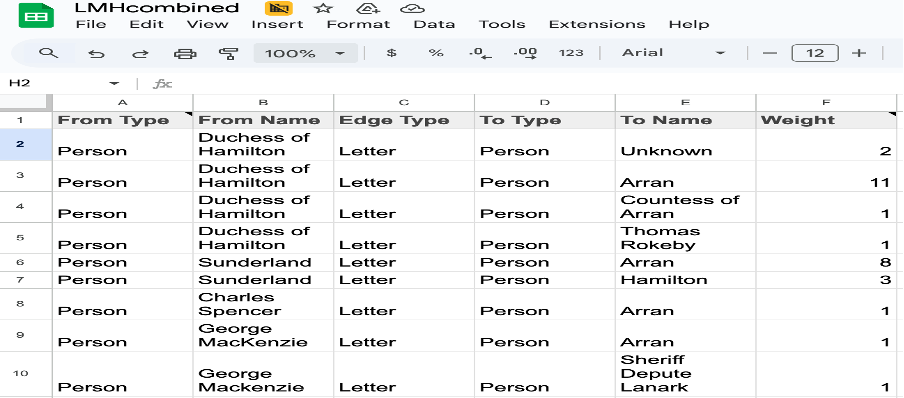
We followed a similar process in compiling manuscript data into csv data for use in the tool. This time our data followed a different format to accommodate the new tool: graphcommons. The data was collected as follows: nodes (ID, name, description) and edges (from type, from name, edge type, to type, to name, weight). After creating a master spreadsheet information file, we then set about creating different sheets for different visualizations including people, places, keywords, nodes, and then edges. We also converted the Leven and Melville CSV data into this new format as well for importation into the tool. After we imported the data into graphcommons, the result was a very complicated web of connections.
Figure 1. Combined Melville and Hamilton Graph
Outcomes
Given our previous experience with networking from the previous iteration of the project, we elected to do some calculations using python and others in graphcommons. These tools were the foundation of building our API and integrating the Leven-Melville and Hamilton correspondence datasets. The groundwork established through Python libraries such as Networkx and Matplotlib, along with prior documentation and workflow design, provided a smooth transition into expanding this project.
API
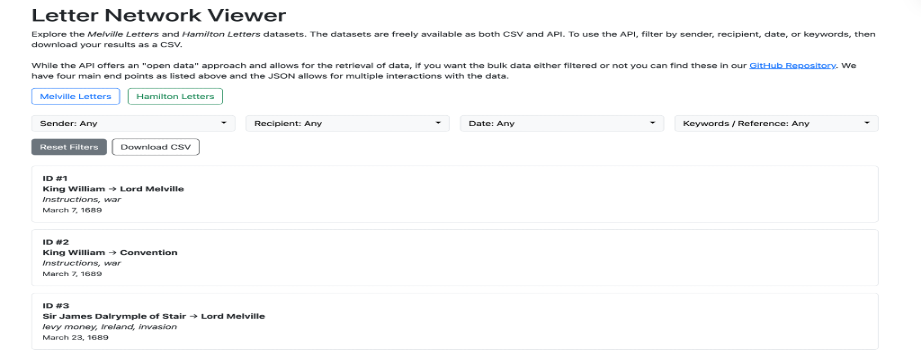
Figure 2. API Letter Network Viewer
The API was developed to provide access to two collections of letters, the Hamilton correspondence and the Leven-Melville correspondence. Each dataset was converted into a JSON file with consistent fields for sender, recipient, date, and other relevant metadata. In addition, the API includes filtering and download features, allowing users to retrieve subsets of the data as needed.
Hamilton Letters
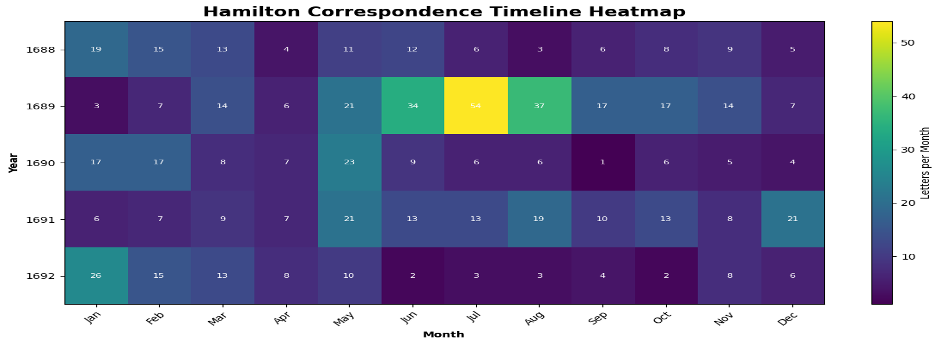
Figure 3. Exploratory Hamilton Correspondence Heatmap
An exploratory analysis of the Hamilton dataset consisted of using python tools and libraries such as Pandas, Matplotlib, and Networkx. This included examining patterns, identifying the most frequent correspondents, and visualizing the structure of Hamilton’s network. These analyses provided insight into the dynamics of his correspondence and served as a model for examining additional datasets as well as a comparison to the Melville network.
Combining Hamilton and Leven Melville Data
Figure 4. Combined Networking Spreadsheet
In order to analyze both networks, the next step was to combine the Hamilton and Leven and Melville letters into a combined dataset. This required some data processing and filtering of names and formats so that the two sets could be analyzed together. Once integrated, the data allowed cross-network comparisons and offered a broader view of correspondence across different figures and contexts.
Leaflet Map
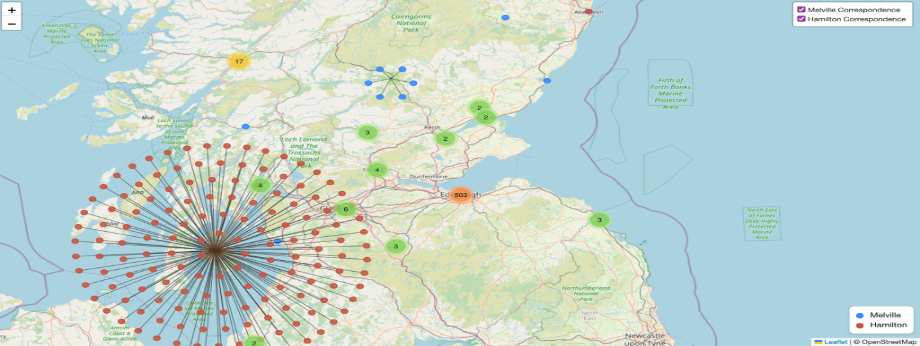
Figure 5. Combined Leaflet Maps
Developing a Leaflet map of the combined networks provided a more visual and interpretable view of the correspondence. The map incorporates both the Hamilton and Melville networks, with each node representing a correspondent. Users can also toggle between datasets to view them individually. This visualization reveals geographic and relational patterns that are not immediately apparent in the raw CSV data.
Future Directions
Networking Letters of the Revolution has had the opportunity to expand with the addition of the Hamilton correspondence. With the initial network consisting of approximately 600 pages of material from the Leven-Melville papers; it has now grown considerably with about 650 pages of new content. This expansion and the integration of the two corpora have enabled new analyses of late seventeenth century correspondence dynamics. Looking ahead, future directions in this project include the continuation of expanding the network with the addition of the privy council and committee for plantations. This would allow a more comprehensive view of the data as well as expanding the scope of the network. We also plan to pursue additional funding to support labor costs, enhance digital infrastructure and tools, and cover domain expenses.
THATCamp (which stands for “The Humanities and Technology Camp”) is a gathering where the agenda is set by attendees on the day of the event based on what people want to learn and/or share. It is an event where students, staff, and faculty from any discipline and from all skill levels learn and build together in sessions proposed, led, and voted upon by the community.
At DH@MSU THATCamp, we create space for meeting fellow members of the community in informal networking sessions. We encourage people to share their work in impromptu discussions and workshops.
This January, we are holding THATCamp as a virtual event from 9:30AM – 3:00PM EDT.
The goals of DH@MSU THATCamp are:
To bring people back together at the beginning of the semester
To introduce new folks to the DH community
Build connections between community members for future collaborations, troubleshooting, and less formal, unplanned interactions
Who is THATCamp for?
This is an opportunity for people, whether formally a part of the DH@MSU community or part of the larger DH community, to gather, learn from each other, and make connections to carry forward into the academic year. We welcome:
Members of the DH community, old and new
Students in–or interested in– MSU’s Digital Humanities or Digital Cultural Heritage and History undergraduate minors or the Digital Humanities graduate certificate
Humanists who are engaged in digital and computer-assisted research, teaching, and creation
Anyone interested in exploring digital topics especially (but not exclusively) in the areas of arts, humanities, and social sciences
Family members (kids, pets, are welcome!)
This is a flexible, family- and pet-friendly event.
10:20 – 10:50AM – Discussion and workshop topic ideas – gathering proposals, voting, and creating the schedule
10:50 – 11:50AM – Session 1 (breakout rooms)
11:50AM – 12:00PM – Break
12:00 – 12:30PM – Session 2 (breakout rooms)
12:30 – 1:15PM – Lunch Break
1:15 – 2:15PM – Session 3 (breakout rooms)
2:15 – 2:25PM – Break
2:25 – 2:40PM – What did we learn?
2:40 – 2:55PM – Breakout Facilitation for connections
2:55 – 3:00PM – Ending Remarks
*This schedule may shift if the community decides to make adjustments on the day of the event. For example, one of the sessions may break into two thirty-minute sessions in order to accommodate more topics. This page will be updated during the day of the event with any schedule changes.
How the day will work
Meet and Greets / Introductions
Using breakout rooms, we will have 3 short meet and greet opportunities. This means that groups of 4-6 will be gathered in a breakout room to introduce themselves and answer a question prompt for 7 minutes and then will be reshuffled into another room for 7 minutes with different people.
Sessions
Over the course of the day, there are two one-hour sessions and one half-hour session. During each of these session times, there will be up to 4 concurrent sessions that participants can choose among.
These sessions will be proposed or requested by THATCamp participants at the time of the event.
Session types could be:
Panel – 2-3 subject matter experts (and one moderator) gather to discuss a specific topic and offer differing perspectives. Panelists share facts or personal experiences, express opinions, and answer audience questions. The moderator keeps the momentum going, facilitates the discussion, and manages questions from the audience.
Demo/How To – A practical instruction that can be accomplished in a session wherein attendees learn a single skill. How-To sessions are similar to workshops in that they are participatory, but are less in depth, concentrated on audiences walking away with a single skill, rather than multiple, or more involved, skills.
Deep Dive – An in-depth discussion of a particular subject in DH, such as pedagogy, research, or outreach that digs extensively into a single topic
Problem Solving – A open forum to discuss moments when you may have hit a block with a DH project and would like to brainstorm ways forward with THATCamp participants
Show and Tell – an individual or group showcases a project and explains how it was created, what went into it, including the technology, etc (this type of session may also group together 1 to 3 project show and tells)
Other: You decide what format you will use
Technology and Communication
Zoom
THATCamp will take place on Zoom. The meeting link and information will be sent via email to registrants when registration is complete. For the best experience, please update to the most recent version of Zoom via these instructions.
When you enter the Zoom meeting room, your video and microphone will be turned off/muted by default, and you are welcome to turn them on/unmute as you prefer throughout the event. We will all convene in one room, and we will use breakout sessions to facilitate introduction sessions and the discussion sections. There will be moderators available throughout the day and in each breakout room to assist with technical issues and Zoom questions.
Neshnabé Nengosêk Kenomagewen (Potawatomi Star Knowledge) is an Indigenous-centered digital humanities effort to sustain and share Potawatomi constellations, celestial stories, and teachings about the movements of the skies. The project’s core purpose is intergenerational: to return star knowledge to everyday use among Potawatomi families, especially youth, while offering non-Native learners a respectful window into a living intellectual tradition.
Rooted in Pokagon Band–led star knowledge gatherings (2019) and formalized through the Digital Scholarship Lab incubator (2023–2024), the project pairs careful cultural protocol with practical technology. Using Stellarium, a free, open-source planetarium used worldwide in classrooms and observatories, we are building a Potawatomi “sky culture” that renders Potawatomi constellations, names, narratives, and seasonal practices in place and time. This approach keeps the work accessible (web, desktop, and mobile), sustainable (open formats), and accountable (guided by an advisory committee with Potawatomi linguistic and cultural expertise). Artwork by Pokagon Band illustrator Aaron Martin aligns the digital renderings with Woodland-style visual language, reinforcing meaning through culturally resonant design. Together, these choices make the project not only a technical deliverable but a community stewardship model for celestial knowledge and a decolonial teaching tool that centers Potawatomi ways of seeing the night sky.
Project Description
The purpose and rationale of this project is to preserve Potawatomi traditional knowledge for future generations by digitally documenting Potawatomi knowledge related to astronomy, celestial navigation, and cosmology focusing on constellations, their names, associated stories, and seasonally specific practices. By developing an interactive digital map using the free and open-source platform, Stellarium, to show the locations of Potawatomi constellations in the sky relative to users’ selected location and time of year, this project maps cultural heritage. It seeks to ultimately develop culturally relevant curricular resources. Digitizing Potawatomi constellations is a necessary first step to ensure the feasibility, sustainability, and efficacy of future phases.
Respecting Cultural Protocols
The necessity of a deliberate and cautious approach stemmed from the presence of culturally significant protocols concerning traditional knowledge stewardship within most, if not all, Indigenous communities with which Morseau is acquainted; this ensured that all necessary approvals were secured and that genuine interest in the project existed. The incubation period yielded considerable progress, such as investigating applicable technologies and formulating a feasible work plan; however, Morseau required consistent feedback as the project developed from an advisory committee with relevant Potawatomi linguistic and cultural knowledge. Quarterly meetings between the advisory committee and Morseau have been held since fall 2024.
Accessible Software
As a free and open-source software, Stellarium offers users a real-time simulation of the night sky, thus facilitating the exploration of constellations, planets, and other celestial bodies as they would appear from any location at a given time. Due to its open-access and free availability, Stellarium was deemed the optimal choice for this project, maximizing accessibility for various audiences. The system offers users a choice of access methods: a web platform, a downloadable desktop application, and a mobile application. Using an existing app instead of developing one for this project (which was considered) is a more cost-effective and time-saving solution. Existing apps like Stellarium have already set user expectations and offer the level of customization required for this project.
Stellarium is widely used, respected, and considered reliable by both professional and amateur astronomers due to its accuracy, open-source nature, and extensive features. Not only does it offer realistic night sky simulation and constellations from various cultures, Stellarium benefits from contributions from a global community of developers and astronomers, ensuring regular updates and improvements. Its combination of precision, lifelike rendering, and versatility positions it as a leading choice for use in stargazing, education, and astronomical research.
“Sky Culture”
Stellarium defines “sky culture” as a specific cultural understanding of the night sky, including constellations, star names, and the myths surrounding celestial bodies across diverse societies and historical contexts. The rudimentary components of a sky culture include labeled “stick figures” that delineate constellations and their relationships. Contributors frequently incorporate artwork to enrich the content and provide visual representations of the stick figures. There are over forty existing celestial cultures, enabling users to observe the night sky as perceived by various civilizations, including Western (Greco-Roman) constellations (the standard in modern astronomy), Indigenous nations (e.g., Lakota, Navajo, Inuit, and Hawaiian), and ancient systems (e.g., Egyptian, Babylonian, Chinese, and Hindu). Examination of these astronomical traditions reveals significant knowledge concerning how disparate groups across time and space have interpreted and represented celestial bodies, underscoring Stellarium’s potential as a valuable tool for both education and cross-cultural understanding.
Potawatomi Artwork
Artwork significantly enhances the quality of sky cultures in Stellarium, particularly when it aligns with the style, motifs, and cultural expressions of the community whose astronomical knowledge is represented. The transmission of celestial knowledge in many Indigenous and historical sky cultures is facilitated through oral traditions, symbolic imagery, and storytelling. The integration of such artistic styles in Stellarium enhances the credibility of celestial narratives and fosters a culturally rich user experience. For example, if the star lore of the Potawatomi people is depicted using traditional Woodland-style painting motifs, it visually reinforces the cultural worldview and cosmology of the community. The integration of sky culture artwork with historical and contemporary artistic traditions offers significant educational and interpretive merit, bridging modern digital tools and traditional learning methods. Educators, students, and researchers benefit from accurate visual storytelling, making Stellarium not just a scientific tool but a decolonial space that acknowledges and respects Indigenous and local knowledge.
In consultation with the advisory committee, we decided to reach out directly to an artist for this work rather than solicit blanket proposals. Aaron Martin, an illustrator and citizen of the Pokagon Band, has been working with the project team creating images for the astronomy program.
Outcomes
Software deliverable and access
The Potawatomi Sky Culture is publicly available for download via GitHub and is being iteratively updated as artwork is completed. Upon the planned November 2025 milestone, the sky culture will ship with standard Stellarium downloads/updates so that educators, families, and learners can access it without extra steps. This aligns our work with Stellarium’s supported “sky culture” format and distribution pathway, ensuring long-term maintainability and discoverability by global users.
Curation decisions and documentation
Many Potawatomi constellations can be represented by different figures and names depending on season and story (e.g., Western “Orion” as Ktthe Sabé, Nenikboz, or Bgak). For visual clarity in Stellarium, we selected one stick figure and one artwork per constellation and are documenting alternatives in the sky culture description so learners understand the plural nature of the tradition rather than a single fixed mapping.
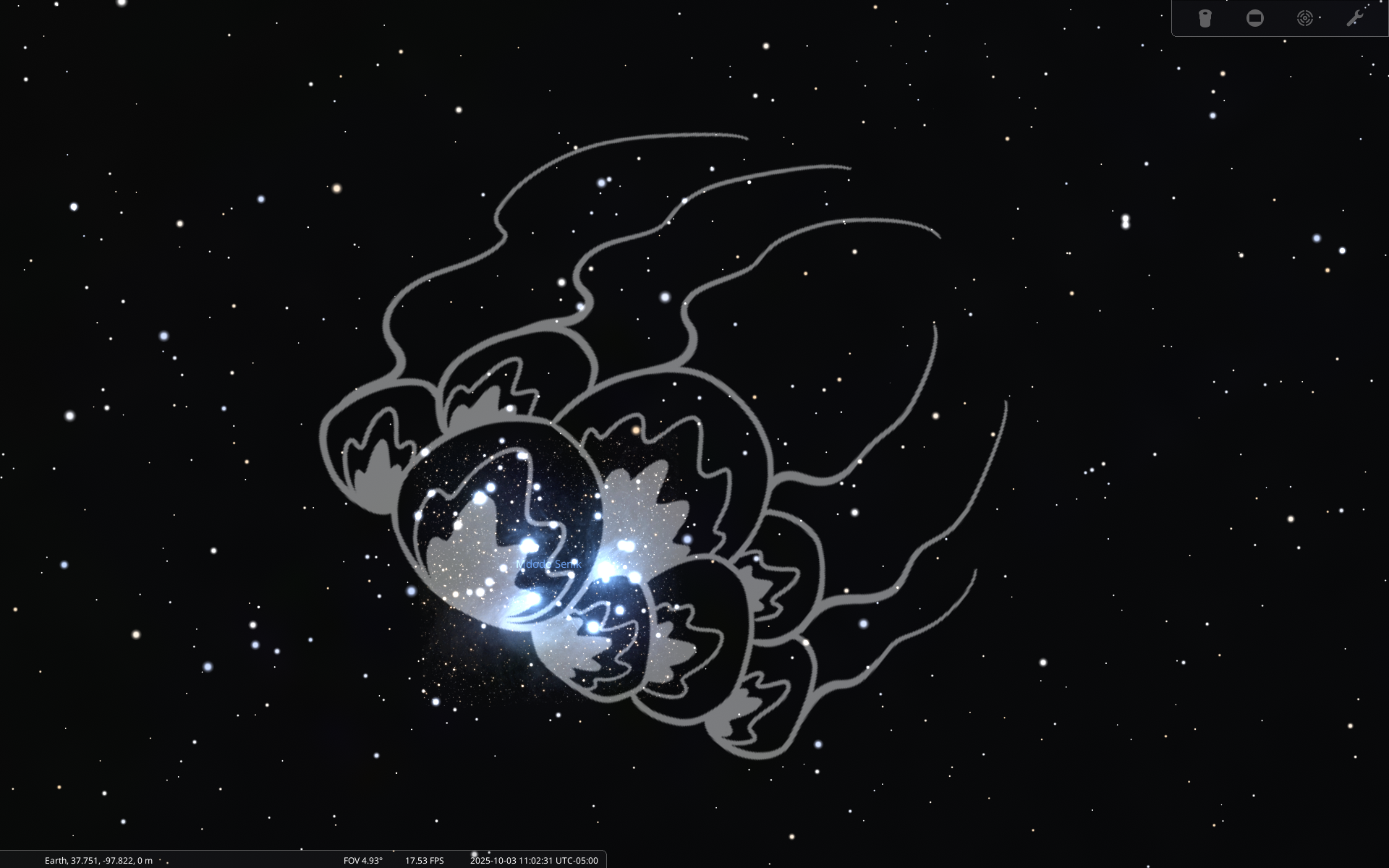
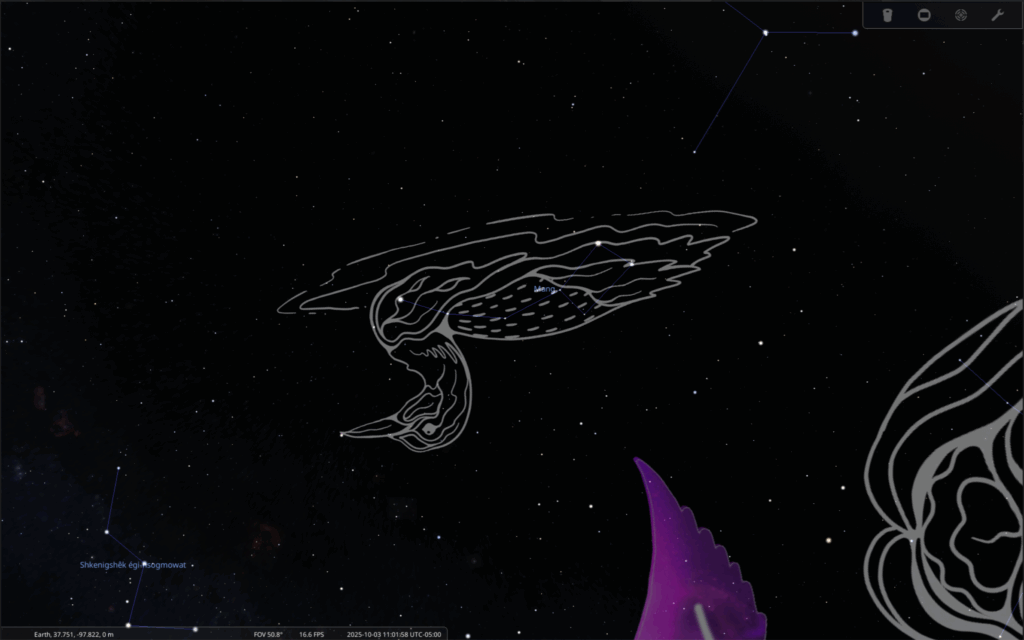
Art and data integration status. Most stick figures are complete, and a majority already have final artwork integrated (e.g., Bzhêké/Taurus, Ktthe Sabé/Orion, Mang/Ursa Minor, Mdodosenik/Pleiades, etc.). Remaining figures (e.g., Gigo/Delphinus, Moz/Pegasus, Nenikboz/Scorpius, Shkenigshêk égi-nsogmowat/Cassiopeia, Wthik/Ursa Major, Thethak/Summer Cross) are awaiting artwork. Each integration pass updates metadata, narrative notes, and forthcoming Creative Commons licensing.
Educational and community impacts (anticipated)
Making Potawatomi constellations visible in a mainstream astronomy tool supports:
Classroom use across grade bands with culturally relevant science content, seasonal observation, language learning, and storywork;
Family and community star nights that connect teachings to on-the-land practice;
Instructor adoption via ready-to-use software and a forthcoming user guide/lesson plans co-developed with tribal Head Start educators.
Status of stick figures and artwork into Stellarium:
Potawatomi Constellation Name
English Translation
Corresponding Western Constellation
Stick Figure
Artwork
Status
Bzhêké
Bison
Taurus
X
X
COMPLETE
Gigo
Fish
Delphinus
X
awaiting artwork
Ktthe Sabé
Bigfoot
Orion
X
X
COMPLETE
Mang
Loon
Ursa Minor
X
X
COMPLETE
Mdodosenik
Sweat Lodge Stones
Pleiades
X
X
COMPLETE
Mdodoswen
Sweat Lodge
Corona Borealis
X
X
COMPLETE
Mëk
Beaver
Gemini
X
X
COMPLETE
Mko Shtegwan
Bear Head
Summer Triangle
X
X
COMPLETE
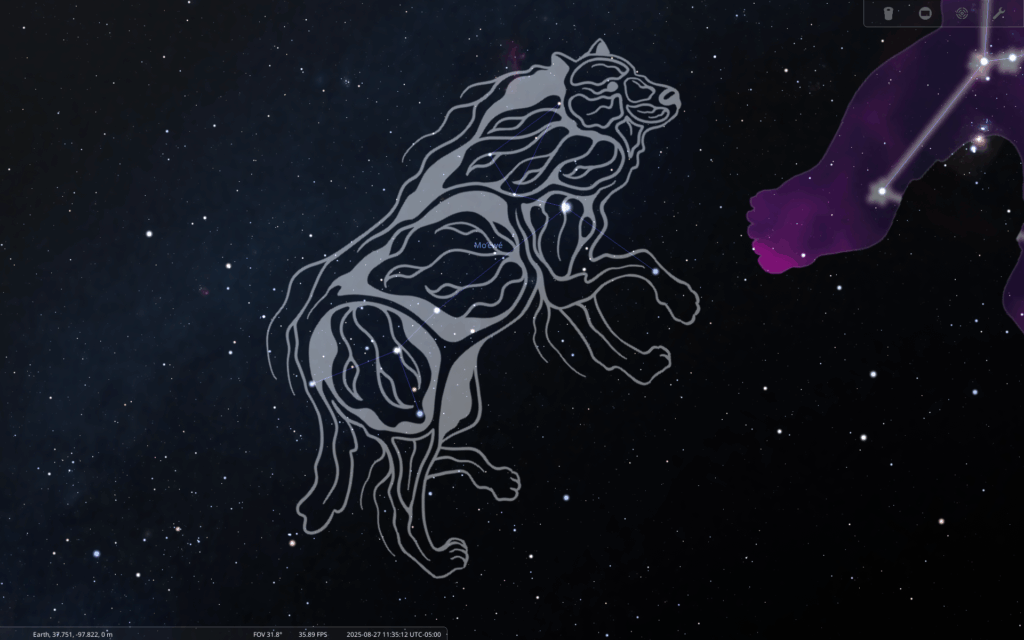
Mo’ëwé
Wolf
Canis Major
X
X
COMPLETE
Moz
Moose
Pegasus
X
awaiting artwork
Mshignébêk
Big Snake
Hydra
X
X
COMPLETE
Mshiké
Turtle
Capella
X
X
COMPLETE
Nambezho
Underwater Panther
Leo
X
X
COMPLETE
Nenikboz
Nanabozho
Scorpius
X
awaiting artwork
Shkenigshêk égi-nsogmowat
Three Brothers Floating in a Canoe
Cassiopeia
X
awaiting artwork
Thethak
Crane
Summer Cross
X
awaiting artwork
Wénondeshik
One Who is Exhausted
Hercules
X
X
COMPLETE
Wthik
Fisher
Ursa Major
X
awaiting artwork
Some examples:
Moewe – Wolf constellation in Stellarium
Mdodo Senik – Sweat Stones constellation in Stellarium
Screenshot of Mang – Loon constellation in Stellarium
Future Directions
Future phases will include public programs and the development of curricular resources for multiple grade levels. In collaboration with tribal Head Start instructors at Zagbëgon Early Learning & Development Academy, future phases of this project will include developing educational resources such as user guides and teacher lesson plans to educate both Indigenous and non-Indigenous audiences about the importance of Potawatomi traditional knowledge.
Building on the public release and continual iteration of the Potawatomi sky culture in Stellarium and its planned inclusion in standard Stellarium downloads/updates, which ensures long-term access for educators, families, and community learners, our next phase expands programming and curricular resources across campus, community, and regional dark-sky settings. Some preliminary plans are listed below.
Public Programs & Partnerships
On-Campus at MSU
Star Knowledge Nights @ the campus observatory/planetarium: Live sky tours using Stellarium’s Potawatomi sky culture, paired with short talks on cultural protocol and storywork. Sessions scaffolded for families, K–12 field trips, and university courses.
Workshop series for MSU instructors and graduate TAs: Quick-start training on running Potawatomi sky sessions, integrating stories responsibly, and adapting the lessons to different disciplines (astronomy, Indigenous Studies, language, art/design).
In-Community on Tribal Lands in Michigan
Seasonal star gatherings led by community educators: Co-designed evenings that emphasize observation-in-place, seasonal practices, and intergenerational learning—extending the project’s core goal to return star knowledge to everyday family life.
Portable “Stellarium-to-Go” kits: Laptops/tablets with the sky culture preloaded, printed story prompts, and activity cards for community educators and Head Start teachers.
At State Parks & Dark-Sky Regions (e.g., Sleeping Bear Dunes)
Dark-sky interpretive programs: Park-hosted stargazing that layers Potawatomi constellations with land-based teachings and seasonal stories; programs tailored for the public and for ranger/interpretive staff professional development.
“Sky & Story” family activity trail: A self-guided, printed/map-based experience that pairs on-site viewing with Stellarium screenshots and QR codes linking to short audio clips.
Curricular Resources (Specific, Ready-to-Use)
In collaboration with tribal Head Start instructors at Zagbëgon Early Learning & Development Academy, we will develop grade-banded, discipline-spanning resources that educators can adopt directly.
Early Childhood / Head Start
Picture-card constellation sets (Potawatomi names + artwork) for sorting/matching, language play, and story sequence.
Circle-time mini-lessons (10–15 min): “Find Mdodosenik (Pleiades),” call-and-response vocabulary, and a simple “make the pattern with dots” craft.
Family take-home sheets with evening sky prompts and QR links to Stellarium web view.
Primary users: Head Start teachers, family educators, and caregivers.
Upper Elementary (Grades 3–5)
“Constellation & Season” stations: Students use Stellarium to compare Potawatomi and Western constellations, then complete a graphic organizer on seasonal appearance and related practices.
Language-across-the-curriculum: Word banks, pronunciation guides, and simple sentence frames for describing sky patterns.
Primary users: Classroom teachers, media specialists, after-school coordinators.
Middle School / High School
Inquiry lab: “One Sky, Many Mappings” — Students investigate how different sky cultures organize stars, then reflect on how knowledge systems shape observation and science. Includes a short reading on cultural protocols and respectful use.
Project: Seasonal Sky Journals — Students log weekly Stellarium observations, connect them to Potawatomi teachings, and propose a community-facing infographic.
Primary users: Science teachers (astronomy/earth science), social studies, Native studies, and art teachers.
Undergraduate / Graduate
Module for Astronomy & Physics labs: Measuring angular distances and star paths inside Stellarium using Potawatomi mappings; reflection prompts on epistemology and ethics in data representation.
Seminar unit for Religious Studies / American Indian & Indigenous Studies: Storywork, cosmology, and decolonial pedagogy—students facilitate a public mini-planetarium session as a praxis assignment.
Digital Humanities assignment: Students contribute to a public-facing glossary or annotated star-map layer (e.g., adding citations or seasonal notes to the sky culture description) following community-guided protocols.
Instructor Tooling & Accessibility
Instructor User Guide with:
Quick-start setup for web/desktop/mobile Stellarium;
Suggested 10-, 30-, and 60-minute agendas;
Slides/screenshot banks and printable star cards using the project artwork;
Safety and cultural-protocol tips for night programs;
Lesson Plan Packs aligned to grade bands and adaptable to family nights, aligning with the report’s plan for ready-to-use adoption.
Content & Artwork Completion to Support Teaching
As remaining constellation artwork is finalized and integrated (e.g., Gigo/Delphinus; Moz/Pegasus; Nenikboz/Scorpius; Shkenigshêk égi-nsogmowat/Cassiopeia; Wthik/Ursa Major; Thethak/Summer Cross), each update will refresh metadata, narrative notes, and open-license documentation so teachers can confidently use images in class materials.
Anticipated Impact
These directions directly operationalize the overall project’s outcomes and anticipated uses: culturally relevant classroom learning across grade bands, family and community star nights connected to on-the-land practice, and straightforward instructor adoption via supported materials and distribution through Stellarium.
From MSU to Northwestern: A Journey Shaped by Digital Humanities
When Taylor Hughes-Barrow arrived at MSU, she never expected all the opportunities that would come her way. Taylor has always been passionate about education reform, but she was not sure which direction she wanted to take towards that path.
She switched her course of study from Political Science to Human Development and Family Studies, and had a minor in law. Taylor strived to combine all of her interests from education, development, law/policy to media/technology, but wasn’t sure how to bring these interests all together. She longed for a creative element in her studies to highlight her research in a way that meets people where they are, through art and technology.
She came across an internship with the Global Digital Humanities (DH) Symposium that changed everything. What began as an internship turned into a job position with the DH program. She created newsletters and worked on committees, which exposed her to all of the possibilities Digital Studies had to offer. She soon became a Digital Studies (DS) minor, a place where her interests converged and her creativity and research flourished.
Through Kristen Mapes’s Intro to Digital Humanities, DH 285, she worked with her peers to design and build an immersive exhibit highlighting the women that served in the Monuments, Fine Arts and Archives (MFAA). She had the opportunity to present at conferences, design educational immersive experiences and even published her first review. She learned how to use storytelling and visualizations to make research accessible. Just as importantly, she built relationships with mentors and peers that gave her confidence and community.
Now, in her second year of her PhD program in Learning Sciences at Northwestern, she has found a program where she can combine all of her interests and skills. She balances coursework, teaching, and exploring labs while preparing for her dissertation path. She credits the people and programs at MSU for teaching her to advocate for herself, take risks, and show up authentically.
Her advice to students: try everything, build connections, and dream big even if your path is
unconventional or unknown, cultivate your own journey! Looking back, she says DH didn’t just give her skills; it gave her the permission to be curious, creative, and bold, guidance she still carries today.
Thursday, November 13 12:00-2:00pm Main Library, Digital Scholarship Lab, Flex Space (2nd Floor, West)
Join the Digital Humanities at MSU for our third annual DH Research Showcase in the MSU Main Library, Digital Scholarship Lab, Flex Space (2nd Floor, West), where recipients of DH summer funding will discuss their projects, and where we invite all faculty, staff and students working on DH projects to share their projects in process.
Please feel free to bring your own lunch.
The interdisciplinary field of digital humanities (DH) aims to bring together humanistic inquiry and digital technologies, organizing new modes of archival research, developing computer-aided methodologies for answering humanistic questions, curating digitized archives of all kinds, bringing digital platforms into the classroom in creative ways, and engaging critically with the culture of new media.
12:02 – 12:17PM: Jon Keune: Creating, Maintaining, and Expanding the Bhakti Virtual Archive (BHAVA)
After briefly introducing the Bhakti Virtual Archive (BHAVA) project and website, I will describe the development timeline from receiving a DH@MSU Summer Seed Grant in 2018, through unsuccessful and successful external grant proposals, the website’s growth through the pandemic and first full incarnation in 2022, and its continued maintenance, enhancement, and new audiences.
12:20- 12:35PM: Gillian MacDonald and Morgan Fox: Expanding the Network: New Nodes and Relationships in the Revolution (1688-1692)
The launch of the beta version of Networking the Letters of Revolution project on Github pages has so far been a success. The project itself, still nascent, is building upon the idea that communication and relationships during conflict are incredibly important in terms of political capital during chaos. The project’s success is reflected in the fact that the authors were invited to unveil at the Omohundro Institute’s Digital Project Coffee Hour in April 2025. Using one main corpus of letters, Leven and Melville Papers, the project visualized this world’s letter communications, places of importance, and most connected people. We were able to get all the data from the 599 letters contained in the digitized copy of the Leven and Melville papers into a usable dataset. This approach allows us to focus our attention on the interactions and relationships. The letters, memorandums, warrants, and petitions exchanged in this period are more than just networks of exchange. In the late seventeenth century, people were bound together through community, print, and dialogue. From the success of this first endeavor we were inspired to expand the project to include at least one more corpus of letters and any extant manuscripts from the Leven and Melville Papers that existed archivally. Read the Seed Funding Report
12:35-12:40PM: Q&A
12:40-12:55PM: Blaire Morseau: Neshnabé Nengosêk Kenomagewen (Potawatomi Star Knowledge)
Neshnabé Nengosêk Kenomagewen (Potawatomi Star Knowledge) is an Indigenous-centered digital humanities effort to sustain and share Potawatomi constellations, celestial stories, and teachings about the movements of the skies. The project’s core purpose is intergenerational: to return star knowledge to everyday use among Potawatomi families, especially youth, while offering non-Native learners a respectful window into a living intellectual tradition. Read the Seed Funding Report
1:00 – 1:15PM: Destiny Canning: A Public-Facing StoryMap for ER, Urgent Care, and Clinic Navigation
This work-in-progress pairs humanistic inquiry into health communication, plain-language, translation, equity, with ArcGIS StoryMaps to curate an accessible directory of emergency departments, urgent cares, and safety-net clinics. We describe our metadata scheme, sourcing and verification workflow, and design decisions that prioritize readability and multilingual access. We also share early findings from user testing with Lansing community partners and international students at MSU, reflecting on ethics, accessibility, and the public-humanities role of DH in improving health literacy and care-seeking decisions.
1:20-1:35PM: Jesse Draper: Digitizing the Radical Historians Newsletter
In collaboration with the U.S. Intellectual History Association, the department of History, and LEADR, H-Net digitized The Radical Historians Newsletter (1969–2003). This project involved digitally scanning original copies of the newsletter, creating a Drupal-based home for the collection on H-Net Spaces, and storing the originals with the MSU Libraries Radicalism Special Collections.
1:35-1:55PM: Q&A
1:55 – 2:00PM: Wrap up
MSU Food Bank and Basic Needs Program Donation Drive
Please bring items to the Research Showcase and we will deliver them!
The MSU Food Bank and Basic Needs Program provides essential food and personal care items to students and scholars experiencing food insecurity. Serving over 350 orders each week and supporting more than 2,000 individuals monthly, the program plays a vital role in ensuring Spartans have access to healthy, culturally required food options that reflect the diversity of the MSU community.
Items that are most needed include:
Quick Meal Options
Microwaveable meals (rice bowls, quinoa, mac & cheese, instant noodles)
Canned soups, stews, and chili (consider pop tops, many students do not have can openers)
Ready-to-eat rice or grain pouches
Canned beans and lentils
Protein Sources
Peanut butter or nut alternatives (e.g., sunflower butter, almond butter)
Canned fish, poultry, pork, or beef
Protein bars or shelf-stable shakes
Shelf-stable and plant-based milk (soy, oat, almond, coconut, rice)
Shelf-stable tofu or chickpea-based proteins (check allergen-free)
In WRA 415: Digital Rhetoric, the goal is to engage you in the observations of the social, political and ethical conversations and communities that occur online. The class explore multiple mediums such as social media, websites, apps and programs. The three projects consist of identity and community. Each project should enhance your ability to analyze and understand digital environments as well as developing and executing research projects.
My current major is Computer Science, and my current minor is Digital Studies in the Arts and Humanities.
How did you find Digital Humanities?
I found Digital Humanities while I was looking for study abroad opportunities that fit my interests, and I came across the Technology, Humanities, and the Arts program for the Digital Humanities minor. As someone who has always loved technology, the arts, and the humanities, I was immediately interested in the program since it combined all of my interests, and that was where I first learned about Digital Humanities Minor!
What do you like most about Digital Humanities?
I think some of my favorite parts of Digital Humanities have been learning about and using creative techniques to make really interesting projects! As a visual and tactile person myself, I love learning about how to create interesting interactive visualizations using digital tools, such as creative maps or other unique ways to visualize data. I think being able to take research and data and then make it unique for an audience through digital storytelling is an extremely valuable skill that has helped make all of my projects better, whether it’s for research, for a class, or for myself!
How is Digital Humanities enriching your academic experience?
I have gained a lot of experience working with and utilizing technology and developing digital scholarship projects through Digital Humanities. Throughout my experience so far, I have also gained a ton of confidence working with groups, communicating my ideas to others, and learning how to use creativity and digital tools to develop my own projects. I’ve used so many DH techniques in almost every aspect of my life, so they are extremely useful beyond just DH projects!
What have you learned so far that you didn’t expect about Digital Humanities?
One thing that I’ve learned so far that I didn’t expect about Digital Humanities is how important DH methods are for any digital scholarship project or any project overall. For example, I’ve learned that DH is so much more than just learning how to use digital tools in projects; it’s also about learning how to approach your work and determine your audience, the story you want to tell, and how to pick the right tools to make a project better. Instead of just learning about digital tools in a humanities context, I’ve also learned a lot about digital storytelling and how and and when to use digital tools to tell a story the way you want to. Learning about these techniques has helped give me a completely new and different perspective on how to create a good project overall!
What advice might you have for other students as it relates to Digital Humanities?
I think that Digital Humanities is an amazing minor and discipline, no matter your major or background. One of the unique things about DH that I really like is that everyone comes in with different perspectives. For example, since I’m a computer science major, I have somewhat of a technical background, so I’ve brought that perspective into the projects I’ve worked on, but I’ve met so many people with different majors, and they all brought different perspectives that I’ve learned so much from! DH encourages people to be creative, so my advice would be: don’t be afraid to lean into your own interests and strengths!
THATCamp (which stands for “The Humanities and Technology Camp”) is a gathering where the agenda is set by attendees on the day of the event based on what people want to learn and/or share. It is an event where students, staff, and faculty from any discipline and from all skill levels learn and build together in sessions proposed, led, and voted upon by the community. This “un-conference” event is a fun, low stakes way to engage and learn from like-minded folks in the MSU community about new and emerging ideas in the digital humanities field. Unlike typical conferences, at THATCamp, we set the schedule the morning of the event based by voting on a series of possible sessions proposed that day by participants. The event will be held from 8:30AM to 3PM on Thursday August 21, 2025, in the Digital Scholarship Lab of the MSU Library (2nd Floor, West), but attendees may come and go as their schedule allows. Also, join us for an Ice Cream Social from 3:15PM to 4:30PM at DSL.
Why THATCamp MSU?
At DH@MSU THATCamp, we create space for meeting fellow members of the community in informal networking sessions, and we encourage people to share their work in impromptu discussions and workshops.
DH@MSU started hosting bi-annual THATCamps each August and January targeted at MSU faculty, staff, and students for a few reasons:
To bring people back together at the start of the semester
To introduce new folks to the DH@MSU community
Share knowledge, expertise, and skills among the community
Build connections between community members for future collaborations, troubleshooting, and less formal interactions
This day-long unconference is a fantastic opportunity for members of the DH@MSU community (old and new) to gather, learn from each other, and make connections to carry forward into the academic year.
THATCamp is FREE, but we do strongly encourage registration in advance (it helps us determine how much food and coffee to buy). A tentative schedule and the registration form are available below. Please direct any questions to Max Evjen (evjendav@msu.edu).
As of August 10, 2022, MSU has lifted its face-covering directive. Masks are encouraged, but they are not required.
Contact Us
If you have any questions about this event, please do not hesitate to contact DH@MSU at dh@msu.edu or planning committee chair Max Evjen at evjendav@msu.edu.
Ashley Cerku is a Doctoral Candidate in the Anthropology Department at Michigan State University. She holds a B.A. in English and Writing/Rhetoric and an M.A. in Liberal Studies from Oakland University as well as an M.A. in Anthropology from Michigan State University. Her research focuses on historical photography, cultural heritage, community memory, and digital work. More specifically, she investigates the semiotic landscape of downtown Main Street and how digital technologies can provide a more immersive and inclusive approach to heritage preservation. She completed her Graduate Certificate in Digital Humanities in 2025 and is also pursuing the Graduate Certificate in Community Engagement. From 2024-2025, she was a Graduate Fellow in the Cultural Heritage Informatics (CHI) Initiative where she created Memory Lane, an augmented reality experience and educational website of downtown Romeo, Michigan’s Main Street, which will also be used as part of her dissertation project. Her interest in doing digital research grew when she worked as a Graduate Assistant in the Lab for Education and Advancement in Digital Research (LEADR) from 2023-2024. Teaching others how to use different digital tools to conduct and analyze research prompted her to include different interactive elements in her own project. She is also the Manager of the Oakland University Writing Center where she facilitates staff collaboration and communication about center management and professional development as well as enhances the center’s visibility by sponsoring educational programming for the campus community.