
-

LOCUS: Text Analysis in Humanities & Social Science, CFP EXTENDED to 4/3
LOCUS is a new series of presentations from people at MSU doing work in DH. The second is Apr 9, 3pm. Click here for more info. LOCUS: Call for Participation (full information found at digitalhumanities.msu.edu/locus/next) Partners: Writing Rhetoric and American Cultures, Political Science, and the Social Science Data Analytic Initiative Submit Proposal( CFP Closes – 3/31/2015 4/3/2015) – dts@mail.lib.msu.edu Register (space is limited) – http://classes.lib.msu.edu/view_class.php?class_id=125 Date: 4/9/2015 Time: 3:00-5:30 Location: Main Library, 3 West, REAL Classroom Increasingly, scholars operating in a wide array of disciplines use computational methods to study digital texts. These digital texts include but are not limited to journal articles, professional…
-
DH Reading Group: Topic Modeling
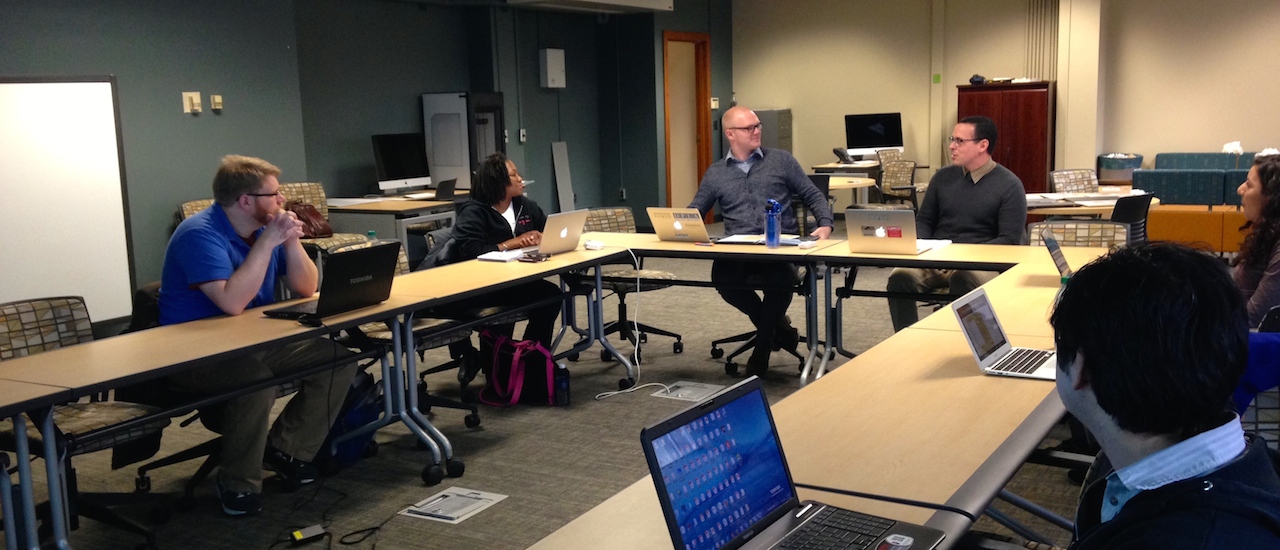
On January 28th, we had the first meeting of Michigan State University’s DH Reading Group. There was a good turn out to discuss topic modeling. Topic modeling involves algorithmic methods for organizing, sorting, and utilizing large corpuses of information. These topics can be modeled over time as well as in relation to other topics. They are not restricted to texts but can also be used for images, sounds, and other media structures. We read and discussed the following articles: Megan R. Brett, 2012, Topic Modeling: A Basic Introduction, Journal of Digital Humanities, 2.1, http://journalofdigitalhumanities.org/2-1/topic-modeling-a-basic-introduction-by-megan-r-brett/ David M. Blei, 2012, Topic Modeling and the…
-
LOCUS: Centering DH Research & Pedagogy
Over the past year, a group of Digital Humanists from the Libraries, College of Arts and Letters, and LEADR have banded together to ramp up Digital Humanities programming on campus. A core component of this effort has consisted of a Digital Humanities Workshop Series that has covered a wide range of topics like geographic information systems, Omeka, Python, network analysis, data preparation for DH projects, and Humanities Data Curation. Workshop attendees have come from across campus: English, German, Geography, History, Matrix, Agriculture, Food and Resource Economics, Media and Information, Teacher Education, Writing Rhetoric and American Cultures, Neuroscience, the College of…
-

Reading Group: What is the Dark Side of DH?, Wed, March 25, 5pm
Join us on Wed, March 25 from 5-6pm (Location: Beggars Banquet) for the third DH Reading Group of Spring 2015. Matt Handelman will lead a discussion on “What is the Dark Side of DH?” based on the following articles. Please read as many of the articles as possible in advance of the discussion, but also feel welcome to attend even if you haven’t had a chance to read it all! Wendy Hui Kyong Chun and Lisa Marie Rhody, 2014, Working the Digital Humanities: Uncovering Shadows between the Dark and the Light, differences 25.1, http://www.lisarhody.com/wp-content/uploads/2014/04/WorkingDH_WHKChun_LMRhody.pdf Adam Kirsch, 2014, Technology is Taking Over English Departments:…
-

Cheryl Geisler, Road to HASTAC Speaker Series, March 24, 10am
Join us for a Road to HASTAC Speaker Series talk on “Approaches to Analysis of Verbal Data” given by Cheryl Geisler of Simon Fraser University Dr. Geisler will give a talk on Monday, March 23, 4:00pm in Bessey Hall, Room 300 (Writing Center). She will also give a workshop on Tuesday, March 24, 10:00am – 3:00pm in B342 Wells Hall. This talk and workshop are part of the WRAC Department’s Speaker Series as well as the Road to HASTAC Speaker Series. As scholars and teachers, we often find ourselves with access to copious amounts of texts, talk, or other verbal…
-

William Pannapacker, Road to HASTAC Speaker Series, March 16th, 3:00-4:30
Please join us for a Road to HASTAC Speaker Series talk by William Pannapacker of Hope College: “Why I don’t do Digital Humanities: Regional Collaboration in the Digital Liberal Arts”. The talk will consider the promise and challenges of engaging with digital technology in an undergraduate context, the criticisms made of Digital Humanities, as practiced in research universities, and the possibilities for collaboration between different kinds of institutions with a focus on the Great Lakes College’s Association’s Mellon-sponsored Digital Liberal Arts Initiative. Pannapacker offers a unique perspective on the Digital Humanities coming from the vantage of a liberal arts college.…
-

Workshop: Text Analysis with Python, March 17th, 12:00-1:30pm
This workshop will provide an introduction to using Python programming and the Natural Language Toolkit (NLTK) to prepare and analyze text, covering the basics of Python data types along with an overview of NLTK text analysis tools. Register Tuesday, March 17 2015 12:00 PM – 1:30 PM Location: Old Horticulture, Room 112
-

Workshop: Data Prep for DH Research, Feb 17 @ 12pm
Join us for the 3rd workshop of the semester, Tues Feb 17, given by MSU Digital Scholarship Librarian Thomas Padilla, on Data Preparation for Digital Humanities Research, from 12-1:30pm in the Library’s REAL Classroom (3rd floor West). Learn data preparation principles that will help you refine how you prepare data for a wide range of Digital Humanities research. Principles learned during the workshop will be applied through hands on work with Open Refine. Registration is encouraged. Please register here. Image from Flickr user Ian-s
-
Isaac Weiner, Religion Out Loud, and MSU DH
Last Thursday, January 29, about twenty students and faculty gathered to listen to a talk on the place of religious sound in a pluralist society. Drawing from his research on the 2004 public debate surrounding the adhan (call to prayer) in Hamtramck, the speaker, Isaac Weiner, a professor of comparative studies at The Ohio State University, discussed tensions and reactions to the inescapable public presence religious sound: what sounds are sanctioned, and which ones merely tolerated, while others are strictly proscribed. For Weiner, the logic of pluralism generated several responses to religious sound, ranging from domesticating religious traditions (in effect,…
-

LOCUS: Spatial Humanities & Social Science, CFP EXTENDED to 2/10
LOCUS is a new series of presentations from people at MSU doing work in DH. The first is Feb 25, 3pm. Click here for more info. LOCUS: Call for Participation (full information found at digitalhumanities.msu.edu/locus) Spatial Analysis in Humanities and Social Science Partners: German Studies & Anthropology Digital technology has brought about a renewed interest in geographic space in humanities and social science research. Projects using spatial analysis or cultural mapping take many different forms: aggregated data layered on geographic information systems (GIS), archaeological or archival objects tied to their places of origin, a visualization tool to illustrate differences in…
-

Reading Group: Corpus Selection, Wed, Feb 11, 5pm
Join us on Wed, Feb 11 from 5-6pm (Wells Hall 2nd Floor Atrium) for the second DH Reading Group of Spring 2015. Erin Beard will lead a discussion on Corpus selection based on the following articles. Please read as many of the articles as possible in advance of the discussion, but also feel welcome to attend even if you haven’t had a chance to read it all! Ted Underwood, 2014, Distant Reading and the Blurry Edges of Genre, http://tedunderwood.com/2014/10/22/distant-reading-and-the-blurry-edges-of-genre/ Mark Algee-Hewitt and Mark McGurl, 2015, Between Canon and Corpus: Six Perspectives on 20th-Century Novels, Stanford Literary Lab Pamphlet 8, http://litlab.stanford.edu/LiteraryLabPamphlet8.pdf…
-

Workshop: Mapping with QGIS, Feb 3 @ 12pm
Join us for the 2nd workshop of the semester, Tues Feb 3, given by MSU Map Librarian Kathleen Weessies, on Mapping with QGIS, from 12-1:30pm in Wells B-125. QGIS is an open source GIS program that will allow you to map your research data, analyze it, and create attractive map layouts. In this workshop you will learn how to acquire and display GIS shapefiles, map a list of addresses, perform a spatial analysis, and create a layout. Registration is encouraged. Please register here.
-
LOCUS: Spatial Humanities & Social Science, CFP Due 2/3
LOCUS is a new series of presentations from people at MSU doing work in DH. The first is Feb 25, 3pm. Click here for more info. LOCUS: Call for Participation (full information found at digitalhumanities.msu.edu/locus) Spatial Analysis in Humanities and Social Science Partners: German Studies & Anthropology Digital technology has brought about a renewed interest in geographic space in humanities and social science research. Projects using spatial analysis or cultural mapping take many different forms: aggregated data layered on geographic information systems (GIS), archaeological or archival objects tied to their places of origin, a visualization tool to illustrate differences in…
-
Reading Group: Topic Modeling, Wed, Jan 28, 12pm
Join us on Wed, Jan 28 from 12-1pm in Linton 120 for the first DH Reading Group of Spring 2015. Coffee will be provided! Sean Pue will lead a discussion on Topic Modeling based on the following articles. Please read as many of the articles as possible in advance of the discussion, but also feel welcome to attend even if you haven’t had a chance to read them all! Megan R. Brett, 2012, Topic Modeling: A Basic Introduction, Journal of Digital Humanities, 2.1, http://journalofdigitalhumanities.org/2-1/topic-modeling-a-basic-introduction-by-megan-r-brett/ David M. Blei, 2012, Topic Modeling and the Digital Humanities, Journal of Digital Humanities, 2.1, http://journalofdigitalhumanities.org/2-1/topic-modeling-and-digital-humanities-by-david-m-blei/ Benjamin M. Schmidt,…
-

First Spring ’15 Workshop, Jan 20 @ 12pm
Join us for this term’s first workshop, 1/20, 12-1:30pm “Web Based Mapping” on StoryMap Js & Google Maps Engine. Register in advance at lib.msu.edu/dh/events
-
Reading Group – Leaders still needed!
Meet up 4 times this semester (1/28, 2/11, 3/25, 4/15) to discuss writings on DH. Leaders for 1/28 & 4/15 still needed! Email kmapes@msu.edu if interested.
-
Workshop Series
Join us for this term’s LAST workshop, 11/5, 1-2:30pm “Reading from a Distance: Introduction to Text Analysis” Register in advance at lib.msu.edu/dh/events
-

Digital Humanities Brown Bag Lunch Series
Join us Today, November 13 for the last Brown Bag discussion of the semester, held in the MATRIX Conference Room, 12:00-1:00pm
-

THATCamp Languages a Success!
The THATCamp Languages, held on September 6-7, 2014, was organized by students and faculty from the College of Arts and Letters and featured conversations and workshops on language research, learning and teaching topics. For a full article wrapping up the event, see the CAL website.
-
DH Open Office Hours at the MSU Libraries
Tuesdays 12:00-1:30 Main Library Collaborative Technology Lab, W101C Have a question or idea about Digital Humanities? Come chat with the DH librarians!