• THATCamp- August 2019

    Thursday, August 22, 2019
    Digital Scholarship Lab (Main Library)

    What is THATCamp?

    THATCamp stands for “The Humanities and Technology Camp.” It is an unconference: an open, inexpensive meeting where humanists and technologists of all skill levels learn and build together in sessions proposed on the spot. An unconference is to a conference what a seminar is to a lecture, what a party at your house is to a church wedding, what a pick-up game of Ultimate Frisbee is to an NBA game, what a jam band is to a symphony orchestra: it’s more informal and more participatory. (From: http://thatcamp.org/about)

    Why THATCamp MSU?

    There have been THATCamps held at MSU in the past, but DH@MSU is beginning an annual THATCamp each August targeted at MSU faculty, staff, and students for a few reasons:

    1. To bring people back together after the summer
    2. To introduce new folks to the DH@MSU community
    3. Share knowledge, expertise, and skills among the community
    4. Build connections between community members for future collaborations, troubleshooting, and ice cream breaks
    5. Identify needs for and interest in future workshops and training

    This day-long unconference is a fantastic opportunity for members of the DH@MSU community (old and new) to gather, learn from each other, and make connections to carry forward into the academic year.

    THATCamp is FREE, but we do strongly encourage registration in advance (it helps us determine how much pizza and coffee to buy). A tentative schedule and the registration form are available below. Please direct any questions to Kristen Mapes (kmapes@msu.edu or @kmapesy).

    Schedule

    Schedule is available at go.cal.msu.edu/thatcamp

    8:45-9:15 – Breakfast and check in
    9:15-9:45 – Opening talk about DH@MSU
    9:45-10:15 – Orienting about THATCamp and Ideas/Brainstorming session
    10;15-10:30 – Voting & coffee break
    10:30-10:40 – Announcing sessions & answering questions
    10:40-12:00 – Session 1
    12:00-1:00 – Lunch
    1:00-2:20 – Session 2
    2:20-2:40 – Break
    2:40-4:00 – Session 3
    4:00-4:20 – Break
    4:20-5:00 – Share out from the sessions, closing thoughts, and next steps

    In advance of the day, feel free to request topics you would like to learn more about or suggest things you would be willing to share/teach by editing this document.

    Loading…
  • The Longhua Civilian Assembly Center: 1943 to 1945

    The Longhua Civilian Assembly Center: 1943 to 1945

    Summer 2018 Seed Grant Funding Report

    Submitted by Daniel Fandino and Erica Holt

    Summary of seed grant activity

    The summer seed grant from DH@MSU allowed for the collection of photos, documents and other information on the Longhua Civilian Assembly Centre in Shanghai, China.

    Background of the Longhua Civilian Assembly Center

    This project aims to preserve the history of the former Longhua Civilian Assembly Center through the creation of a publicly accessible digital archive. The Longhua Civilian Assembly Center served to house close to 2000 foreign residents of Shanghai from 1943 to 1945 while the city was under Japanese control during the Pacific War. Once the wartime situation turned against Japan in 1943, foreign nationals who had been trapped in Shanghai by the start of hostilities between Japan and Western nations were sent to various labor camps including Longhua. The Longhua Center has notably been depicted in American popular culture, as the writings of author and former internee J.G. Ballard were the basis for the Steven Spielberg film Empire of the Sun.

    Although the preservation of the memory of the Longhua Centre is driving force behind this project, the digital archive on the Longhua Center will also serve to document the history of civilian internment in Shanghai and to highlight the connection between World War II in East Asia with the twilight of American and European involvement in China through the old treaty system. The collection of images and materials from the Longhua Centre is made possible by the location chosen for the Centre. Japanese authorities opted to use an existing school complex on the outskirts of Shanghai that had been abandoned with the initial attack on the city in 1941. After the war, the complex was returned to use as a school. Today Shanghai High School now occupies the grounds and some of the buildings of the former Longhua Center. The school is owned and operated by the Shanghai city government which has shown little interest in maintaining the original buildings or preserving the history of the Center. This is partially due to the fact the Longhua Centre occupies a difficult position in the way the Chinese government has sought to frame the memory of the war.  

    The Longhua camp was operated by the military forces of Japan to house non-Chinese foreign nationals. The foreign residents of Shanghai, including Japanese citizens, enjoyed extraordinary privileges within China due to a series of unequal treaties. Most foreign nationals resided in the special autonomous enclaves of the Shanghai International Settlement or the French Concession. The existence of these settlements was linked to the treaties imposed on China by Western nations, which remains a difficult topic in China along with the memory of Japanese actions during the Second Sino-Japanese. As the Chinese government has sought to focus the national narrative on the impact of the war on the Chinese people, the story of the Longhua Centre does not fit neatly into this history. It is worth noting that conditions in the Longhua Centre were reasonable for most internees as they were able to maintain a semblance of normal life through leisure activities and holiday events, although it was far from ideal and still a prison.

    2-story brick abandoned building
    A Longhua camp blockhouse just prior to demolition.

    Over the years buildings such as the blockhouses which housed the internees have been destroyed without documentation, occasionally over the protests of teachers working at the school. A small museum on the grounds of the school with the only visible mention of the Longhua Center on the entire campus was removed in 2012. The construction and modernization of the school facilities has rendered parts of the campus unrecognizable from the 1943 – 1945 state of the Longhua Center. One section of campus has been turned into an entirely separate educational institution.

    Summer project overview

    Despite the measure of fame brought to the Longhua Camp by the film Empire of the Sun, available information on the camp is sparse and scattered across different platforms. Most of what is online is in the form of articles discussing life in the center, J.G. Ballard, or the connection to the Spielberg film. Many sites that are dedicated to World War II history have simply copied the Wikipedia entry for the Centre, which itself focuses on a description of the physical layout of the Centre as it existed in during World War II and today. A few American universities have photographs or artifacts, but as part of a larger collection on East Asia or World War II. Any effort to document the remaining buildings is difficult, as entry to the grounds is restricted as it is an operational school serving students from 1st grade to 12th grade.

    Gray , 3-story school building with gold-colored trim. Leafy green trees from the building.
    One of the remaining original Longhua buildings, now used as high school classrooms.

    This project benefited from the participation of members of the faculty of Shanghai High School International Division who have expressed interest in assisting in the creation of an archive of the Longhua Center’s history. This allowed for photography and other work to be done on site by persons authorized to be on campus and familiar with the history of the Longhua center. Members of the faculty have been interviewed to provide context for their attempts to teach the history of the school and the failed teacher-led attempts at preservation, as the question of how Shanghai chooses to preserve the memory of the Pacific War and of foreign intervention is connected to the slow deconstruction of the Longhua site.

    Challenges and Future Directions

    The material collected falls into two general categories. The first are photos of the Shanghai High School campus from a span of approximately 10 years, focusing on the 1945 structures. The second are wartime images of the Centre, comprising of personal photos and images of documents such as Christmas programs. The present and former teachers who provided the modern photographs were able to give time and dates as to when the pictures were taken and of what structures. However, the second category included photos and documents that were collected over time and in some cases passed along from instructor to instructor with no explanation as to their origin or provenance. Aside from the question of ownership, the people depicted in the photos are generally unknown. The documents submitted are also scans of photocopies or photos of a photo of a document. Metadata for each photo is being worked on. The last step for the initial phase of this project is the construction of the archive site. Once the site is launched, an update will be added to this report.

    Part of display board showing text and photos of images and scanned documents telling the story of the Centre
    Part of an informational sign in the now-vanished Shanghai high school museum.

    As mentioned previously, the disinterest of the Shanghai government and Shanghai High School in maintaining the Longhua site as a historical site has resulted in the displacement of an unknown number of artifacts and papers. One of the more difficult future aspects of this project concerns the status of the items that were once part of the small on-campus museum. Although some images exist of the museum exhibits, the school administration has proven to be reticent to discuss the status of the items. Interest in the Longhua Centre has been kept alive by interested foreign nationals and the teaching staff of Shanghai High School who occasionally give tours of the campus. All these efforts have been off the books—tolerated by the school administration but not expressly supported or condoned. There may be more documents than the ones displayed in the museum, but the possibility also exists that any materials have been lost through lack of preservation or because of the uncertain position the Centre occupies in the school administrations vision of how to depict the history of the school. Efforts will be made to ascertain the whereabouts of the museum exhibits and photograph them if possible. Given the capabilities of the Digital Scholarship Lab, 360 images will be taken of the campus over the course of 2019. These images will be used to create a walkthrough of the school grounds, using historic images and commentary to give an impression of the Longhua Centre during the war. Longhua was not the only internment center in Shanghai. However, due to presence of Shanghai High School, the Longhua grounds are relatively intact and some materials are still extant. To place the Longhua Centre in context with the overall picture of civilian internment in Shanghai, the site will map out the remaining sites around the city.

    In conclusion we would like to thank DH@MSU for their generous support. The DH@MSU summer seed grant allowed for the initial development of this archival project that will aid in preserving the story of the Longhua Civilian Assembly Centre.

  • The Weeping Season

    The Weeping Season

    Summer 2018 Seed Grant Funding Report
    Report submitted by Alexandra Hidalgo

    Project Synopsis

    When I was a child, my father embodied magic with every step and word. He was a black belt in Karate who could walk on his hands, and he meditated over a glass of water every morning, inviting me to help him predict the future through what I saw in the water with my mind’s eye. Every afternoon we would sit on the floor and imagine a flying carpet under us. We told each other about the world we flew over, one brimming with unicorns and eternal sunsets. He only missed our afternoons together when he was not in Caracas. When I was six years old, he began taking trips to the Gran Sabana, a region of Venezuela located at the heart of the Amazon. On December 18, 1983 he called from the Gran Sabana and promised he’d be home by Christmas Eve. It was the last time I heard his voice. Three days later he vanished without a trace.

    The Weeping Season is a first-person feature documentary that tells the story of my father, Miguel Hidalgo’s life and disappearance in the Venezuelan Amazon. Dad was inventor, economist, philosopher, and martial artist whose absence left a gargantuan void in our lives. Three decades later, I, the film’s director/producer, travel through Venezuela, the US, Spain, and Portugal untangling the intricate mystery of his vanishing while trying to overcome the disintegration of my homeland. After decades of a populist, nationalist regime, Venezuela is plagued by food and medicine scarcity and astronomical inflation. As the film unravels the enigma at its heart, it explores how to survive personal and national loss and how to grow into kinder human beings as a result.

    Our progress

    We have made substantial progress on The Weeping Season:

    We created a 13-minute scenes-from-a-work-in-progress trailer for the film for grant seeking and a 2-minute version to create interest in viewers:

    2018 Trailer for The Weeping Season from Alexandra Hidalgo on Vimeo.

    We completed our interactive, bilingual website of the film.

    We have begun a monthly bilingual newsletter that is on its sevenths installment and has over 1,200 subscribers. We have an average open rate of almost 40%, which is high for newsletters, for which anything over 20% is considered high. You can see our archive here.

    We have now completed 95% of principal photography for the film. One of the key things we did this summer is that we sent a crew of three Venezuelan filmmakers to the Venezuelan Amazon where my father vanished to conducts interviews and create high-quality images of the area.

    We are currently editing a rough draft of the film. Our editor, Cristina Carrasco, and I have been collaborating on this draft and aim to have one down by spring of 2019.

    We have hired a Venezuelan composer who is currently working on some key melodies for the score.

    We have continued to apply to grants and have received some press for the film, including the MSU Today article and this Computers and Composition Digital Press profile.

    Featuring Diversity

    Unlike many films about struggling nations, The Weeping Season is not a story told by outsiders looking in but by a crew that features some of the most talented Venezuelan filmmakers working today. Those telling the story are experiencing the disintegration of our homeland from within the country and from the places we have fled to. As with fellow refugee crises, the story of Venezuela is one of families scattered around the globe. The Weeping Season features that situation through my attempt to maintain strong bonds with my family while living in the US and being unable to return home due to having an expired Venezuelan passport that I’ve been unable to renew. My mother, for her part, cannot come to the US without a visa. Although her visas had previously been granted for ten years, the one she received in 2018 is set to expire after one year, meaning that she will have to apply again next year. If they deny it, we may be indefinitely separated.

    As our team set out to make the film, it was clear to us that the topic—the loss of a father and the loss of a homeland—is a heavy one. However, it is crucial for anyone living today to come to terms with these issues because understanding the situation will help give them have a more realistic sense of the world in which we live, as well as a more compassionate outlook on the immigrants and refugees around them who are seeking to rebuild their lives. Because the message of the film is one of hope, showing ways in which we can cope with loss and help those we love do the same, we chose to add some lightness to the story. One way to get over our losses is to find joy in something and to allow ourselves to feel that joy without guilt. The film showcases both the pain of tragedy and ways to find happiness again after experiencing loss. The mystery and the characters draw audiences into the story, and through them, viewers engage with difficult topics they might otherwise avoid.

    As The Weeping Season invites viewers to lose themselves in its mystery and characters, it portrays a version of Latinxs that is rarely seen in mainstream American media, which often feature Latinxs as criminals or menial labor workers. We rarely see Latinx characters living in the US who are artists, activists, authors, and inventors like the characters in this film. By telling the story of a highly educated Venezuelan family, whose creative and intellectual labor has contributed to the fabric of American culture for decades, the film will help battle harmful stereotypes. By the time the credits roll, audiences will have experienced what it’s like to lose someone and to lose one’s country, as well as how one family overcame those tragedies. Moreover, we hope they will see Latinxs as multifaceted human beings whose contributions to the US are far-reaching and enrich American society. Just like I learned my father’s loss was not an isolated incident but an experience I shared with thousands around the world, audiences will see aspects of their own lives reflected in the film’s characters, helping them better understand the plight of the immigrants and refugees around them.

    Bringing Attention to the Venezuelan Crisis and to Refugees Worldwide

    From a social and political perspective, the film will help get the word out about a country’s plight that has been largely ignored by the international mainstream media. The situation in Venezuela is hard to report on. For other tragedies unfolding right now like the wars in Syria and Yemen and the genocide of Rohingya Muslims in Myanmar, the thousands of casualties and physical destruction are palpable. However, the destruction caused by governmental violence in Venezuela does not involve mass murder and destruction of entire towns. And yet, as National Geographic reports, millions of Venezuelans have fled their homeland in the last two decades, with over one million of them crossing into neighboring Colombia since 2017 alone. This refugee crisis is caused by food and medicine scarcity and by an astronomical crime rate. Caracas was proclaimed the world’s most violent city by the Citizen’s Council for Public Security and Criminal Justice, a Mexican research group. Moreover, The Washington Post reported in July that the International Monetary Fund unveiled a prognosis of a possible one million percent inflation in Venezuela by the end of 2018.

    One of the problems with providing statistics like the ones above is that the mind can’t process what one million percent inflation means. Besides invoking a sense of alarm, statistics don’t have the same power to touch a person that a story does. The Weeping Season personalizes the situation unfolding in Venezuela today and how it affects those who still live in the country, like my mother and my aunt, and those who have immigrated, like myself. By blending the story of today’s political situation with the mystery of my father’s disappearance, the film also provides audiences with a sense of what Venezuela was like before the current nationalist, populist regime took over.

    It is vital for the international community to become familiar with what is happening in Venezuela through a film like mine because things are only getting worse, and we need international pressure to check the actions of Venezuelan President Nicolás Maduro’s government. The borders continue to close with, as the Miami Herald reports, years of passport scarcity that has left Venezuelans inside their homeland unable to leave and those of us already outside unable to come home. Closed borders, mass starvation, and repression of public opinion are signs that Maduro may be creating a regime in Venezuela reminiscent of those found in North Korea and Myanmar. With citizen and governmental pressure from the international community, however, we can prevent the country from falling into that path, a situation that would not only be detrimental to Venezuela but to neighboring countries. The Weeping Season can help raise awareness and get the international community involved. Moreover, for countries such as Colombia, Panama, and Spain, which are now housing hundreds of thousands of fleeing Venezuelans, the film will provide a deeper understanding of why these new members of their society are there and what they have to offer.

    The Weeping Season is a story that goes beyond the situation in Venezuela. It’s also a story about the value of democracy and about our internationally shared duty to be more understanding of the plight of refugees and those who immigrate to escape deplorable situations at home. This is a message that the US desperately needs to hear. As of August 31, 497 of the 2,654 children who were separated from their parents by the Trump Administration after entering the country—some illegally, some seeking asylum—have yet to be reunited with their parents, and the government has provided no clear plan for bringing them together. By personifying the pain of indefinite separation from a parent and portraying the causes of immigration, The Weeping Season is a story that invites audiences to view those who are unlike them, whether or not they legally entered the country, as fellow humans in need of respect and compassion.

  • Level 101: A Video Game About Video Games

    Level 101: A Video Game About Video Games – Interdepartmental Collaboration, Tutorials, and Pre-Production

    Summer 2018 Seed Grant Funding Report
    Report submitted by Justin Wigard and Beth LaPensée


    Project Overview

    We applied for the DH Summer Seed Grant to further the development of Level 101, a video game developed with the program Unity that addresses a pedagogical gap in higher education. This grant was to go towards three components of research and development in order to further the development of Level 101: 1) Unity development assets, 2) video games created with Unity, and 3) research texts associated with game studies, game development, and digital humanities.

    Currently, the methods of understanding and analyzing video games are taught through a variety of formats (traditional text publications, video critiques, audio podcasts, etc.), but there is one avenue that is curiously absent: playable criticism.

    Black space background with words Level 101: The Video Game and About Video Games in pink and orange with spaceship in bottom right corner Level 101: A Video Game About Video Games is a serious video game that hopes to address this gap in pedagogy by explaining, interrogating, and deconstructing the video game medium through three significant branches of understanding video games: 1) Video game history, 2) Video game design, and 3) Video game genre. Each of these three branches features five levels that are designed to educate players about the video game as a medium, as well as encourage players to think critically about video games and the process of playing through them. The primary audiences are twofold: college instructors who will use and assign the video game as a lecture supplement, and college students who would play through the video game.

    As a result of the DH Summer Seed Grant, the project’s development process has evolved to include interdepartmental collaboration with the MSU Library, an informal user experience study aimed at gathering data on video game tutorials, and the pre-production of Level 101. Ultimately, a playable alpha-demo of Level 101 is expected to be unveiled at the DH Locus-Symposium in December 2018.

    Previous Progress on Level 101

    Prior to receiving the DH Summer Seed Grant, Wigard began this project during a summer 2017 course with Dr. LaPensée, MI 491 in the form of a 2-minute playable demo, which was developed further in coursework such as MI 831 (also with Dr. LaPensée) and MI 830 (with Dr. Carrie Heeter) as part of the Graduate Serious Games Certificate, as well as in DH 865 with Dr. Kathleen Fitzpatrick as part of the Digital Humanities Graduate Certificate.
    Over the course of the last year, Wigard created two separate stages of the video game as proof of concept.

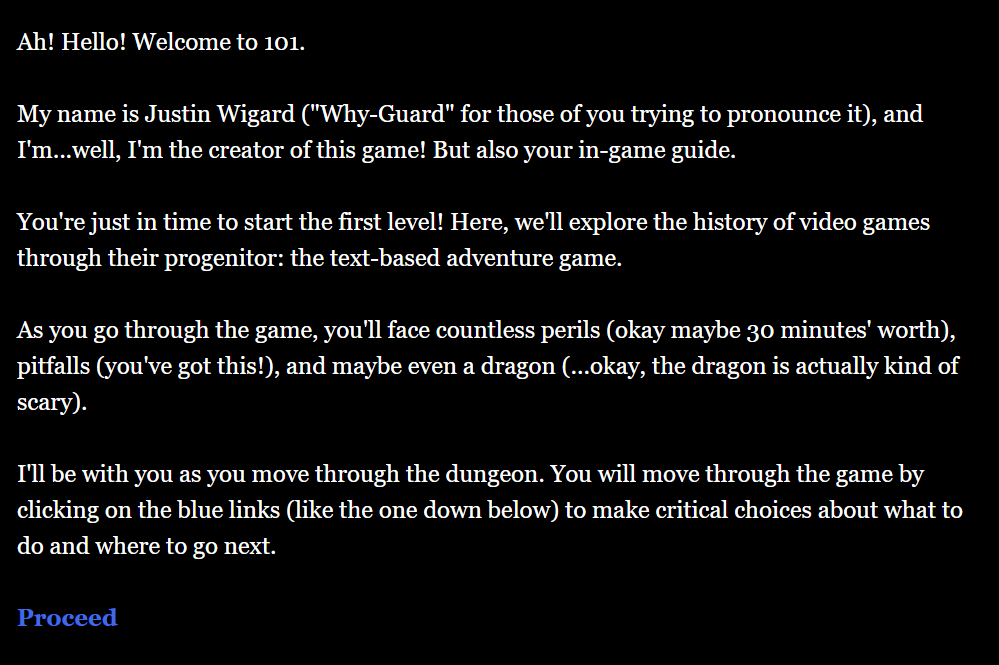
    One is a stage aimed at teaching players the history of early video games through a playable demo of a text-based adventure game.  Black background with white text introducing the game


    The other is a stage intended to provide players with experience engaging with the platformer genre in order to understand and critique other platforms like Super Mario Bros. Two comic figures talking standing on a stup with text boxes explaining their speech with sky background, Mario Bros video game style


    Development #1: Working with the MSU Library

    However, we worked in conjunction with the MSU Library to acquire several video games created with Unity and several of the texts related to the study. This collaboration with the MSU Library meant that the texts and games would be available to us throughout the growth of this project, but still be able to be circulated to the MSU community as a whole once the project was completed. Through the collaborative efforts of several MSU librarians, including Jonah Magar and Ranti Junus, as well as the efforts of Kristen Mapes, Assistant Director of Digital Humanities at MSU, the MSU Library was able to purchase six video games for the Library’s Video Gaming Lab, as well as four books for overall library circulation. These include:

    1. Books
      1. The Video Game Theory Reader 2, edited by Bernard Perron and Mark J.P. Wolf
      2. Blood, Sweat, and Pixels: The Triumphant, Turbulent Stories Behind How Video Games Are Made by Jason Schreier
      3. Game On! Video Game History from Pong and Pac-Man to Mario, Minecraft, and More by Dustin Hansen
      4. Cybertext: Perspectives on Ergodic Literature by Espen J. Aarseth
    2. Video Games
      1. Gone Home
      2. Firewatch
      3. Ori and the Blind Forest
      4. Inside
      5. Limbo
      6. Subnautica (expected: December)

    In particular, Game On! By Dustin Hansen and The Video Game Theory Reader 2 have been instrumental in the design of future stages, as Game On! provides a historical foundation for one primary track of gameplay in Level 101, the History module, and The Video Game Theory Reader 2 informs the Genre module of Level 101.

    Development #2: Pre-Production on Level 101

    Upon receiving the DH Summer Seed Grant, pre-production began on the game as a whole, and specifically, at the beginning of the game: the tutorial stage. At this stage of production, we felt that it would be beneficial to gain more insight into what elements of a video game tutorial are most effective, before we proceed with developing our own tutorial.

    An informal user experience study was conducted (in conjunction with MI 841, taught by Dr. Carrie Heeter) to collect information and data about the user experiences of instructors playing through a video game tutorial of an existing video game, Pokemon FireRed. This study featured two phases: one observational task analysis study, and one 10-question interview conducted after the study. Each session was expected to take 20 minutes total.

    While we are still processing a lot of the data which will inform the design and development of the tutorial sequence, some highlights that came out of the study were recommendations to:

    • Provide information on why players are making choices, and what impact that might have on their future gameplay (Task Analysis, Interview)
      • Level 101: Provide insight/feedback on what branch of the game might be easier for newer players, or which is suggested to begin with to help frame the rest of their playthrough.
    • Make early objectives easy to see or find (Task Analysis)
      • Level 101: Players should know what they are looking for (visually or narratively), and players should know how to proceed further.
        • Perhaps there could be a function to reveal a glowing blue or yellow arrow to indicate what direction players should head if they feel lost.
      • Use a combination of direct, indirect, and supplemental instruction (Interview)
        • Level 101:
          • Direct instruction: implement a button tutorial.
          • Direct instruction: refine Professor’s lectures
          • Indirect: Implement NPCs that provide helpful information.
          • Supplemental instruction: refine helpful signs already present
        • Have the tutorial be woven into the story, and vice versa (Interview)
          • Level 101: Reinforce the narrative that they are a learner of video games, be they student, instructor, developer, or somebody outside that trifecta.
        • Implement a skip function for experienced video game players (interview)
          • Level 101: Because this is a pedagogical game, this may be best implemented in terms of a questionnaire:
            • Ask questions about whether they feel comfortable skipping mechanics
              • Perhaps implement a “Quiz” level, where players can skip the tutorial if they pass a series of questions about the mechanics of the game.
              • Perhaps implement a “Tutorial Challenge,” where players can skip the tutorial if they pass a gameplay challenge.
            • Consider a follow-up study or survey about skipping tutorials.
          • Implement a 5-10 minute tutorial, one that begins with direct instruction before slowly introducing new mechanics or new elements to the game.
            • Level 101: Explain the buttons, explain the core mechanics and purpose, then introduce the game world itself.

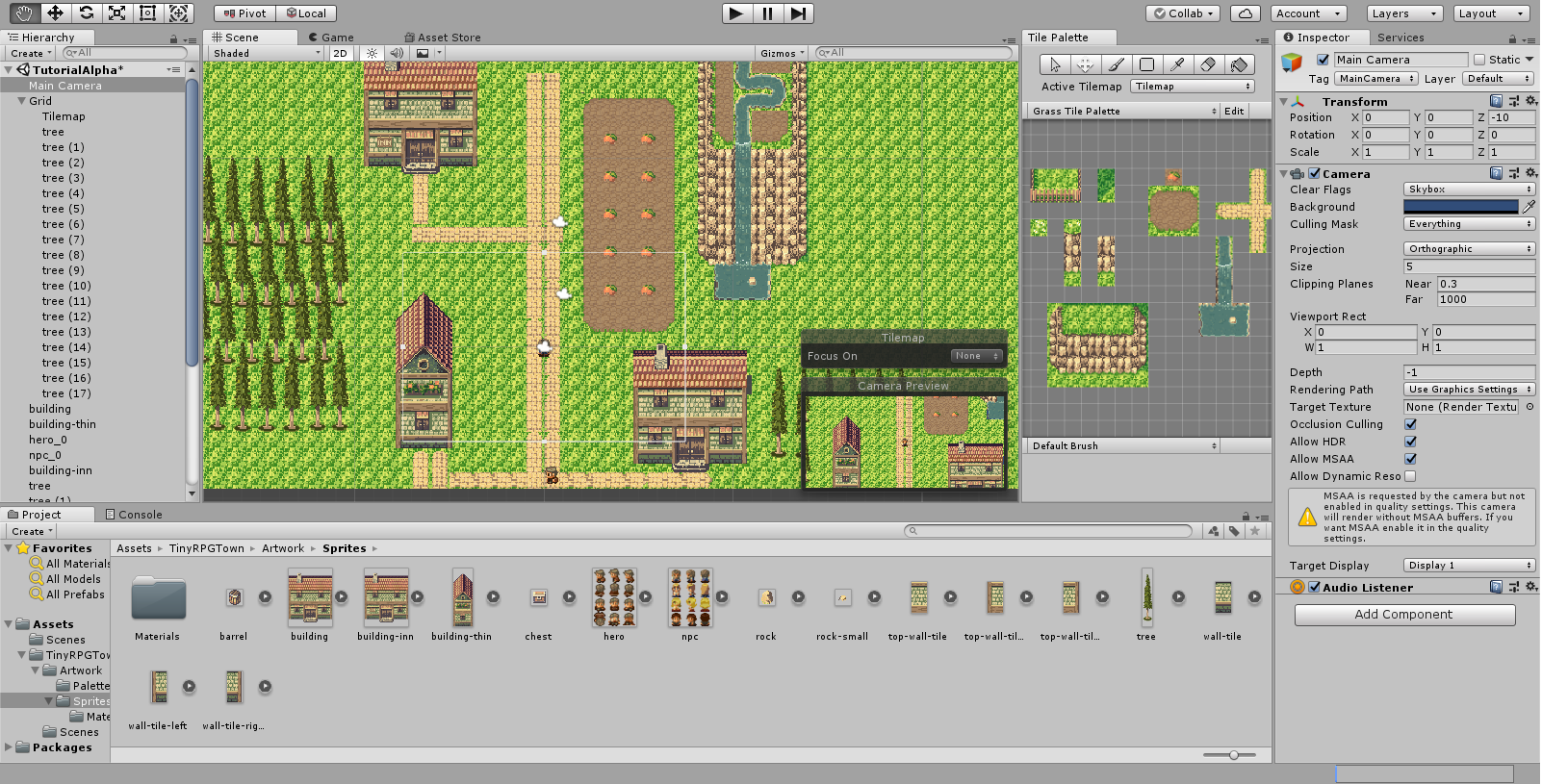
    Screenshot of Unity software backend for game with display of landscape in center and building control options around the left, bottom, and right sides


    With this in mind, we have begun developing the tutorial level using Unity. Because this level is in the Alpha stage of development, we have started with a premade set of visual assets, “TinyRPGTown,” which will allow us to construct our main scene using freely available assets. Once we have proceeded further into our development, we will be purchasing specific visual assets and audio assets to fit the level we design.

    We have begun implementing the informal recommendations gleaned from our user experience study by focusing on creating a 5-10 minute tutorial that is woven into the story. Our intention is to create a tutorial that positions the player as a hero-figure on a quest to gain knowledge about the world around them. Each level thereafter represents another stepping-stone in the quest for knowledge, levelling up by proceeding through more lessons. In addition, we are working to make early objectives easy to find, so there will only be a few paths and a few objects to interact with in the tutorial.

    Looking Ahead

    We plan to use the rest of our DH Summer Seed funding to purchase audio and visual assets for our tutorial stage, as well as common assets that can be used across the rest of the levels. In particular, we are considering several Graphical User Interface assets that can be more or less universal across the different planned levels

    As our development process took longer than expected to gain traction, we hope to present a playable demo of Level 101’s tutorial at the December Locus mini-symposium here at MSU. Because the existing Beta-stage levels were developed with other programs (Twine and Construct 2), we hope to translate or recreate these beta stages within Unity in order to present a more complete demo of Level 101. Once we have presented our work at the December Locus, we plan to update this post or append it with an update to include a link to the playable demo of Level 101.

  • Theme and word analysis in the contemporary corrido (Mexican Ballad)

    Theme and word analysis in the contemporary corrido (Mexican Ballad)


    Summer 2018 Seed Grant Funding Report

    Report submitted by Miguel A. Cabañas and Mary Ann Lugo


    Thanks to the support of Digital Humanities at MSU, our Theme and Word Analysis of the Corrido initiative has evolved from a proposal to a collaborative, textual-analysis project exploring violent themes in the contemporary corrido and narco-corrido from the 1960s to the present.

    In the past six months, we have assembled a project team, narrowed the scope of our inquiry, and begun designing a research strategy for our theme and word analysis of the corrido. The project got off the ground in May of this year with just three initial members, a faculty advisor and scholar of Latin American and Chicano/Latino studies, Prof. Miguel Cabañas, and two doctoral students in Hispanic Studies, José Badillo Carlos and Mary Ann Lugo. Early on we sought the advice of Kristen Mapes, who guided us through the process of setting up a team that includes Cabañas as the principal investigator, Lugo as the project manager, MSU librarian Devin Higgins as our DH programmer and text-analysis advisor, and Badillo-Carlos as a corrido specialist. As our project evolved, we realized we needed expertise in statistical analysis and research design, and therefore invited Prof. Valentina Bali from the Political Science Department at MSU to join our team.

    Our work began with asking some foundational questions: What corpus of corridos would we include in our analysis? What criteria would delimit the corridos included in the study? Are there existing archives of corridos that we could mine for such work? How would we digitize the lyrics for these songs? What would be the focus of our study? For instance: would we conduct our study on contemporary corridos or historical ones? Or both? Would we trace the evolution of words and themes in genre across time? Would we focus on the most influential corridos or try to choose a random, representative sample?

    Initially, we hoped to create the corpus of corridos for our analysis based on the holdings of the Strachwitz Frontera Archive, the largest extant, digitized collection of Mexican and Mexican-American recordings (http://frontera.library.ucla.edu/). Over the summer we contacted the archive to gain access and learn more about its scope. Working with Devin Higgins, we discovered that the archive includes 10,000 corrido recordings from the 1800s to the 1980s with metadata specifying artists, song titles, genre, recording label, and catalogue numbers for each recording. The process helped us discover some of the archive’s limitations for the purposes of our study: no song lyrics are included and the quality of the recordings will not allow for machine transcriptions. Furthermore, the corridos in the archive are not explicitly dated. Therefore, if we use of the archive, one of our forthcoming tasks will be to locate and date corridos from the sixties onwards and then digitize their lyrics.  Thanks to the MSU DH Summer Seed Grant, we have hired an assistant to digitize the corrido lyrics in print volumes that include many written since the sixties. For this task, we have also discussed making use of lyric aggregating sites like Genius.com.

    To use the archive, we will also need tools to facilitate locating and dating its contemporary corridos. For example: Devin was able to link about 400 corrido artists in the archive with their MusicBrainz entries (MusicBrainz is an open music encyclopedia like Wikipedia). This process will yield wide date ranges for those artists and therefore for their corridos.  We anticipate that we may have left-over Summer Seed Grant funds to pay our graduate assistant for about ten hours towards identifying and dating contemporary corridos in the archive.

    Considering the limitations of the Frontera Archive, by the Fall our team questioned whether to refine our study to include mostly contemporary corridos since the lyrics for these are more readily accessible. After a number of discussions, we decided to focus on a question posed by Prof. Cabañas: Is the corrido today a significantly more violent genre now than in the past? How have themes related to violence evolved in the corrido since the 1960s? We arrived at this focus by considering the somewhat infamous reputation of contemporary narcocorridos that tell stories of drug-traffickers. Narcocorridos have anecdotally been labeled a darker, more violent offshoot of the genre, but Prof. Cabañas does not buy that narrative and hopes that a large-scale digital humanities study of corrido and narcocorrido lyrics will add some quantitative truth to the anecdotal perceptions. The analysis will be achieved by engaging in textual analysis of the lyrics and compiling data about the question.

    Corridos have a long history of telling stories of heroes and outlaws. The corrido has been defined as a ballad that tells unofficial versions of history, often by the underdog, or those far from circles of power. [1] Corridos have been sung for nearly 200 years and have been described as an “epic-lyric” that since the nineteenth-century tell of heroes and outlaws in U.S.-Mexican border culture. [2]  In the 1970s, narcocorridos started to appear and two decades later they had become a lucrative industry. Some of the most successful producers are Mexican-American artists in Los Angeles selling music to Hispanics in the United States and Mexico who have never met a drug trafficker let alone picked up an AK-47.  Possibly because of their commercial success, narcocorridos have been the subject of public curiosity and debate.  Narcocorridos became the subject of national debate during the Presidency of Felipe Calderón when violence related to drug trafficking in Mexico reached crisis levels. In Mexico, the genre was banned from certain radio stations, and in the U.S., newspapers published stories exploring the links between the fictional stories sung in the narcocorridos and actual violence inflicted by drug cartels.  For example, in 2009, NPR published a story titled “Narcocorridos: Ballads of Mexican Cartels” telling of the murder of narcocorrido Mexican musicians who became too closely associated with the drug wars.[3] In another example, in 2013, The Washington Post ran a story about the release of a documentary called Narco cultura (2013) produced by photo journalist Shaul Schwarz.[4] The article describes Schwarz’s journey in which he ponders the relationship between the narcocorridos and Mexico’s actual violence. This sensationalist documentary features only one group to show how narcocorridos permeated a violent society.

    No doubt media and political portrayals of narcocorridos have contributed to the perception that the corrido today contains previously unheard-of levels of violence. Yet, it is hard to know whether these perceptions are accurate or not without a more comprehensive study. For this reason, our analysis of corrido lyrics will focus on analyzing themes of violence in the genre at large.

    Armed with this question, in the last month our team began designing a new research strategy. We first explored whether we could generate a list of thousands of contemporary (since the 1960s) corridos and narco-corridos to serve as the dataset for a random sampling of the genre. We surmised that the results of the random sample could yield a manageable list of corridos whose lyrics would be digitized and analyzed in a second phase of work in the Spring. For this task, we invited Prof. Valentina Bali from MSU’s Political Science Department and specialist in statistical analysis. Working with Prof. Bali, we discovered that creating a comprehensive list of contemporary corridos is a surprisingly complex endeavor, as the record labels and distribution channels for selling corridos are diverse. For example, the issue is complicated by the various forms of distribution in this industry ranging from CDs sold at Walmart to giant record companies distributing content online through well-known platforms like iTunes or Spotify. Furthermore, scholars of the corrido have tended to catalog older corridos (as in the Frontera Archive), but contemporary recordings have not been systematically catalogued in any one place.

    Given the complexity of generating a comprehensive catalogue of contemporary corridos, we weighed the options for choosing a corpus for our analysis. Prof. Bali advised us to try a two-fold approach: 1) Conduct a pilot study of a few major performers who have been producing corridos for several decades. The pilot study will then trace the evolution of themes related to violence from the earlier parts of these artists’ careers to now. 2) At the same time, continue to research strategies for assembling a comprehensive a catalogue of the genre. This could serve later DH researchers and would also be a model for research with music genres.

    At the moment, we have settled on conducting a pilot study with the following artists:

    Los Tigres del Norte, Tucanes del Norte, Grupo Exterminador (Tijuana), and Huracanes. We plan on working on this for the next few months.


    [1] Hernández, Guillermo.“What is a Corrido? Thematic Representation and Narrative Discourse,” in The Arhoolie Foundation’s Strachwitz Frontera Collection of Mexican and Mexican American Recordings edited by Agustín Gurza. UCLA Chicano Studies Research Center Press, 2012. p.176

    2 Ibid, p. 177-178

    [3] https://www.npr.org/2009/10/10/113664067/narcocorridos-ballads-of-the-mexican-cartels

    [4] https://www.washingtonpost.com/lifestyle/style/director-shaul-schwarz-explores-drug-war-subculture-in-new-film-narco-cultura/2013/12/05/bdeb5a68-579d-11e3-ba82-16ed03681809_story.html

  • Bhakti Virtual Archive

    Bhakti Virtual Archive (BHAVA)


    Summer 2018 Seed Grant Funding Report

    Report submitted by Jon Keune and Gil Ben-Herut


    Summary of seed grant activity

     
    The summer seed grant from DH@MSU enabled us to create a set of static image mockups that were integrated into a basic website that demonstrates the search capabilities of the Bhakti Virtual Archive (BHAVA) that we are working to build: http://www.regionalbhakti.org/bhava/walkthrough/.  We contracted with Addis Enterprises (AE) of Lansing, who consulted with us about what we were looking for in a user interface, pointed out issues that we will need to address when it comes time to code the project, and designed twelve images in Photoshop that illustrate what we plan for BHAVA’s functionality.  We included this HTML walkthrough in our proposal to the National Endowment of the Humanities for a Humanities Collections and Reference Resources (HCRR) grant at the Foundations level.


    BHAVA project overview


    The Bhakti Virtual Archive (BHAVA) will be a freely accessible online platform for exploring scholarship on diverse regional devotional (bhakti) traditions in South Asia. The ultimate goal of the BHAVA project is to have an expertly curated database of research on South Asian devotional traditions that accelerates research and enhances teaching about South Asian history, literature, philosophy, language, and culture. We have been slowly developing BHAVA for the past three years and have recognized the importance of getting an external grant to support more intensive work, to make it visible to university-level metrics.  To carry out this project, we are seeking support from the NEH HCRR at the Foundations level to create 1) a faceted classification system with 2) cataloging protocols, 3) a robust database that integrates linked open data, and 4) an online search interface. After this infrastructure is built, we will submit a proposal for an HCRR Implementation grant to populate the database with bibliographic records that are compiled and cataloged by thirteen experts in diverse Indic languages and regions.

    The rise of regional bhakti traditions, starting in the 7th century CE, heralded major transformations across South Asia. Bhakti traditions became known for promoting emotional experience of the divine, communal participation in ritual worship, and an inclusive vision that everyone was welcome to serve the traditions’ preferred deities. These regionally based and locally organized groups deeply impacted South Asian society, philosophy, and literature. As part of cultural studies’ turn toward the popular and non-elite, over the past thirty years, scholars of South Asia have paid greater attention to the regional-linguistic contexts of bhakti traditions. Research on bhakti traditions encapsulates, in many ways, the study of popular, non-elite culture in South Asia. This approach required scholars to invest great time in learning regional languages (some of which are rarely taught outside India) and becoming familiar with regional particularities. This research trend heightened appreciation of the distinct local characters of these traditions, thereby enriching our understanding of social and cultural history. But it also had an unfortunate side effect: compartmentalizing knowledge into region- and language-specific silos. So, a new challenge arose from this approach’s own success: how to coordinate multiple, rapidly growing, largely independent bases of knowledge about a phenomenon that crossed languages and regions.

    Two hurdles stand in the way. The first is conceptual. Given the diverse languages and regions involved in the study of bhakti traditions and literatures, an overarching rubric is needed to help people navigate this vast area of knowledge to address big-picture questions about the field as a whole. Identifying broad patterns across regions and languages requires a level of comparative analysis that is difficult to carry out now, with current silos of knowledge. The second hurdle is logistical and pertains to the lack of a solid platform (beyond accidental conversations at conferences) to encourage knowledge sharing among scholars of various languages, regions, and periods. Today, someone studying one particular tradition has no central resource to identify relevant bhakti-related materials in other languages and regions. This problem is exacerbated by the fact that most research on bhakti is published in journal articles and edited volumes, which are not cataloged by the Library of Congress intensively like monographs, leaving them less visible and well connected in the digital network of humanistic knowledge. Consequently, bhakti scholarship (with all its implications about historical, literary, and social knowledge) has tended to proceed by focusing on a partial understanding of the history and significance of a given tradition while overlooking its development, cross-fertilization, and interaction with traditions elsewhere. BHAVA will provide a way to link region- and language-specific silos of knowledge together, so that people within and outside academia can find connections and deeper understandings of Indian culture and history.

    The bibliographic holdings of BHAVA will refer mainly to secondary scholarship in Western and Indic languages about bhakti traditions, as well as to key primary texts, in translation and in original languages. By integrating linked data to interface with external catalogs and repositories (WorldCat, Archive.org, Transliteral.org, etc.) and other South Asia-related digital resources (University of Chicago’s Digital South Asia Library, the South Asia Open Archive, the PANDiT Project, and Sahapedia.org) the project will be well situated for further possible content expansion (images, video, geographic data, e-texts, and manuscripts) and continued growth, after the Foundations and Implementation phases of BHAVA’s development are complete.


    Mockups and walkthrough

    Although we had roughly envisioned the search features that we wanted BHAVA to have, working with AE to create the interface images brought these hopes into clearer focus.  AE asked us to refer them to examples of existing websites that had some of the features we wanted.  We knew that BHAVA’s search interface would be based on users selecting subjects from our faceted classification table that will be used to catalog each bibliographic reference in BHAVA.  Designing this aspect of the search (what eventually become the Standard Search Mode in the mockups) was just a matter of deciding on layout.  What we didn’t anticipate was that in the process of looking at other search interfaces online, we were inspired by one site (American Merchant Marine Veterans Oral History Project at http://seamenschurch-archives.org/sci-ammv/tagcloud) to imagine using a word cloud as an alternative interface that would visually represent the relative frequency of subjects in BHAVA’s holdings.  Based on users’ selections (single or multiple) in one facet’s word cloud, other facets could then be represented to aid further searching.  Not only would this be visually engaging, but it would build a level of interactivity into the search activity itself; the world clouds would help users anticipate the number of discoverable items within their selected parameters.  This eventually became the Word Cloud Browse mode of the search in the mockups.  Although describing the Word Cloud Browse feature is difficult in a narrative, it is easily understandable when viewed in the HTML walkthrough.

    We provided AE with some potential search terms and imagined results numbers (educated guesses), so that they could create images that would lead users through a few potential searches in the BHAVA interface.  In the HTML walkthrough, we also wrote short commentaries on each of the twelve image mockups.


    Challenges

    A challenge that we faced immediately after receiving the seed grant was that we hadn’t anticipated how limited our hiring options would be because of the MSU accounting office.  We soon discovered anyone we wanted to hire to do the mockup work would have to be vetted by MSU Purchasing—a process that could take several weeks.  This would not have allowed us to have the mockups ready before the NEH HCRR submission deadline.  We were eventually directed toward a handful of design and coding services that MSU had pre-vetted, whose rates were higher than we could have found with freelancers.  We are pleased with AE’s work, be we had anticipated being able to afford more work with the seed grant and a couple weeks went by as we sought answers from MSU administrators how to do this kind of contracting.

    The mockup creation process left us with several questions about design that we will need to address in the future.  1) In the Standard Search Mode, the terms of nearly all the facets can be displayed vertically at the same time on the search interface.  But the Topic facet will have too many terms and must be represented with a pop-up balloon that users will have to click to open.  If additional terms get added to other facets eventually, we may encounter a similar problem with them.  2) We haven’t yet found an elegant way to incorporate Boolean operators into the search modes on a search interface screen that is already fairly full.  By default, we would assume that items selected within a facet would be governed by OR, while items selected across facets would be governed by AND.  We’ll need to think more about this. 3) We will also need to think more about enabling users to search on details of bibliographic references themselves (author name, publication year, etc.).  Currently, this kind of search is possible only through the Keyword field.  We always planned that BHAVA’s strength would come from the faceted classification table that will be used to catalog each bibliographic record.  This level of detailed cataloging will lead users to make connections that they could not have made before.  But perhaps users may miss searching on conventional fields like author name.  We will think more about this, including how those fields could be laid out on the screen.  4) We will need to consider further how using Linked Open Data in the search interface will enable us to link to external resources meaningfully and in ways that can be coded affordably.  5) As AE created the mockups, they built in a “Preview” feature on the results screen, so that a user could hover over an individual bibliographic item in the results list and see some details pop up; this potentially makes the full view of a single bibliographic item redundant.

  • Digital & Community Publishing Collective

    Digital & Community Publishing Collective

    Summer 2018 Seed Grant Funding Report

    Report submitted by Kate Birdsall and Emily Jenkins

    The Digital & Community Publishing Collective (DCPC) at MSU is a new initiative that will centralize support for a broad range of publishing activities, including a monthly magazine, a literary journal, scholarly journals, a community of feminist filmmakers, a collaborative fandom, a blog, and a zine. The collective will offer publication resources for students and organizations at Michigan State University and for members of Greater Lansing and mid-Michigan communities.
    The DCPC will utilize its unique position within the Department of Writing, Rhetoric, and American Cultures at MSU to provide meaningful experiences for undergraduate and graduate students that arch over digital and print publications. The commitment of the DCPC to bring faculty, students, writers, readers, and community members together expands MSU’s visibility as an institution committed to digital humanities, research, writing, and undergraduate/graduate education.

    The DCPC was able to begin research and content strategy during the summer of 2018 thanks to a summer seed grant awarded to the director of DCPC, Dr. Kate Birdsall, by DH@MSU. Birdsall is an Assistant Professor at MSU in the WRAC Department.

    DH@MSU summer seed grants are available through the Digital Humanities Department at MSU. Without the help of this grant, the DCPC would have been unable to begin important research over the past summer. This memo details how the DCPC used the grant over the summer months of 2018 to begin work on establishing the collective in the MSU and Lansing communities.

    The funding was primarily used for:

    • Performing a landscape analysis
    • Researching the most effective structure for the DCPC
    • Researching similar initiatives or collectives at other universities

    The rest of this report will describe in detail the outcomes of these objectives.

    Landscape Analysis

    The first step taken by the DCPC during summer 2018 was to perform a landscape analysis. This analysis would inform the DCPC of other similar publishing collectives run through universities, and would also help the DCPC begin to make decisions about what these collectives are doing well and what the DCPC could potentially replicate or build on as it becomes more established.

    Three interns were hired for summer 2018 by Director Dr. Kate Birdsall. All three of these interns contributed to the landscape analysis.

    The results from the landscape analysis revealed that no other organization is doing exactly what the DCPC aims to accomplish. The two projects that have missions the most closely aligned with the DCPC that are also housed through MSU are the iVerse Lab and the Family Communication and Relationships Lab.

    The iVerse Lab is run through the Communication Arts and Sciences Department at MSU. This lab works to provide faculty and staff opportunities for research, publication, innovation, and community outreach. The six main branches of the lab’s objectives are: virtual reality design, virtual reality development, research studies, create activities, game design development, and UX design and playtesting. The director of the iVerse Lab is Dr. Taiwoo Park, an Assistant Professor at MSU in the Department of Media and Information.

    The Family Communication and Relationships Lab is also run through the Communications Arts and Sciences Department at MSU. This lab is a collaboration between MSU and the University of Washington. The lab functions as a hub for research and publication for both universities involved. The directors of this lab are Dr. Elizabeth Dorrance Hall, an Assistant Professor in the Communications Department at MSU, and Dr. Kristina M. Scharp, an Assistant Professor in the Department of Communication at Washington University.

    While these two labs are similar to the DCPC in that they provide publication opportunities for students and faculty, they do not include the community in the same way the DCPC will. As a community-focused publishing collective, the DCPC will provide a space for a diverse range of people, places, and communities to participate and foster connectivity through digital humanities, research, writing, reading, and undergraduate/graduate education.

    DCPC Structure

    Determining the structure of the DCPC was another important goal for the summer 2018 DCPC team. In order to run smoothly and be an efficient and effective publishing collective, the DCPC must have an organized internal structure. Some of the models searched include internship models, MSU organizational models, classroom models, and non-academic publishing collective models.

    Three interns were hired for summer 2018 by Director Dr. Kate Birdsall. Two of these interns contributed to the structure research and design of the DCPC.

    The DCPC recognizes that developing a complete organizational structure will take time. However, it has created two models that will eventually come to fruition as the DCPC grows.

    This is the projected model of the DCPC’s structure for the 2019-2020 academic year:
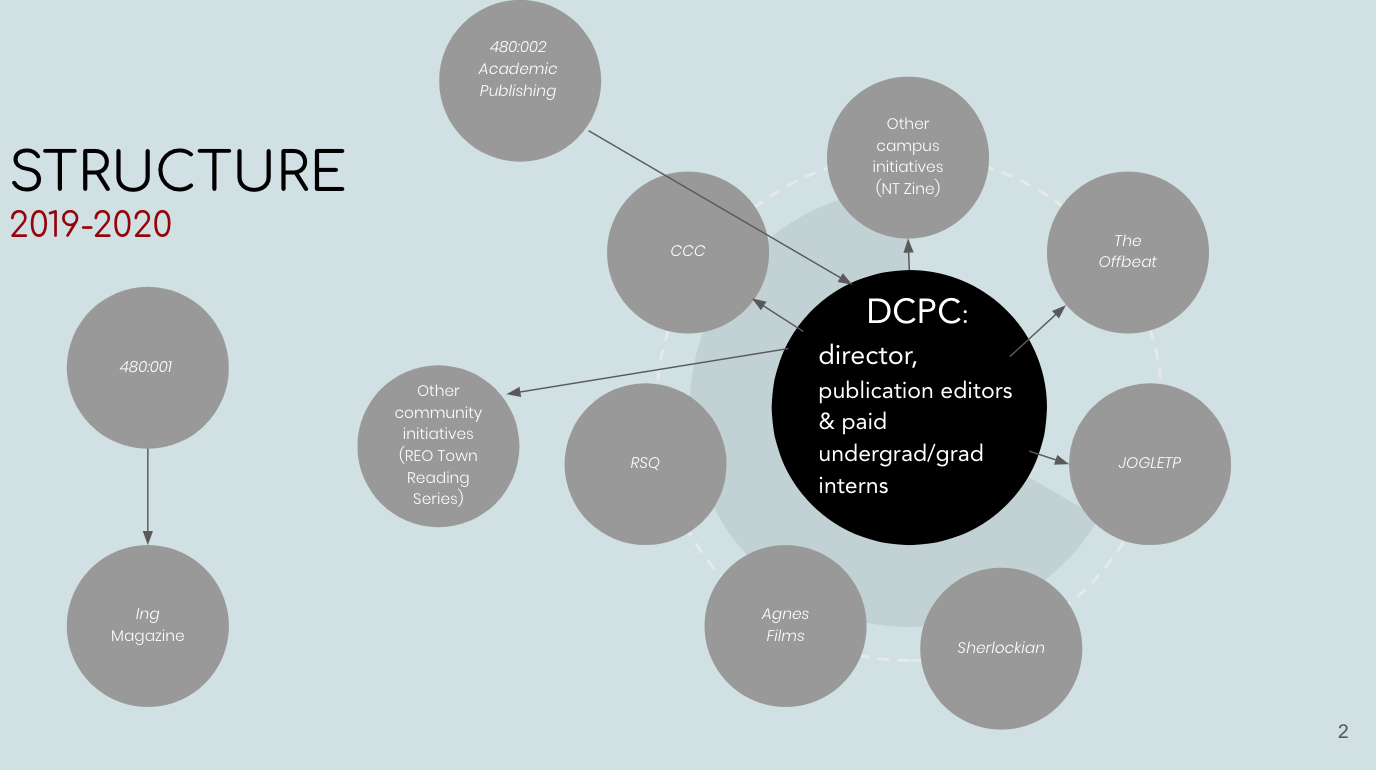
    2019-2020 structure diagram with DCPC director, publication editors, and student interns at the center, with variou nodes branching off, including CCC, RSQ, Agnes Films, Sherlockian, JOGLETP, The Offbeat, and other campus initiatives, as well as 480 academic publishing course and other community initiatives as notes connected to the center. The 480 course and Ing magazine are connected to each other but not connected to the central diagram.

    This is the projected model of the DCPC’s ideal structure, which will take time to obtain:
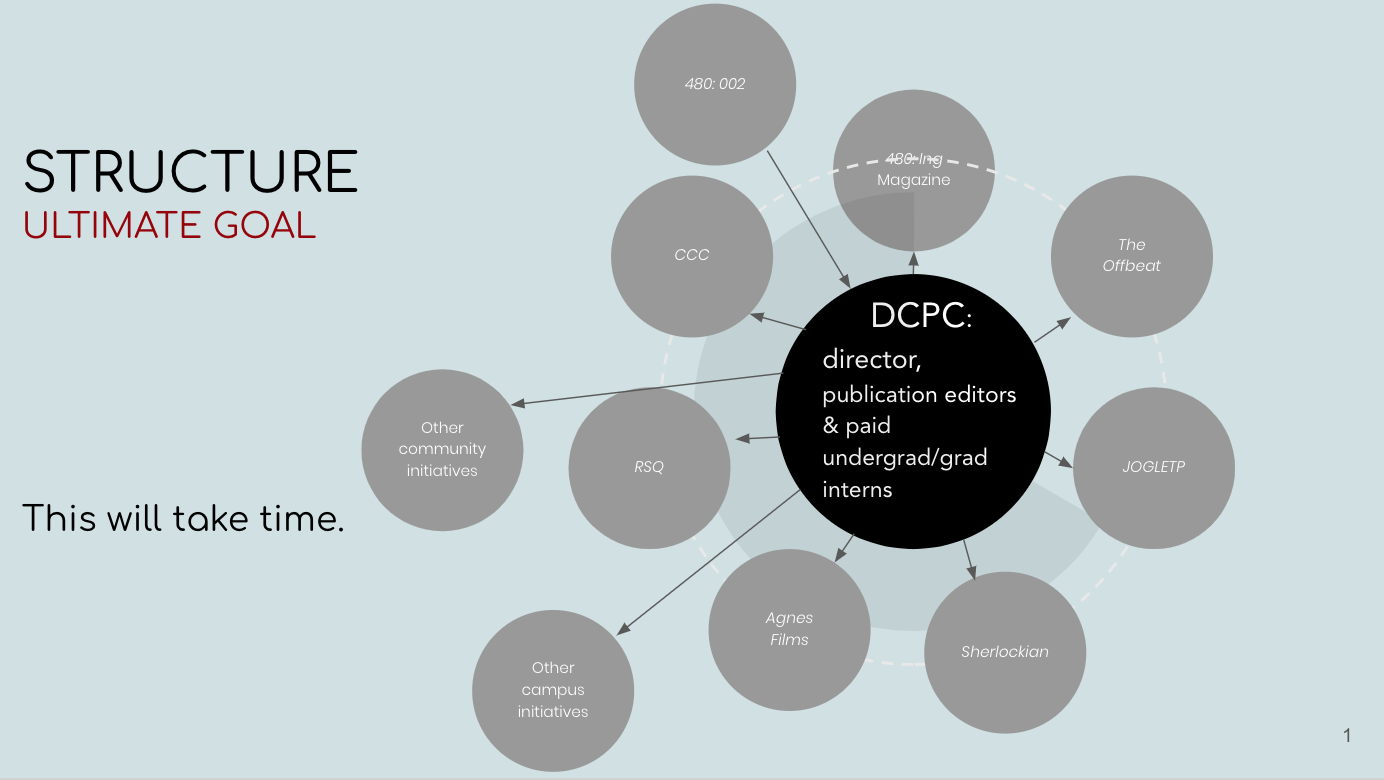
    Ultimate goal for the structure, shown as a diagram with DCPC director, publication editors, and student interns at the center, with various nodes branching off, including CCC, RSQ, Agnes Films, Sherlockian, JOGLETP, The Offbeat, and other campus initiatives, as well as 480 academic publishing course and other community initiatives as notes connected to the center. All of the nodes are connected to the central node, with feedback shown through directional arrows between the center and connected courses and publication nodes.

    Research

    Performing extensive research about other similar initiatives, structures, and information about publishing collectives was also necessary during summer 2018.

    Three interns were hired for summer 2018 by Director Dr. Kate Birdsall. One of these interns contributed to the research.

    Search terms utilized during summer 2018 include: “university publishing collective,” “Wayne State publishing collective,” “University of Minnesota Press,” “publishing collective university,” “Lansing MI writing,” and “university publishing.”

    The sources collected include scholarly journal articles, books, and the websites of other university presses. This research has helped the DCPC learn more about the publishing industry and how it is being executed at other institutions. It has also inspired many ideas for the mission, structure, and organization of the DCPC.

    Other research done by the DCPC includes interviews with prominent individuals at other publishing collectives. The interview completed during summer 2018 was with Dr. Joanna Ruocco, who is a member of the Board of Directors at FC2, a publishing collective housed by Wake Forest University. Dr. Ruocco gave the DCPC valuable information about branding, networking, student involvement, board structure, and meeting structure. This research was not only helpful to the DCPC, but could also serve as the starting point for the development of a relationship or partnership between the DCPC and FC2.

    While the in-depth interviews have not been completed yet, other prominent figures in the publishing business have been contacted and are currently in conversation with the DCPC. The institutions that have connected with the DCPC include: University of Minnesota, Wayne State University, LKA Publishing, Capital City Writers, and Michigan State University. The interviews once completed will supplement the research performed during summer 2018.

    Looking Ahead

    During the summer of 2018, the DCPC was able to make significant progress by performing an extensive landscape analysis, designing the internal structure of the collective, and researching the practices of other publishing institutions while making steps toward developing partnerships with these institutions.

    Dr. Kate Birdsall is currently working with two student interns to develop a content strategy, continue the research started during the summer, and launch a website. The soft launch for this website is currently planned for January 2019, with full implementation planned for fall semester 2019.

    The DCPC wants to again reiterate its appreciation for the summer seed grant presented by DH@MSU. By being awarded funding for summer 2018, the DCPC was able to get a crucial start before fall semester, and is on track to begin publicizing the collective during spring semester 2019. The DCPC thanks the Digital Humanities Department at MSU for its support in establishing a publishing collective at MSU that will facilitate student, faculty, and community involvement in the digital humanities, research, writing, reading, and undergraduate/graduate education.

  • Summer Seed Grant Recipients

    We were very pleased to support 6 digital humanities projects during the summer! They are listed below, and the project leaders will present about their projects during the Fall DH Colloquium series.

    • The Weeping Season, film by Alexandra Hidalgo (see the trailer here)
    • Bhakti Virtual Archive (BHAVA) project (formerly, Connected Bhakti Bibliographies Database), led by Jon Keune
    • Digital & Community Publishing Collective (DCPC), led by Kate Birdsall
    • Theme and Word Analysis in the Corrido from the Frontera Collection project, led by Miguel Cabañas
    • Level 101 – A Video Game about Video Games, led by Justin Wigard and Elizabeth LaPensée
    • The Longhua Civilian Assembly Center: 1943-1945 project, led by Daniel Fandino and Erica Holt
  • Job Opportunity: Specialist in Literature, Cognitive Science, and Digital Humanities

    The College of Arts and Letters (CAL) at Michigan State University seeks a continuing system specialist in Literature, Cognitive Science, and Digital Humanities (DH) to participate in ongoing initiatives in history of the mind, literary cognition, and digital humanities as manager of the Digital Humanities and Literary Cognition Lab (DHLC) and academic specialist in digital humanities.

    Please see the full listing at http://careers.msu.edu/cw/en-us/job/499309/specialist-teachercontinuing for more information.

    Review of applications will begin July 2, 2018 and will continue until the position is filled. Applications must be submitted electronically to the Michigan State University Human Resources website, http://careers.msu.edu/.

    For more information contact Kathleen Fitzpatrick, Chair of the Search Committee, Department of English, kfitz@msu.edu

    Persons with disabilities have the right to request and receive reasonable accommodation.

    MSU is an affirmative-action, equal-opportunity employer. MSU is committed to achieving excellence through cultural diversity. The university actively encourages applications and/or nominations of women, persons of color, veterans and persons with disabilities.

  • 2018 Global DH Symposium Videos are up!

    Videos from the 2018 Global Digital Humanities Symposium are now available on YouTube. Check them out here!