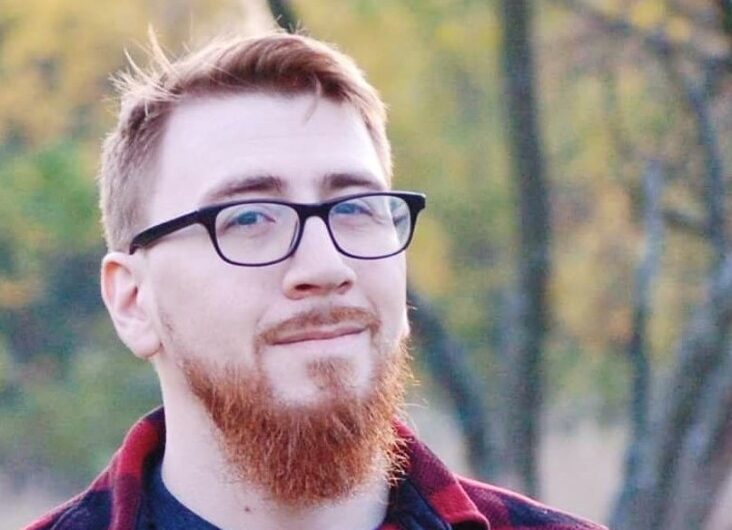
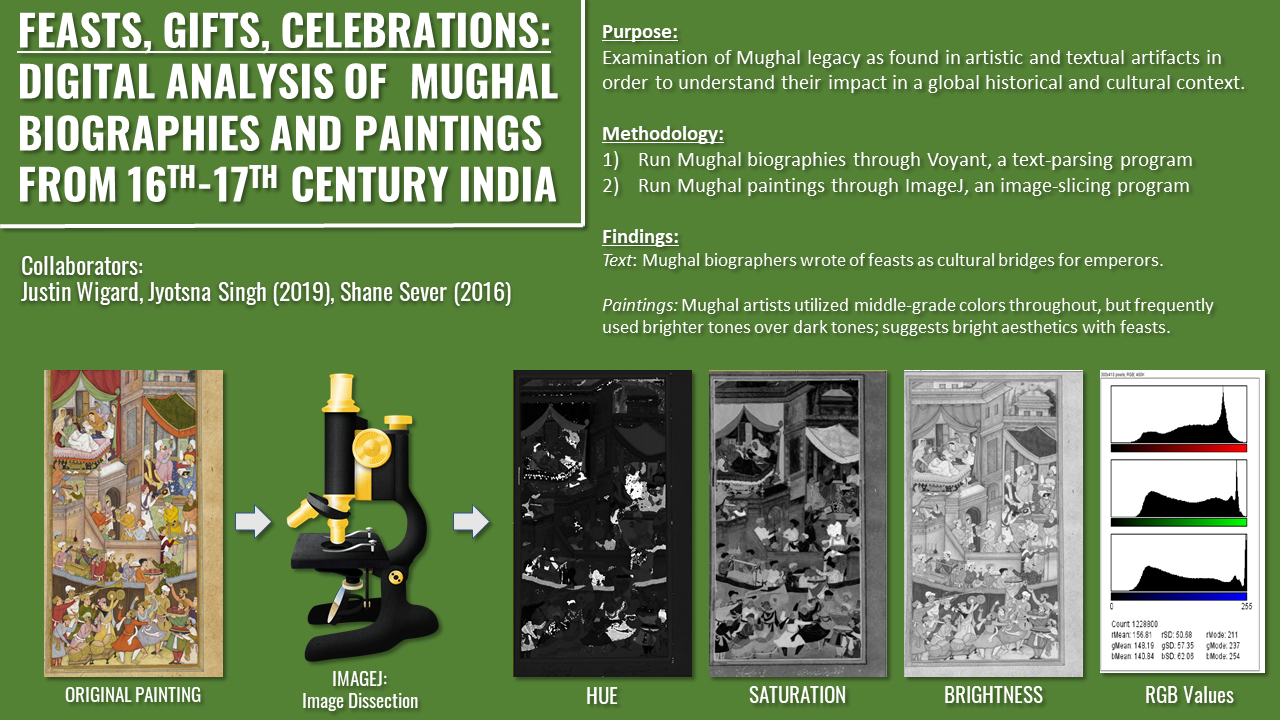
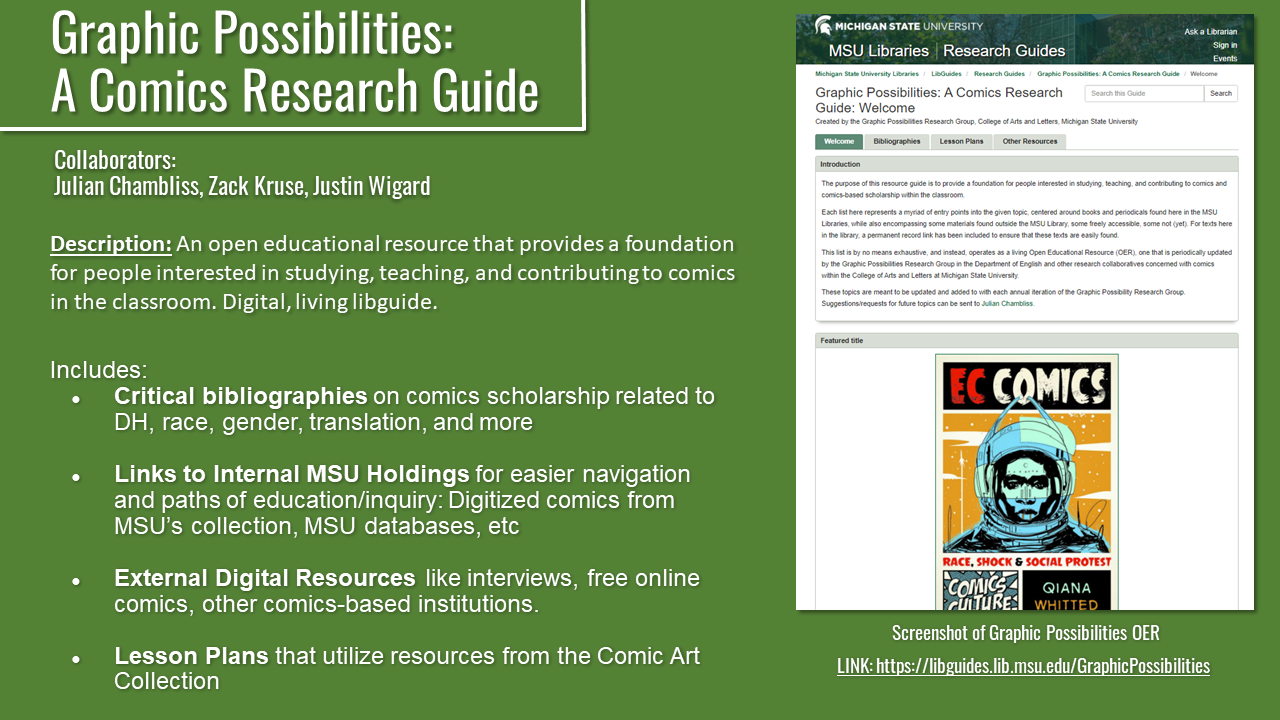
Justin Wigard received the Graduate Certificate in Fall 2020. While at MSU, he worked on DH projects related to comics, games, and literature. Two prominent projects include creating an Open Educational Resource and organizing an international Wikidata editing event, both which lower barriers of access to the MSU Comic Arts Collection. His primary Digital Humanities project whaile at MSU was his dissertation, titled Level 101: A Video Game About Video Games, a playable video game that he wrote, coded, and programmed to teach players about video game history, design, and theory. This project unites his interests in literary studies, digital practices, and teaching: to play is to learn, and vice versa. Justin received his Doctorate in English in 2022 and is continuing his academic adventures in comics, games, literature, monster flicks, and digital humanities. He is currently a Postdoctoral Research Fellow in the Distant Viewing Lab at University of Richmond.
In light of recent changes to the MSU Spring Semester schedule, THATCamp will be a shorter event than originally planned and will run from 10:00am to 12:00pm. The event (THATCamp Lite) will take place virtually, and has been modified from an all-day unconference to reduce the time asked of participants in light of the changes to the semester start date.
THATCamp is an unconference: an open, less formal meeting where students, staff, and faculty from any discipline and from all skill levels learn and build together in sessions proposed, led, and voted upon by the community. There will be time for networking, discussion, and sharing about projects.
Included in the schedule is a DH Project Showcase, which is a great way to share your work and to learn about Digital Humanities work taking place around campus via short, 1-minute lightning talks. Participants are invited to sign up to share out by adding a slide to this slidedeck in advance or on that day of THATCamp. Also, there will be a raffle!
The goals of DH@MSU THATCamp Lite are:
To (virtually) bring people back together at the beginning of each semester
To introduce new folks to the DH@MSU community
Build connections between community members for future collaborations, troubleshooting, and less formal interactions
Who is THATCamp for? This is an opportunity for people, whether formally a part of the DH@MSU community or not, to gather, learn from each other, and make connections to carry forward into the academic year. We welcome:
Members of the DH@MSU community, old and new
Students in the Digital Humanities undergraduate minor or graduate certificate, and students interested in the minor/certificate
Humanists who are engaged in digital and computer-assisted research, teaching, and creation
Anyone doing or interested in exploring work in the digital, especially (but not exclusively) in the areas of arts, humanities, and social sciences
Family members (kids)
In the spirit of Martin Luther King, Jr. day, we especially welcome ideas and work that explore social justice in addition to welcoming all work in digital humanities underway by all members of the DH@MSU community.
This is a flexible, family- and pet-friendly event.
Using breakout rooms, we will have 3 short meet and greet opportunities. This means that groups of 4-6 will be gathered in a breakout room to introduce themselves and answer a question prompt for ~5 minutes and then will be reshuffled into another room for ~5 minutes with different people.
Discussion Session
On the morning of THATCamp, participants will be asked to share topics of interest for discussion and then to vote on those most of interest to them. The topics with the most votes will be slotted into the discussion session.
Each session will take place in a Zoom breakout room, and participants will be able to select which session they would like to go to and to move among the sessions as desired.
DH Project Showcase
This is an opportunity for participants to share out about a project (or projects) at any stage of development through very short (60 second) lightning presentations.
THATCamp will take place on Zoom. The meeting link and information will be sent via email to registrants at the time of registration. For the best experience, please update to the most recent version of Zoom via these instructions.
When you enter the Zoom meeting room, your video and microphone will be turned off/muted by default, and you are welcome to turn them on/unmute as you prefer throughout the event. We will all convene in one room, and we will use breakout sessions to facilitate introduction sessions and the discussion section. There will be moderators available throughout the day and in each breakout room to assist with technical issues and Zoom questions.
Closed Captions will be provided throughout THATCamp Lite and made available to all in main sessions. If participants would like captions provided during breakout rooms, please let the organizers know via the Registration form or by emailing dh@msu.edu.
Slack
In addition to using Zoom for the videoconferencing portion of THATCamp, we strongly encourage all participants to join and engage in discussion and information/resource sharing on the MSUDH Slack group. Please sign up if you haven’t already at https://msudh.slack.com/signup#/.
If this is your first time signing up, you’ll be added to several “channels” when you first join, including the #thatcamp channel. The #thatcamp channel will be where we talk about the event and share resources, but we encourage you to explore the other channels as well!
Unlike Zoom, chat that happens in Slack will still be accessible after the event, so if you want to share resources with the community or revisit a conversation, you’ll be able to do that. We look forward to seeing you there!
Submitted by Divya Victor, Julian Chambliss, and Natalie Phillips
Overview & Project Goals
Inspired by Professor Divya Victor’s forthcoming book Curb (2021), CURBED3 is a web-based multimedia space that seeks to visualize instances of racial othering in the United States. The DH@MSU Summer Seed Grant supported Digital Humanities and Literary Cognition Lab’s (DHLC) first fellow in our Public Humanities Fellow program. Our goal is to aid Professor Victor in developing her digital praxis. Borrowing heavily from Professor Victor’s book, which utilized geolocation data to highlight instances of racial othering in public spaces, our central effort is to design a web prototype that would allow the public to share their stories of othering inspired by CURB. We utilized seed grant funds for research and work on the prototype.
A digital extension of Victor’s poetry, Curb (2021), CURBED seeks to catch and document a particular quotidian feeling of being fearful in a anti-Muslim, anti-Sikh, anti-immigrant United States, asking: when did that begin, who is that feeling made for, and how does that feeling make us who we are? The webspace is a fundamentally collaborative effort intended to build cross disciplinary connections in approaches to storytelling and interpretive witnessings. The webspace will host commissioned, interactive materials created in response to poetry from Curb: rhetorical musical assemblages created by Carolyn Chen, Los Angeles based new musique composer; experimental, minimalist documentary using Google satellite imaging, by Bay-area based video artist and writer Amarnath Ravva; printable “hacks” into public space and illustrations by Austrian illustrator and designer Karin Aue who is based in Singapore. Using a combination of Omeka S and WordPressing platforms, we are hoping to build a web space that encourages and hosts new approaches to narrativizing acts of exclusions and inclusion in public spaces. We are asking how the United States can be mapped experientially and phenomenologically, through storytelling and sensory engagements. This project’s timing is crucial as we hope to launch it in 2021, which marks the 20th anniversary of the 9/11 attacks as well as a two-decade rise in anti-South Asian and anti-immigrant violence in this country.
Building a Vision
While this project is guided by the artistic and humanistic goals inspired by Divya Victor’s poetry, we sought to contextualize those ideas within the broad narrative of digital humanities work. We examined website projects such as First Days Project ( https://firstdays.saada.org/), which documented stories of immigrants’ first experiences in the United States, as a possible example in the early stages of the research.
These projects provided a framework to consider how public interaction through a digital portal might be accomplished. Moreover, we were able to identify important parameters to consider as consider the best digital platform for the project.
Key First Steps, Consultations and Collaborations Seeking to identify the best pathways for the project, we consulted with Dr. Kalani Craig, Co-Director, Institute for Digital Arts & Humanities and Clinical Assistant Professor, Department of History, Indiana University, Bloomington about digital mapping from an ideological and practical perspective. In dialogue with Professor Craig and drawing on aesthetic concerns about trauma and othering the digital realm, the project shifted to consider how the methodology of mapping fails to provide the nuance necessary to take into account the multiple views on positionality central to this project. Drawing on feminist and queer geographies we increasingly sought to identify ways that we can provide a space for the spaces on the map to take into account the complexities of the lived experience across time and space.
Further consideration of this approach was emphasized by Dr. David Staley, Associate Professor and Director of the Humanities Institute and Director of the Center for the Humanities in Practice Faculty at Ohio State University. In our conversation with Professor Staley, he stressed pushing beyond the boundaries of the conventions offered by traditional web design and consider the “affordance of the page” as means to mirror the complex set of interactions represented by the human experience. Building on these considerations, we pursued a prototype process that sought to understand the ways users experience the creative and the digital within the context of this project.
Project Achievements & Future Plans
Our considerations have led to a multisite experience with the tone and aesthetic working across two distinct websites. This approach allows the project to utilize Omeka as a repository for collecting artifacts from the public. Omeka’s stability, utility, and customization options make it the best option. After the end of the summer, we successfully created a test website to allow us to explore the ways media would be added and visualized. Our next steps are to further identify the best means to customize functions within the site and integrate those elements, allowing Victor to integrate the work of multimedia artists. We/she also began to create a crowd-sourced GPS-based map that anonymously documents lived experiences of both racial hostility and of racial community, and imagine an online space that pushes back against traditional models to create spaces for lingering, loitering, and safe engagement. One of the key questions Victor explores is: how do we not reproduce alienation and retraumatization in gathering these stories—particularly the alienation which comes when you abstract things from the lives of people who are doing the storytelling and giving—through carefully crafted virtual engagements with these storytelling devices or narratives?
CURBED explores these alternatives through a rich aesthetic vision, working with artists who specialize in a particular sensory engagement with narrative. This project, begun with the support of the DH Summer Seed Grant, will be extended, enriched, and bolstered by the project being accepted into the Digital Scholarship Lab Project Incubator. With this additional support, Victor’s innovative public humanities project will be able to develop at an accelerated pace and reach ever-broader audiences and readers.
Puerto Rico’s recent spate of natural and man-made disasters has led to greater public attention on governmental disaster-response methods–prioritization of urban centers, slow distribution of resources, and limited communication with those in need–often leaving marginalized and vulnerable communities to fend for themselves. Individuals and communities were and are highly dependent upon local traditions, oral knowledge, and community organizing. These knowledge systems are key to surviving the conditions lived and experienced in Puerto Rico, and they serve as powerful resources for future disaster response protocols.
In response, I am working with a team of collaborators across Puerto Rico to develop the Archivo de Respuestas Emergencias de Puerto Rico (AREPR), a freely available Omeka S site that depicts and describes the innovative knowledge production of grassroots community organizations in Puerto Rico in the wake of both natural and man-made disasters. A sample of the project can be viewed below:
While this project focuses on Puerto Rico, it also brings attention to the ways in which disasters are weaponized and leveraged by those in power and how crises such as these are becoming more and more frequent as the effects of climate change worsen. We already are seeing these issues at play in the U.S. and Puerto Rican governments’ early responses to COVID-19—centering corporate interests to the detriment of public health and safety. In response, the Archivo de Respuestas Emergencias de Puerto Rico offers us new ways of relating to the pending climate catastrophe by foregrounding the knowledge and lived experiences of Puerto Ricans and shifting our notions of the ethical by laying bare the injustices of colonial policies.
The Archivo de Respuestas Emergencias de Puerto Rico received a DH@MSU Summer Faculty Fellowship during Summer 2020. This partnership made it possible for Ben Dougherty, a graduate student and researcher, to work on the project. During the summer, he worked with me to develop an Omeka S tutorial geared toward project participants. This tutorial is being used by student researchers at both the University of Puerto Rico-Río Piedras and the University of Puerto Rico-Mayagüez as they partner with community organizations to collect and share disaster response artifacts. On July 1, 2020, the project was awarded an Andrew W. Mellon grant in the amount of $325,000. At that time, Ben and I shifted our focus from the tutorial to grant-related infrastructure. Notably, Ben worked with me to organize communications, schedule events, create documentation, and more. His contribution has laid the groundwork for fall 2020, during which we will hire ten student employees, host six workshops, collaborate with two classes (one at MSU and one at UPR), launch our website, and publish our first collection.
This project is connected to my forthcoming book, The Data of Disaster: The Problems with Quantifying Crisis, which examines how disaster response mechanisms are becoming increasingly datafied. These rigid response mechanisms stand in stark contrast to the dynamic and embodied work of on-the-ground crisis response activists: water protectors at Standing Rock, #RenunciaRicky protestors in Puerto Rico, #BlackLivesMatters protestors worldwide—who are an unsung vanguard of disaster response activism. As local and federal governments scramble to develop and implement their own disaster response policies, it is imperative to rewrite these activists into the history – and present – of disaster response and to learn from their instructive examples of how to uplift, transform, and sustain communities. The research I was able to conduct with the support of DH@MSU this summer enabled me to make significant advances on the book as well as on the grant project.
Submitted by Valentina Denzel, Tracy Rustler, and Michael Stokes
The DH@MSU summer seed grant allocated during the summer of 2020, allowed Valentina, Tracy, and Michael to migrate the website “Legacies of the Enlightenment: Humanity, Nature, and Science in a Changing Climate” to Humanities Commons (an open access, open source nonprofit network), and to create an eponymous research group on HC. The website and the research group are part of a larger, multifaceted and interdisciplinary research project that unites scholars from around the globe, working in various disciplines to examine the lasting effects of the Enlightenment on current discussions of race, gender, and social and environmental justice. One of the unique aspects of this project is its inclusion of scholars from all levels of their careers (from undergraduate students to full professors and including independent scholars) as collaborators, who have all contributed to building a searchable website for research and teaching. The research Tracy and Valentina have done thus far responds to the following questions: what was/is/will be the Enlightenment? And why should we care about it in the 21st century?
“Legacies of the Enlightenment” is a well-established DH project and was initially funded in 2017 through the Andrew W. Mellon Foundation’s Humanities Without Walls initiative. The website serves as a repository of knowledge, lectures, and syllabi. Building from our DH-project, we have also successfully organized an international conference from October 5-7, 2018, in Lansing. Faculty and students exchanged ideas about their current research, and students received feedback to revise their work for publication in a peer-reviewed journal. More recently, however, this DH element of their project started to stagnate. Communication and intellectual exchange with project members diminished gradually, due to lack of time, the physical distance that impeded face-to-face meetings, as well as limited funding resources to organize new workshops that would help expand the network of scholars working on topics pertaining to their project. COVID-19 has added a further complication to the project’s success, given that faculty and students are facing higher stress levels than usual, and have significantly less time to devote to outside projects.
Tracy and Valentina therefore decided to apply to the DH@MSU summer seed grant to migrate the entire website to the more dynamic academic platform Humanities Commons and to enhance new collaborations and networking through the research group on HC, thereby ensuring the continuation of their project through a long-term threefold action plan that includes 1) the fostering of new research networks and collaborations, 2) peer-reviewed and open-access publications of scholarly articles and open educational resources (OER) on topics related to our website, 3) the continuation of a biennial workshop including faculty members, independent scholars, graduate and undergraduate students on topics pertaining to our DH-project (first held in October 2018). Through its interdisciplinary and broad-ranging open-access network, Humanities Commons was the ideal solution to regain momentum. It features over 500 research groups and consists of over 21,000 members, which speaks to its dynamic and wide-ranging network. The structure of research groups is particularly engaging: the discussion area, the shared storage area, and the basic collaborative authoring functionality that allows for collaboration on proposals, research papers, and abstracts, all facilitate scholarly exchange among group members. Furthermore, each research group contains a calendar and a centralized place to view and organize activities, helping group members to collaborate on important tasks. The functionality of H-Commons, which allows group members to create content that then needs only to be reviewed and approved by project managers (currently Valentina and Tracy), also adds a level of certainty to the project’s future by eliminating several of the steps that had been involved in adding new content to the previous site.
To accomplish the migration and adaptation of their Omeka website http://enlightenmentlegacies.org/ to the WordPress website on Humanities Commons https://legaciesoftheenlightenment.hcommons.org/, as well as the creation of their research group, Tracy and Valentina hired English doctoral student Michael Stokes during the month of June 2020. Michael had previously worked on their website as a project assistant during the 2019-20 academic year. His tasks funded by the DH@MSU seed grant included mapping out a new site on Word Press, backing up all entries of the “Legacies of the Enlightenment” -website, building static pages in the new site and creating a new research group, filling static pages with categorized posts, and finally creating a new research group. Michael also changed the design of the home page to make it look more engaging and attractive.
In the long term, Tracy and Valentina hope that the website-migration to HC and the research group will enhance contributions of new members to their website. It would also help them finalize a call for abstracts for peer-reviewed special series of an open-access journal such as Environmental Humanities, as well as submitting proposals for public and private grants and research fellowships, including ACLS (American Council of Learned Societies) and NEH (National Endowment for the Humanities). These grant proposals include the publication of open-educational resources (OER) on teaching the Enlightenment and highlighting its impacts on the 21st century, as well as the continuation of their international conference biennially. These workshops are particularly helpful to recruit new group members and to encourage new research projects, including grant proposals, publications, and conferences. The move of the website to the Humanities Commons that was made possible by the DH@MSU seed grant has helped to broaden the site’s visibility and impact, and will therefore help to grow in the near future the base of project contributors, thus making the project more attractive to grant committees.
Prior to receiving the 2020 DH Summer Seed Grant, I was the recipient of a 2018 DH Summer Seed Grant, and that report can be found here. Since 2018, this project has grown from a pedagogical DH project into my dissertation; as such, I applied for the 2020 DH Summer Seed Grant to further the development of Level 101, a serious game that is being developed with the program Unity to address gaps in game studies and higher education. This grant went towards three components of research and development in order to further the development of Level 101: 1) Unity development assets; 2) Playtesting hardware; 3) Preservation and distribution hardware.
Title screen for Level 101
As my dissertation, Level 101: A Video Game About Video Games is a serious video game that explains, interrogates, and deconstructs the video game medium through three significant branches of understanding video games: 1) History, 2) Design, and 3) Theory. Each of these three branches features five levels that are designed to educate players about the video game as a medium, as well as encourage players to think critically about video games and the process of playing through them.
Level 101 makes several crucial and critical interventions as its guiding premises. First, it advocates for alternative scholarship in the form of a digital, interactive, and playable artifact. Second, it advances play as a mode of critical inquiry and humanistic pedagogy, particularly in relation to the digital medium of video games and to game studies. Third, Level 101 acts as an artifact of critical-making, bridging the divide between game creators and game scholars. This dissertation is designed to be simplistic and accessible in gameplay but deep in lessons and dialogue, allowing for the core audiences of undergraduate students and media/DH/pedagogy scholars alike to find value in the endeavor. Level 101 also answers the call from Matt Burton et al’s article “Digits: Two Reports on New Units of Scholarly Publication” for non-traditional scholarly objects, particularly digital ones, to effect change and challenging traditional modes of scholastic inquiry.
Since this is my dissertation, I am handling as much of the development, writing, and programming on my own. As a result of the DH Summer Seed Grant, the project’s development process has been kickstarted, moving from a nascent form of pre-production a firm production stage.
The initial planned outcomes of the 2020 DH Summer Seed Grant were threefold: 1) a deliverable digital game dissertation; 2) a DH article draft; 3) the presentation of this project at pedagogical, academic, and public venues (including an exhibit using the MSU DSL space). However, as a result of the 2020 COVID-19 Pandemic, my project trajectory evolved and adapted to suit. What follows is an accounting of the original outcomes and the adapted trajectory.
The initial planned outcome was to have a major playable demo of each chapter by the end of summer. Instead, I have made significant progress in the form of a playable demo of two chapters: History and Design.
Within each chapter, I have been able to create a playable lecture section, a playable game iteration, and a results screen. This model mimics one standard pedagogy loop of classroom instruction of direct instruction, learner application, and pedagogical feedback.
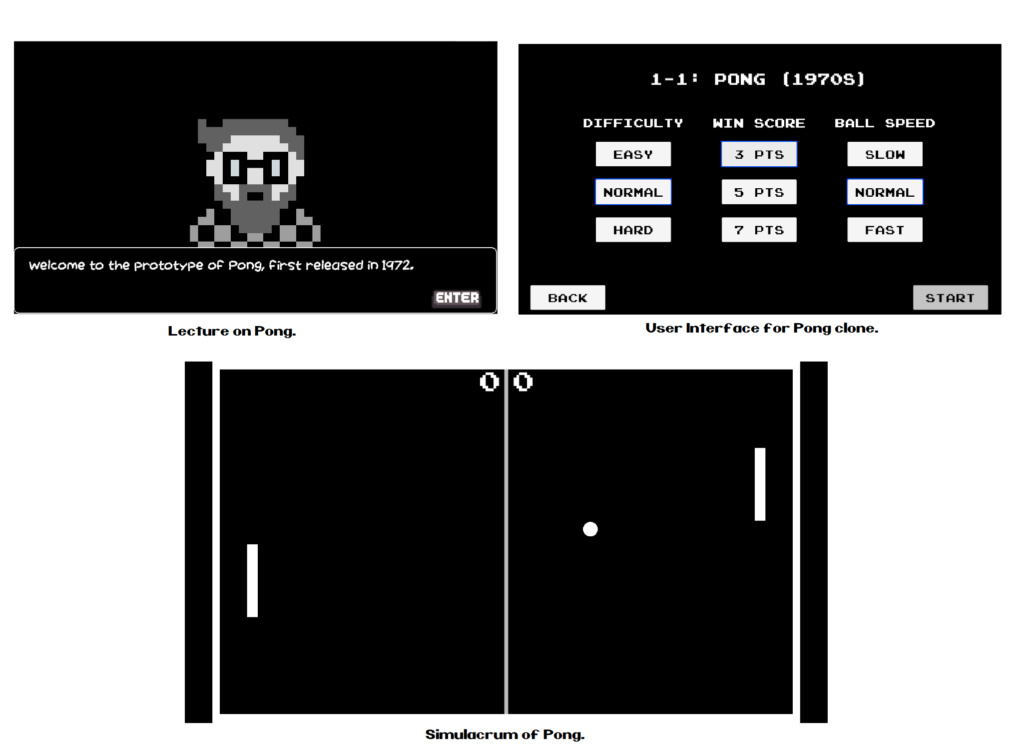
As an example, the History chapter begins in the 1970s with a short lecture on early video game prototypes before focusing in on Atari’s Pong (1972), a game that has had an undeniable cultural and historical legacy on the development of video games. Next, players are able to play a simulacrum of Pong to understand its affordances in a playable format, rather than seeing the game in static images within a book. To complete the level, they must beat the computer AI in a round of the simulacrum, demonstrating their knowledge of game history (though, players do have a choice of Easy/Medium/Hard to account for player skill level). Once completed, players move on to the 1980s, and so on.
Screenshots from the History chapter of Level 101
Developing Level 101 consists of script-writing, programming, object connections, playtesting, and revising. The DH Summer Seed Grant allowed me to purchase playtesting hardware in the form of a USB controller; this has allowed me to playtest the game for different game consoles, whereas I was previously only able to playtest the game for web interfaces. This expansion is valuable as it allows for reaching a potential of reaching larger audiences, particularly ones outside of the academic sphere.
One major outcome of this project is to push the boundaries of digital research and alternative scholarship; thus, my aim was to develop this project for publication, particularly in a digital environment.
I am very fortunate and humbled to say that this project has been submitted to and accepted for publication within a forthcoming edited collection on game historiographies. Due to the hybrid nature of this edited collection, I am currently working with the editors to present a playable portion of the game as the article itself, taking advantage of the digital medium to actually include not just a post-mortem textual report, but a playable section of the game itself as the scholarship. I plan to update this report with a dedicated link to the publication when it becomes available.
Initially, I planned to submit this project to the Serious Games conference Meaningful Play, held biannually at Michigan State University. This conference is a seminal event in the field of game studies due in no small part to the critical work done by scholar-creators sharing game demonstrations at the event. Due to COVID, this conference has been moved to 2021, and I plan to submit the project at that time.
To fill the void of Meaningful Play 2020, I participated in the 2020 Digital Pedagogy Lab in July, held virtually for the first time. This event brings together educators from various fields and approaches together around different workshop tracks; I participated in “PreK-20 Recess: Play in the Time of Pandemic,” a workshop centering conversations around the notion of play (central to my dissertation) and what that might look like in the current moment. Alongside these conversations, we also workshopped our project, allowing me to not only share this project with further communities outside MSU, including K-12 educators and scholars in different fields, but shape it based on their feedback.
One primary limitation to this project is that my expertise lies outside the realms of asset creation. However, through the allocation of grant funding, I was able to rely on Unity’s preexisting game development ecosystem. Within Unity, games are created with a combination of C# coding, hooking up the C# scripts to in-game objects, and then utilizing Unity itself to generate interactions between those objects and the environment. Those in-game objects are Assets, which are audio and visual items, including character sprites or expansive environment visuals, background music or simply just a “Plink” sound effect for a ping-pong ball hitting a boundary. Assets can be built from the ground up, but this requires specialization in this skill and encourages collaboration, a process not viable within the individual confines of a dissertation project. However, Unity’s ecosystem encourages uploading of game development assets for use within Unity; if a user wants to use somebody else’s premade low-polygon dinosaurs in their game, a one-time license purchase is required, and that asset can be used in any Unity project.
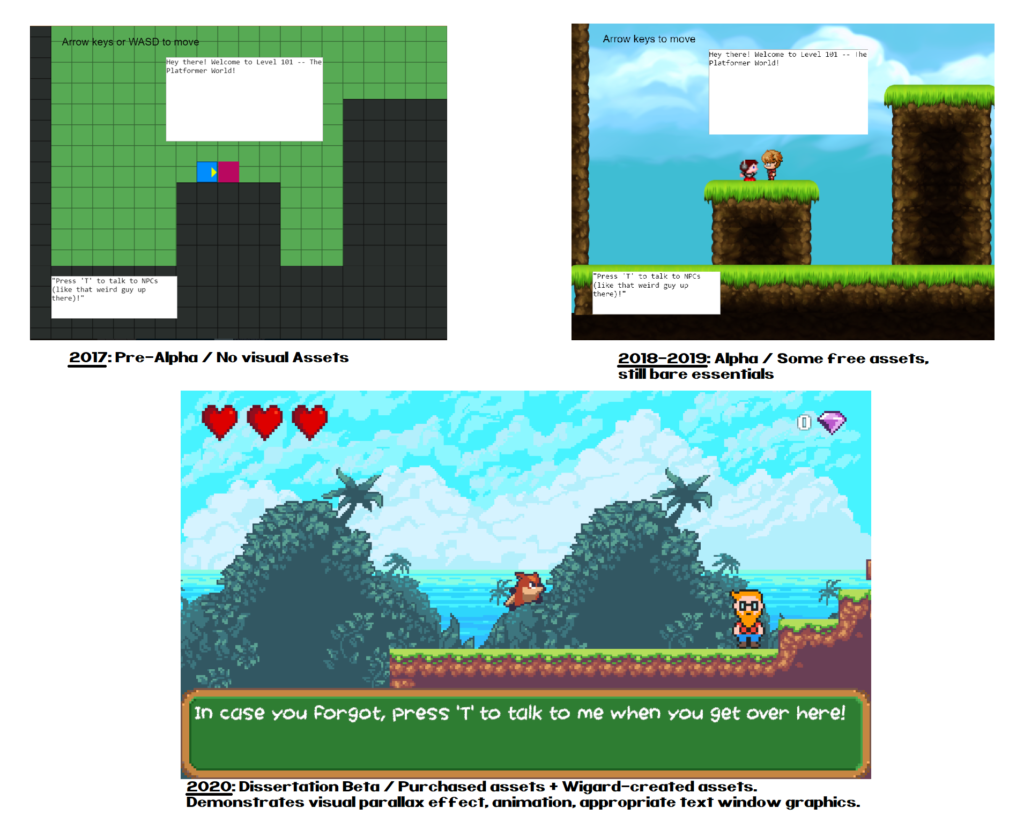
Thus, I have used a portion of the grant to purchase much-needed audio and visual assets to develop these chapters in the form of game frames, character sprites, and sound effects/songs. Shown here are images of what a level from chapter 2 looked like in pre-alpha with no assets, from 2018 and 2019 with some visual assets, and most recently in its final stage.
Evolution of Level 101 assets over time
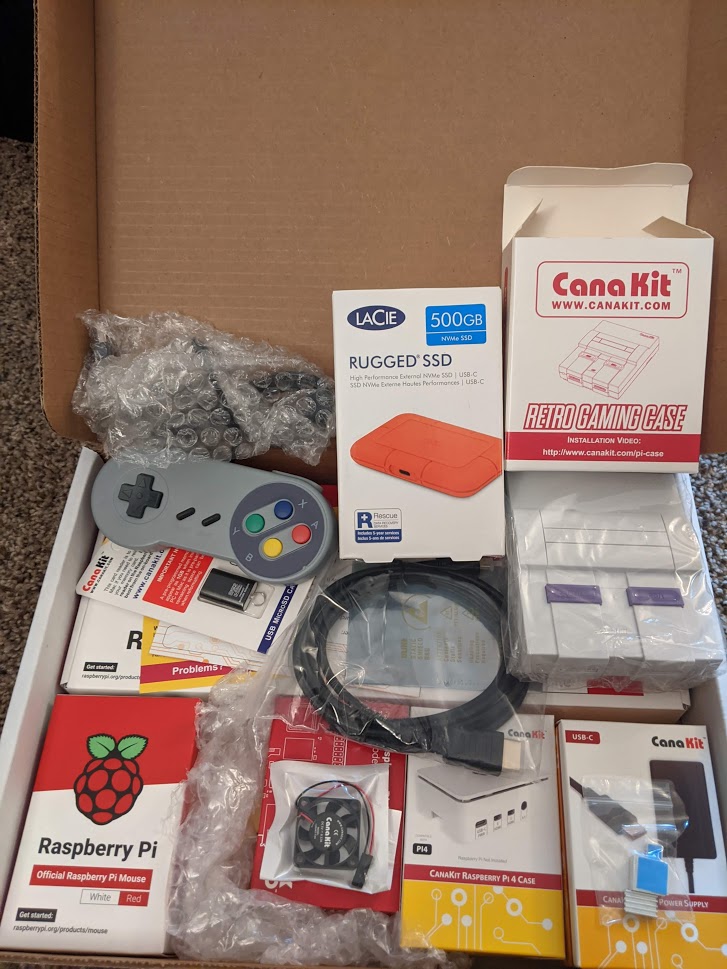
One outcome of the grant has been the purchase and acquisition of a Raspberry Pi 4 computer and related external storage. Over the last few months, I have been working to develop and house my dissertation on this portable computer with the intention of archiving a hard copy of the project for preservation. Due to the issues of digital decay and fragile webspaces, particularly with a game project that is intended to evolve and grow over time, I want to preserve Level 101 on a powerful miniature computer dedicated solely to this digital dissertation.
Raspberry Pi 4, Case, Controllers and External SSD
As a result of my participation in the 2020 Summer Data Visualization Institute, I have also been working with Terence O’Neill on a public exhibition of Level 101 utilizing the affordances of the 360 Room within MSU’s Digital Scholarship Lab. Again, this effort has been delayed somewhat due to social distancing and COVID-19, but I plan to host this exhibit in Spring 2021. One unexpected outcome therein is that Terence and I have been working to think through the possibilities of what a digital exhibit built around a playable game might look like using this visualization technology.
Lastly, I am excited about the prospect of finishing this digital dissertation. My ongoing conversations with DH@MSU communities and external parties have contributed greatly to the development of this project over its lifetime, as have the 2018 and 2020 DH Summer Seed Grants. The goals are to continue deploying this project to my future classes, present this work at Meaningful Play 2021, and defend this digital dissertation in Spring 2021.
Using breakout rooms, we will have 3 short meet and greet opportunities. This means that groups of 4-6 will be gathered in a breakout room to introduce themselves and answer a question prompt for ~7 minutes and then will be reshuffled into another room for ~7 minutes with different people.
Sessions
Over the course of the day, there are three different session sections, of slightly varying length (75 minutes, 60 minutes, 45 minutes). During each of these session times, there will be up to 4 concurrent sessions running that participants can choose among.
These sessions will be proposed or requested by THATCamp participants at the time of registration or via email after registration but before the day of the event.
Session types may be:
Workshop – one or more people teach about a particular tool or method
Discussion – one or more people lead a discussion on a method, topic, or issue
Show and Tell – an individual or group showcases a project and explains how it was created, what went into it, including the technology, etc (this type of session may also group together 1-3 project show and tells)
On the morning of THATCamp, participants will be asked to vote for the sessions that most interest them, and the sessions with the most votes will be slotted into the schedule.
Immediately after the voting, participants will be asked to fill out a form, signing up for the sessions that most interest them throughout the day.
DH Project Showcase
Opportunity for participants to share out about a project (or projects) at any stage of development through very short (60 second) lightning presentations.
Participants are encouraged to sign up in advance to share out about projects through the registration form.
Technology and Communication
Zoom
THATCamp will take place on Zoom. The meeting link and information will be sent via email to registrants in advance of the day.
When you go to the Zoom meeting room, you will first enter a waiting room and then will enter the main Zoom room when THATcamp begins. By default, your video and microphone will be turned off/muted, and you are welcome to turn them on/unmute as you prefer throughout the day. We will all convene in one room throughout the day, and we will use breakout sessions to facilitate the concurrent workshops/discussions. There will be moderators available throughout the day and in each breakout room to assist with technical issues and Zoom questions.
On Tuesday, August 25, 11:00am-12:00pm, we will hold a Zoom test time. This is an opportunity to join the THATCamp Zoom meeting in advance of the day to become familiar with Zoom and to check that your microphone (etc) setup works as you anticipate. Please drop in at any point in this hour to say hi, test your setup, and ask questions!
Slack
In addition to using Zoom for the videoconferencing portion of THATCamp, we strongly encourage all participants to join and engage in discussion and information/resource sharing on the MSUDH Slack group. Please sign up if you haven’t already at https://msudh.slack.com/signup#/.
If this is your first time signing up, you’ll be added to several “channels” when you first join, including the #thatcamp channel. The #thatcamp channel will be where we talk about the event and share resources, but we encourage you to explore the other channels as well!
Unlike zoom, chat that happens in Slack will still be accessible after the event, so if you want to share resources with the community or revisit a conversation, you’ll be able to do that. We look forward to seeing you there!
In the summer of 2019, the DH@MSU Summer Seed Grant enabled Ryan and Matt to build the code for prototype visualizations of archival data of German-Jewish intellectual correspondences during the Weimar Republic. This work is part of a larger, ongoing project, also funded by a Digital Humanities Fellowship from the Research Association Marbach Weimar Wolfenbüttel, to map the social networks that constituted German-Jewish intellectual life in the early twentieth century, especially those networks surrounding liberal-democratic newspaper the Frankfurter Zeitung and the philosopher, journalist, and later film critic, Siegfried Kracauer.The thesis of this project adapts, for research into German-Jewish history, an ability that German-Jewish intellectuals like Kracauer located in technology in the first few decades of the past century–the potential to render the dynamic forces of history legible by focusing the critic’s analytic gaze on its most ubiquitous and, hence, seemingly unimportant details.
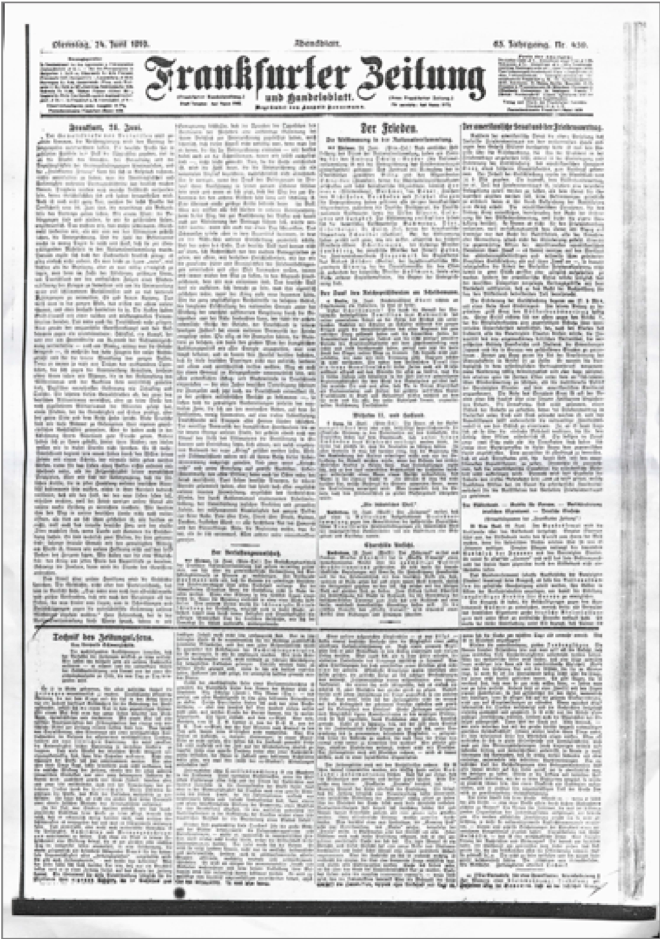
Figure 1: Providing commentary on politics and culture, the feuilleton was located under the solid black line about a third down the page, here of the Frankfurter Zeitung
The idea to use digital methods and archival data to visualize German-Jewish intellectual history arose in Matt’s work on his dissertation and, later, on his first book, The Mathematical Imagination: On the Origins and Promise of Critical Theory (2019). While parts of this digital project have appeared –namely, those exploring the archive of Franz Rosenzweig, a philosopher, translator, and co-founder of the Frankfurt Lehrhaus–these were largely limited by barebones visualizations. The goal of Ryan and Matt’s summer collaboration was, hence, to build more robust and dynamic visualizations which would be accessible online to scholars and students of German-Jewish history. During the summer of 2018, Matt worked in the German Literary Archive in Marbach am Neckar to develop a method to capture and refine the archival metadata that provide the foundation for the project. The Summer Seed Grant from DH@MSU allowed Matt and Ryan to collaborate during the next summer and create new visualizations for the German-Jewish archival metadata using the javascript library, D3,js. The rest of this report will explore some of the theoretical and practical concerns that guided Ryan and Matthew’s thinking while creating the visualizations and discuss the outcomes of this work for their future research.
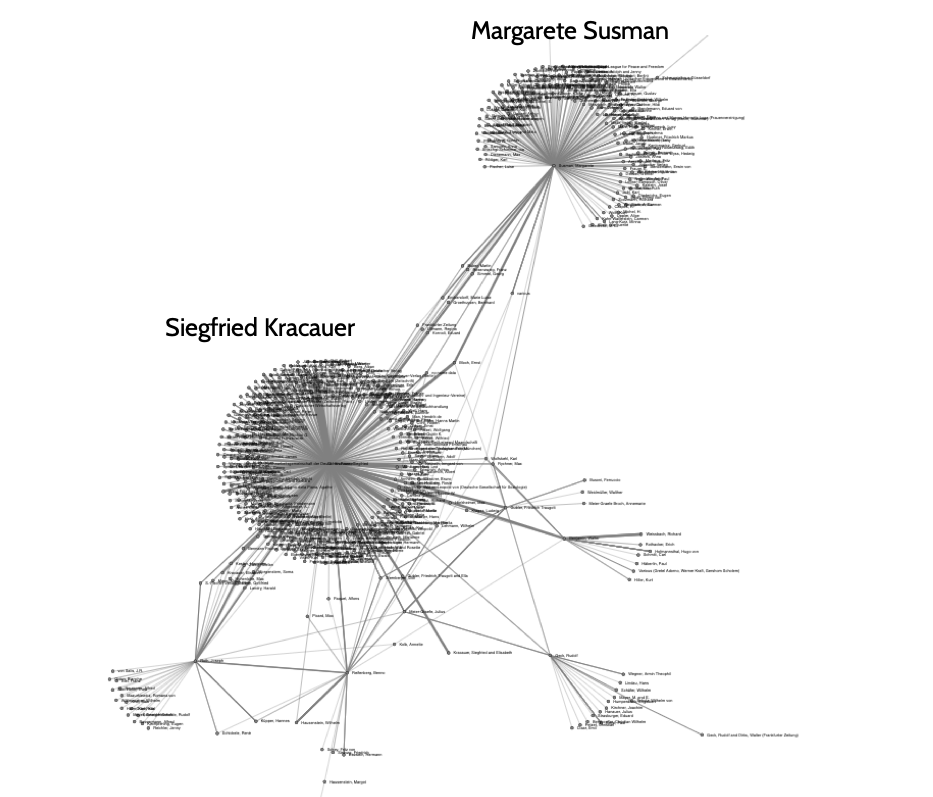
Our work on visualizing the networks around the Frankfurter Zeitung was guided by a number of questions that seek to expand contemporary perspectives on German-Jewish intellectual history. One of the main questions is how German and German-Jewish intellectuals interacted with each other and how German-Jewish thinkers interacted amongst themselves. Was this interaction widespread or mediated between a number of pivotal figures? To what extent can we draw historical conclusions from archival metadata that often reflects the precarity and disruption of German-Jewish life the twentieth century? Ultimately, this work is motivated by the belief that it holds the potential to help address the work of figures and voices traditionally elided in the writing of German-Jewish history: “A better understanding of the social networks that informed and propelled” German-Jewish women such as Hannah Arendt and Margarete Susman, the historian Nils Roemer writes, “might indeed improve our insight into the social process by which ideas circulated.” Data mining and data visualization help us reconstruct these social networks to the extent that the archival record allows.
Figure 2: Network including the data from Siegfried Kracauer and Margarete Susman’s archives as well as those data from other editorial staff
The project consisted of three main tasks: creating a method to harvest data, coding the graphs in D3.js, and plotting sample datasets. Before we move up a layer of historical abstraction, it is important to remember the limitations of the data and the graphs made from them. Their ability to provide reliable information about the configuration of German-Jewish correspondence networks in the early twentieth century is proportional to the question of how representative the metadata are of the archival holdings and how representative the archives are of historical experience–one marked by disruption and diaspora of both humans and objects. The answer, and one that needs further theorizing, is somewhere between 0 and 1. The imagination of a network that perfectly captures the intellectual past participates in the same venture that Kracauer ascribed to photography in 1927: “the go-for-broke game of history.”
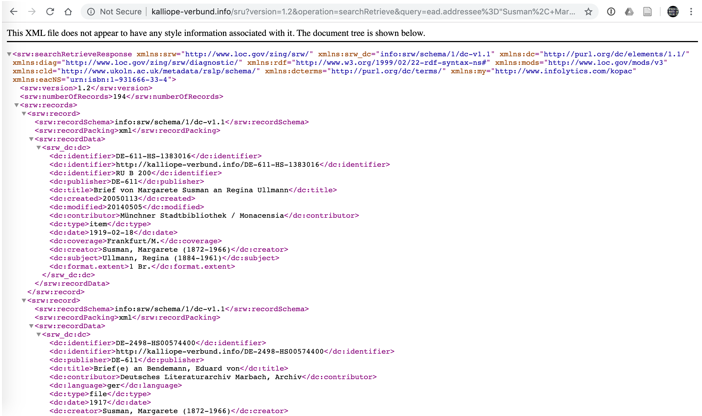
Figuring out how to collect archival data proved to be harder than first expected. Most libraries and archives do not provide an API to access their collection database, leaving researchers to scrape the data manually from catalogs, finding aids, and the like. One way around manually gathering the data or writing code to scrape from online library and archive catalogs (to the extent they exist) was through the Kalliope Association, which aggregates data from institutes across Germany, Austria, and Switzerland, including the German Literary Archive (Deutsches Literaturarchiv). Much of Matt’s summer in 2018 was spent figuring out how to access Kalliope’s metadata through the XML protocol Search/Retrieve via URL (SRU). Accessing Kalliope required constructing searches in Contextual Query Language (CQL), consistent with the Encoded Archival Description (EAD) standard employed by the search engine. For instance, the query:
returns in DublinCore format all documents classified as letters (“Briefe”) created by or addressed to the name “Kracauer, Siegfried” that have a date between 1918 and 1933 (inclusive)–a search that returns the data of 490 letters and correspondences.
Figure 3: Example output of XML-Metadata from the Kalliope system
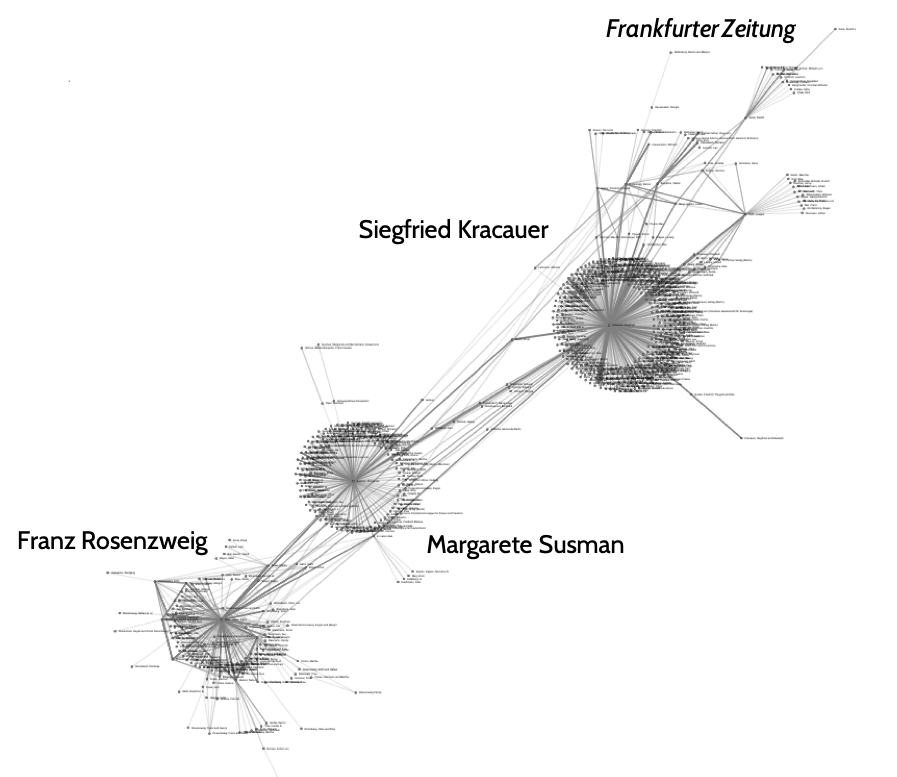
Another challenge was transforming the data into a mangable format. Kalliope offers their data in either DC or Metadata Object Description Schema (MODS) formats. Although easier to manipulate, DC data had the drawback that it cut off data that used a corporate names (such as the name of a publishing house like the “S. Fischer Verlag”) as creator. Using a more descriptive format like MODS worked but proved to be a circuitous strategy to gather data: the hierarchical MODS format had to be flattened with an XML script written by MSU Libraries’ Lucas Mak but still, after much experimenting, proved easiest to use in tandem with OpenRefine when converted into the JSON format. The data used as a beta version to create the prototype visualizations included Matt’s archival work from the summer of 2018 on the feuilleton at the Frankfurter Zeitung–an arts, culture, and politics section immensely popular in the nineteenth and twentieth century. These data stem from the editors and authors of the feuilleton at the Frankfurter Zeitung and were expanded with data from a previous project, “Digital Humanities as Translation: Visualizing Franz Rosenzweig’s Archive” in order to test the graphs with more complex data sets. The two networks include data from the following sources:
Feuilleton at the Frankfurter Zeitung
Frankfurter Zeitung and Frankfurt Lehrhaus
Benjamin, Walter Geck, Rudolph Gubler, Friedrich T. Kracauer, Siegfried
Reifenberg, Benno Roth, Joseph Susman, Margarete
Benjamin, Walter Geck, Rudolph Gubler, Friedrich T. Kracauer, Siegfried Reifenberg, Benno Roth, Joseph Rosenzweig, Franz Susman, Margarete
Figure 4: The data in Figure 2 plus data from Franz Rosenzweig’s archives
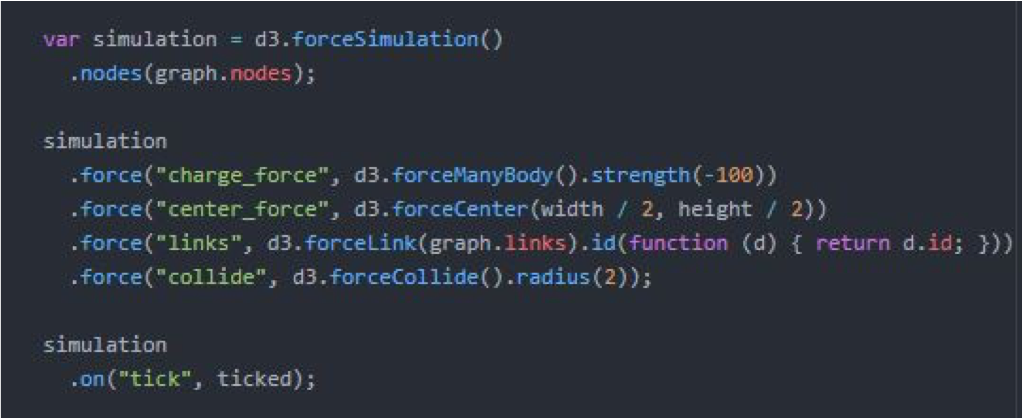
The complex data sets were transformed into web-based social network visualizations with D3.js, a JavaScript library. The visualizations were created as force directed graphs, which use physics-based principles to display the relationships between people in the network. The prototype visualization was built on GitHub to facilitate collaboration between Matt and Ryan. The visualizations contain several interactive features that allow users to engage with the connections between the people in the network. These features include drag, zoom, tooltips, and labels. The drag and zoom features allow users to move the people in the network to different locations in the viewing window, while also zooming into and out of the clusters. The tooltips and labels display the data connected to each of the nodes and their links to other notes in the force directed graph. Accessory features were added to the visualization to enhance the user’s ability to work with the data. Connections between individuals were drawn with curved lines and arrows to illustrate who sent and received letters. Moreover, the width of the lines was calculated as the square root of the number of letters sent between the two people. The color of the line represented the archive in which the materials are deposited. The prototype visualizations built on GitHub could then be connected to either data set to display as a web-based social network visualization.
Figure 4: Sample D3 data
Ultimately, Ryan’s work on the social network visualization relates to his dissertation research in the history department, where he focuses on commodity histories in West Africa. Ryan first used D3.js to construct data visualizations as part of the Cultural Heritage Informatics (CHI) fellowship. He built visualizations of nineteenth century and twentieth century trade data on commodity exports from Africa to Europe. In future, Ryan plans to build on his experience in this project to explore the social networks of traders in West Africa in the early twentieth century. These networks are important for understanding the changing dynamics of internal trade during the colonial period in African history.
These prototype network graphs and their code provide Matt with more solid foundation from which to explore the intellectual networks of German-Jewish history. At this point, the next task is to expand the dataset to include a more diverse and representative group of German-Jewish intellectuals and authors, such as Hannah Arendt, Martin Buber, Käthe Hamburger, and others. In the meantime, the prototypes that resulted from Ryan and Matt’s work during the summer of 2018 offer a few hints of the social structure of German-Jewish intellectual life between the wars. In figure 4, we see that Susman and Kracauer serve as intermediaries between the group around Rosenzweig and the staff of the Frankfurter Zeitung. For instance, the path from Martin Buber, one of the era’s most prominent Jewish philosophers, to a major news venue like the Frankfurter Zeitung runs here through Susman and Kracauer. Perhaps the German-Jewish dialogue before the Second World War was less a mass phenomena of inter-faith debate than a selective conversation mediated and regulated by a small set of individuals.
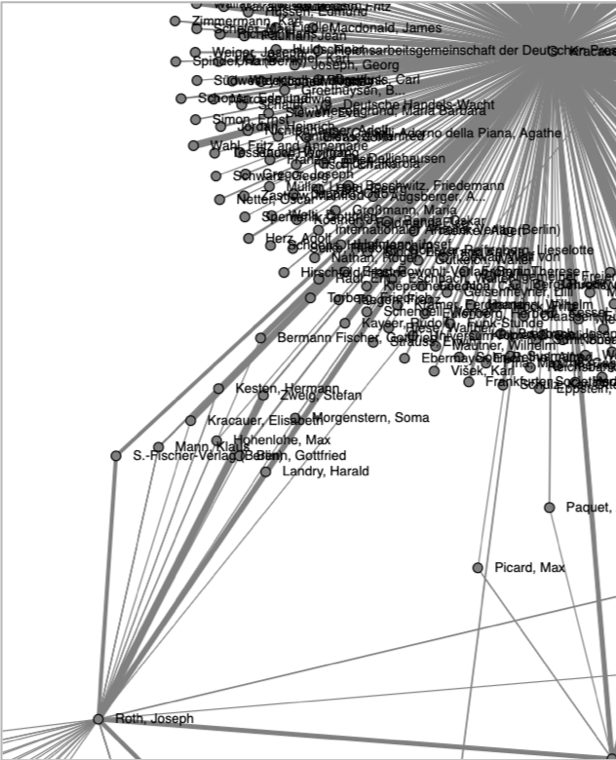
Figure 4: Literary clique between Joseph Roth and Kracauer
Another feature that pops out especially in the preliminary network focused on the editorial staff of the feuilleton of the Frankfurter Zeitung are the cliques surrounding certain individuals. For instance, between Joseph Roth, an Austrian author and regular writer for the Frankfurter Zeitung, and Kracauer we find a distinctly literary group, including authors like Klaus Mann and Gottfried Benn. Likewise, we see a cluster of authors, editors, and publishers in the orbit of Kracauer and the feuilleton’s editor in the early 1930s, Friedrich T. Gubler–Dolf Sternberger, Marx Rychner, and Julius Meyer-Graefe. Since the feuilleton rarely published materials from anyone not directly connected to the newspaper, author-editors like Roth and Kracauer controlled access to the feuilleton’s editors for outside authors at the newspaper, even those better-known today like Benjamin. These networks show a small but not insignificant sliver of the intellectual constellations that shaped the cultural debates of the Weimar Republic.
Beyond Ryan and Matt’s individual research, we see here that, even as the interconnectedness of the current world may appear the result of the digital revolution, interconnectivity, social networks, and key nodal figures were already salient aspects of German-Jewish intellectual life in the early twentieth century. Perhaps gathering and thinking through more data can help us not only create a better historical image of this past, but also better understand the circulation of ideas and their effects in the present.
The
funding that I received from the Digital Humanities program helped support my
attendance at the European Summer University in Digital Humanities at the
University of Leipzig, where I completed the 2-week course on Humanities Data
and Mapping Environments, and supported some of the cost of James Madison
College student team members attending HILT course on Getting Started with
Data, Tools and Platforms (which I attended along with Michael Downs and
Bridget McBride), as well as ILiADS (which I attended along with Michael Downs,
Sofia Cupal and Ryan Lumsden, and we were joined by a colleague from Harvard,
Nargis Kassenova as well). In addition
to the funds that I received from the DH program, part of the costs of this
training was covered by James Madison College, and part was covered by my
personal funds. In addition to some
funding from JMC, I also helped support Michael Downs’ costs at ESU, where he
also completed the course on Humanities Data and Mapping Environments.
The
training that we received was really invaluable. At the end of the training at
HILT we made the decision to develop a prototype of the website using a
combination of two platforms (Esri Arcgis StoryMaps, and Omeka S). One of the major arguments for choosing
StoryMaps (Beta) for our front end is that it has good Russian language
compatibility. We also selected Abbyy
Finereader for OCS because of the strong Russian language support and
comparative accuracy,
We spent
our time at ILiADS, where we worked under the direction of Jenna Nolt, a
Librarian at Kenyon College learning to work with both StoryMaps and Omeka
S. And by the time we left ILiADS we had
done our first story, and we had begun populating Omeka S with our back-end
materials, using Dublin Core for our meta-data. The students who attended
ILiADS all continue to work on the project, and have responsibility for
specialized tasks (Sofia Cupal for Omeka (and has already trained an
“assistant” to work with her)
While at ESU we learned more about other mapping options for the project, which we are likely to try and implement at later phases of the project, assuming we continue to be able to grow the project. We plan to continue to use the current combination of platforms for another 6-18 months, depending upon our speed of progress in populating the back-end archive and whether we are successful in our efforts to secure enough funding to allow for expanding our student led team and to pay for some advice from a professional web-site developed.
While
our plans could obviously change, for now we are thinking that our intermediary
stage should involve migrating the project fully to Omeka-S, with a front-end
designed with some outside advice. We think that this would make the site more
user friendly once we begin our crowd-sourcing efforts. And if we are able to develop a readership
for our site through crowd-sourcing,
then we would hopefully be able to attract enough funding to hire a developer
to help us rebuild and relaunch the site using a platform of our own creation
that would meet the unique needs of our project.
For
now the combination of Story Maps and Omeka-S is working well for us. I was
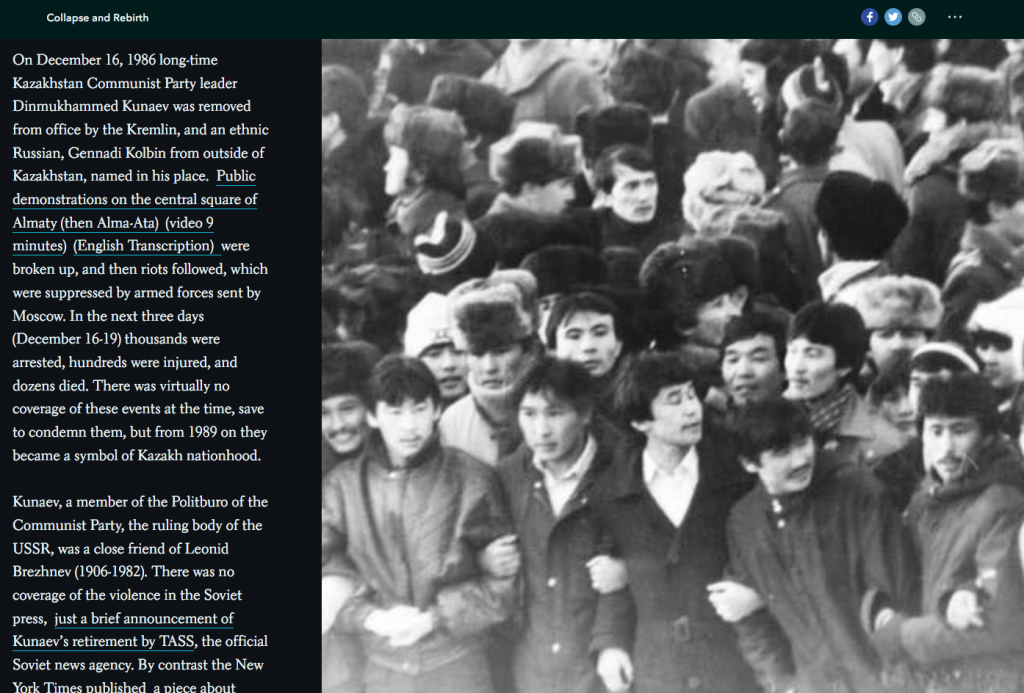
able to present this first story at ESU, where I showed our first story on
“Zheltoksan: The December Events in Kazakhstan (1986).” While at ESU I also was
a speaker on a panel discussion on “Responsibilities of Digital Humanities.” My time at ESU was also very beneficial in
helping me develop contacts with people working in the area of digital
humanities in Russian language contexts.
I hope to continue to expand these contacts during my planned stay at
University College London School of Slavonic and East European Studies where I
have been awarded a 3-week visiting fellow slot to work on this project in
February-March 2020.
I currently have a team of 10 students working with me, including 2 sophomores and 3 juniors, and we will try and recruit more sophomores and juniors during spring semester as we begin to phase our seniors out. Each brings language or technical skills, and some bring both. We hold team meetings each Friday, and my JMC office has been turned into something of a laboratory, with our IT person giving us 3 additional computers, a scanner and a printer (as well as a number of office keys allowing for individual team member access). We also have created a 10 member advisory board, who we try to at least periodically apprise of our progress.
We
currently have a prototype that includes a main narrative story, and the
beginnings of 15 separate stories (one for each Soviet republic), all supported
by the same Omeka-S backend. Our goal will be save all of the stories by
republic in their respective republic “stories” including those that we have
singled out as of particular importance which are in our main narrative as
well.
A group of 7 students travelled with me to the Central Eurasian Studies Society annual meeting in Washington DC, where we presented our current prototype on October 12, 2019. The presentation they gave is available here.
The
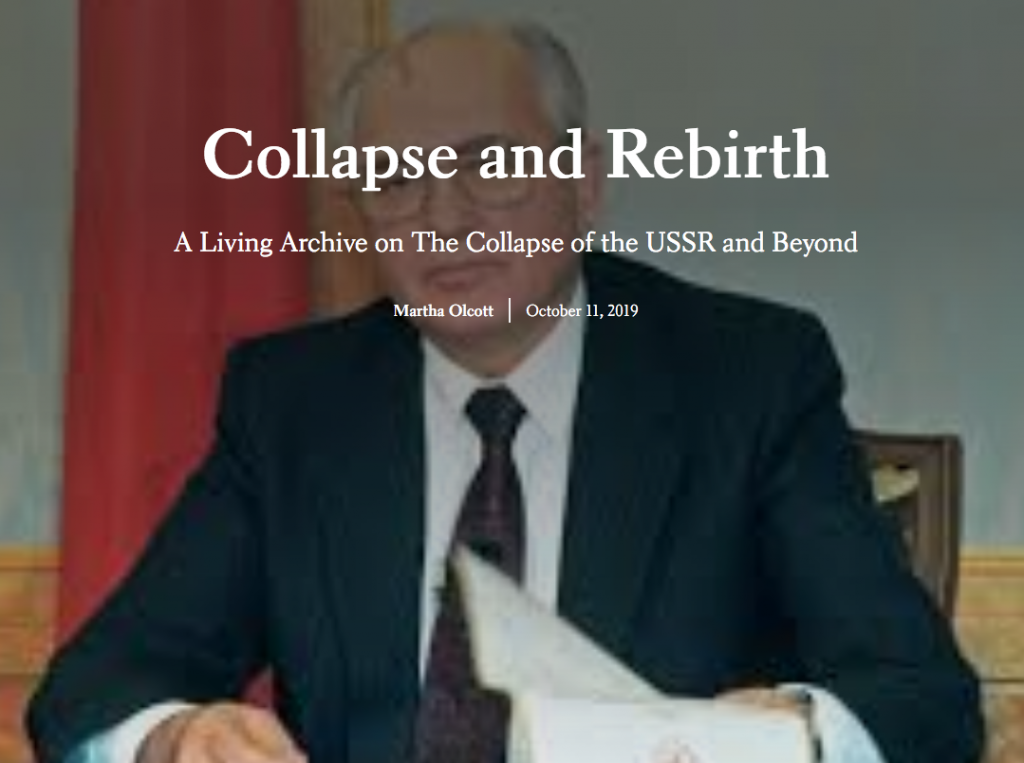
website opens with video of Mikhail Gorbachev’s announcing the end of his rule
and of his country, followed by an introductory narration and 5 key events in
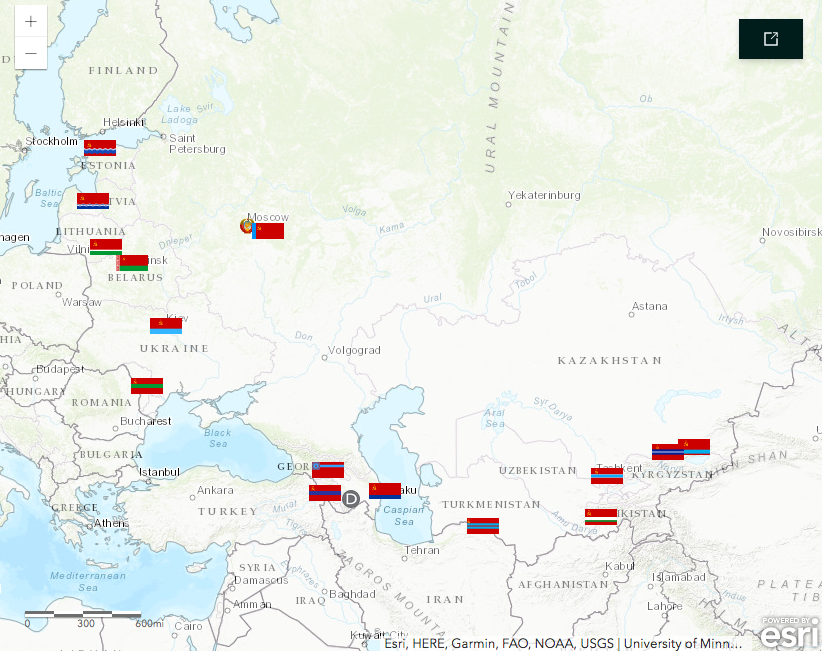
the history of the period: “The December ‘Zheltoksan’ Events” (Almaty,
Kazakhstan, 1986);“ The April 9 Tragedy” (Tbilisi, Georgia, 1989); “The Fergana
Events” (Uzbekistan, June, 1989); “Black January”
(Baku, Azerbaijan, 1990); and “The January
Events” (Vilnius, Lithuania 1991).
We are hoping to do more different kinds conference presentations over the next 7-8 months. We have applied to do a poster and a lightening talk on the fight for national language rights at DH 2020 in Ottawa, and are applying to also present some of this material at MSU’s Global Symposium in March. And the students are applying to do a panel at an undergraduate session that is part of the Midwest Political Science Association meetings in April. The presentation at this meeting will focus on materials from the Congress of Peoples’ Deputies, a partially popularly elected body that both served as a platform for democratization and also hastened the USSR’s demise through the revelation of the deep fissures within the country. We hope that this will serve as a prototype for a presentation in August 2020 at the International Council for Central and East European Studies in Montreal.
In
addition we continue to digitize archival materials and narratives for a number
of other key localized events with long term impacts including: Novyi Uzen riots (Kazakhstan, June 1989); Kishinev events
(Moldova, November 1989); Dushanbe Protests (Tajikistan, February 1990); and
the Osh events (Kyrgyz Republic, June 1990). Finally we are developing
narratives that link to existing resources (included in Appendix X) which
highlight the ‘Baltic Wave,’ a human chain joining peaceful
demonstrators in Estonia, Latvia, Lithuania, on 23 August 1989, the 50th
anniversary of the signing of the Ribbentrop Molotov Pact. We also are
digitizing materials on
Karabakh
Conflict between Armenia and Azerbaijan (1988- 1994, when a cease fire
agreement was signed); Georgia’s conflicts in
Abkhazia and South Ossetia; the Conflict
in Chechnya (1991-1994, also known as the First Chechen War); Tajikistan’s
Civil War (1992-1994, though fighting continued until the National Reconciliation
Agreement in 1997); and Transdniestria’s War (Moldova 1990-1992).
In
addition we are doing bibliographic work to link our project to existing
websites and digitized materials on early political movements in the national
republics: the Popular Front of Estonia (1988-1993), Sajudis (the Lithuanian
movement 1988-1990), and the Popular Front of Latvia (1988-1990); in the
Western Republics: the Popular Front of Moldova (1989-1990), Belorussian
Popular Front “Revival” (1989-1993) and “Rukh”, Ukraine (1989-1990) and its
Human Chain connecting Kyiv to Lviv in 1990; the Roundtable – Free Georgia”
alliance (1990-1993), the Armenian National Movement (started 1990), and the
Popular Front of Azerbaijan (1989-) in the South Caucasus; and Nevada-Semei anti-nuclear
movement (Kazakhstan, 1989-1991), the Democratic Movement of Kyrgyzstan
(1989-1990), the United Tajik Opposition (during Tajikistan’s Civil War) and
the Birlik and Erk movements in Uzbekistan.
We are also looking at materials on the economic and environmental
catastrophes that increased the public’s sense of government incompetence (such
as Chernobyl in 1986, or the Armenian earthquakes in 1988, which spurred
different kinds of political protests, including industrial strikes.
We recognize
that we can’t do everything at once, hence our interest in slowly chipping away
at the materials we have at our disposal, working with members of our advisory
to try and identify and “save” appropriate materials for future digitizing. And
we intend to keep trying to arrange conference presentations of our work, to
maintain a strong incentive system.
The primary goal of this
project is to span best practices in oral history research and archaeology,
while promoting the public outreach missions of both Campus Archaeology Program
(CAP) and MSU. The project began with a series of interviews with the founder
of CAP, Dr. Lynne Goldstein, followed by the creation of an accessible,
public-facing web presence from which to share the oral history and media
documentation of twelve years of CAP. The DH@MSU Seed Grant funded the project
team’s research assistant to transcribe the audio interviews for better
accessibility.
This project draws on the researchers’
existing collaborations at MSU: A.L. McMichael is the Director of LEADR (The
Lab for Education and Advancement in Digital Research) and a DH@MSU Core
Faculty member. The lab is part of the History and Anthropology departments,
and its mission is to incorporate digital methods into the curricula of these
two disciplines for student research. Autumn Painter is a PhD candidate in
Anthropology, the current Campus Archaeologist, and a former Graduate Assistant
in LEADR. This project utilizes the contexts that are unique to working in
these two disciplines.
The timing of this project coincides with Professor
Lynne Goldstein’s retirement from MSU in 2018. Her contributions to CAP and to
archaeology in the larger sense are well summarized by her faculty page on the Department
of Anthropology website:
“Dr. Goldstein retired from MSU in August 2018 and now holds emerita status. At Michigan State, she developed and led the University’s innovative Campus Archaeology Project, persuading University leaders and grounds people alike that documenting the campus’s history through archaeological investigation was a valuable and significant undertaking. As Lynne has frequently advised, one should never undertake research without clear research questions, and in addition to providing countless students with field training and community engagement opportunities (as well as financial support), her work on the MSU campus has contributed significantly to the study of 19th and 20th century midwestern US history and the growth and significance of US land grant universities. An early and enthusiastic adopter of new technologies, she also has played a critical role in the expansion of digital humanities initiatives in archaeology. She is a generous teacher and mentor, with an uncanny ability to cut through academic jargon and pomposity to help her students identify big questions and address them rigorously and clearly.”
As researchers, we
realized that her stories and experiences are an important part of the program,
and recording them would be a lasting contribution to the history of MSU. We
also use this project to argue more broadly that oral history and archaeology
are a natural pairing in terms of both methodologies and topics. As
researchers, we are uniquely poised to explore this via CAP and LEADR.
This project can serve as a
case study for similar programs wherein oral history may serve as both valuable
“grey literature” in recording unpublished archaeological data, as well as
outreach to wider publics. Field notes, white papers, and informal data
recordings are all important aspects of archaeological digs and projects that
don’t necessarily carry the same “weight” as monographs; yet, they offer
insight into the social and historical contexts of the archaeologists
themselves. Blogs are one type of public-facing work that incorporates the
of-the-moment and personal perspectives of archaeologists into the disseminated
record of a dig or project. We argue that oral histories are another genre of
publication that should augment traditional publications in recording the
historiography of archaeological projects, teams, and sites.
Methodology
We would like to emphasize that this is still a
work in progress as of Fall 2019. However, the website is public and we will
roll out new features as the work progresses. The public-facing web presence is
at this URL: http://oralhistory.campusarch.msu.edu/ We
divided the interviews into “chapters” in order to break the data into smaller
sections and allow listeners to engage with sections that appeal to them. The
website is part of CAP’s web presence, which is hosted by Matrix.
In terms of interview
methodology, the audio interviews were recorded in LEADR’s A/V studio. We had
three microphones: a Zoom Handy Mic used in fieldwork, a Yeti desk microphone,
and a backup on Autumn’s iPhone. We used open source Audacity software on a
laptop to record and edit the data.
Rather than trying to
capture all of Lynne’s stories at once, we scheduled several conversations to
speak with her in person. We started with a list of broad categories that
seemed pertinent to historical research, and left the interview questions
open-ended enough that Lynne could help shape the narrative. Some example
research questions include these:
● “Start with a little bit about the origins or the beginnings of Campus Archaeology here at MSU.”
● “What makes MSU ideal for this particular type of program?”
● “Have there been any favorite projects or projects that stand out to you?”
● “Can you give us an overview of the kinds of archaeological jobs that people have gotten after participating in CAP?”
After completing the
interviews, we edited the raw audio in Audacity. We also recorded scripted
ledes to introduce each section. We gave these sections titles using the
metaphor of chapters and divided some into shorter parts to facilitate
navigation and give listeners more opportunities to dip in and out of the
project. Edited audio files are saved as .wav files.
At the beginning of our project, we contacted MSU
Archives about long-term stewardship. Since then, the relationship of Archives
and the Library has changed. The audio is currently hosted on MediaSpace and we
will restart conversations with the Library about stewardship.
Accessibility
It was important to us to make the project accessible, and for the data to be available in multiple kinds of media: audio and text, augmented with photos from the CAP records. A major aspect of this project was creating a web presence that is as accessible as possible. The actions we took to make the project website can and should be applied whenever possible to all digital projects. Each web image has alt-text, which is a brief description that screen readers can convey. We also created a link to a text-only version of the interactive timeline on the website so that people who cannot see the media are able to receive the content in chronological order. Finally, all of the hyperlinks were created as descriptive phrases, rather than generic “click here” to ensure that each one is unique. Most importantly for accessibility the DH@MSU Seed Grant provided funding for research assistant to generate and edit transcriptions of the audio interviews for accessibility.
Research assistant Amber Plemmons is a PhD student in Anthropology and member of CAP. It was great to have a research assistant who is knowledgeable about the program but removed from the interview process. She had a fresh perspective to help in transcribing the audio from one medium to another. Amber started with the automated captions in MediaSpace and edited those while listening to the interviews. She was funded for 25 hours of work, thanks to the seed grant, and she used the entire amount of time. Autumn and A.L. will now produce a “next pass” on the transcripts to get a consistent and final edition of the text.
Transcription Editing: Further Considerations
Best practice in
editing transcriptions is not definitively established. Notably, there are
variations in style among guidelines, especially regarding the copy editing of
verbal tics or representing in text the noises, pauses, and speech patterns of
individual speakers. For instance, historian Susan Emily Allen insists on
replicating the speech patterns directly (“the content of the transcript must
quote the content of the tape.”[1] She
provides some practical suggestions for copy editing such as ellipses when a
speaker does not complete a thought, and extra information in brackets if the
speaker’s dialect or phrasing may need clarification for a listener/reader. She
argues against editing for “clarity” and insists on a literal transcription.
Style guides vary,
however. Baylor University has a thorough style guide (based largely on the
Chicago Manual of Style) with criteria for copy editing transcriptions, and
suggestions such as M-dash for incomplete sentences (rather than ellipses).[2] The Oral
History Association’s “Web Guides to Doing Oral History” is a useful roundup of
guidelines for best practice (among them, the “Oral History in
the Digital Age,” resource developed by MATRIX here at MSU).[3]
While most of these
guidelines pertain to maintaining the integrity of the interview when it is
translated from one form (audio) to another (written text), one of the
lingering questions we have for this project pertains to the way screen readers
pick up various punctuation-based editing, and ways that the voice of the
narrator may or may not be conveyed in transcripts. It is also pertinent to
consider who might use the research in the future: both the original interviews
and a screen reader provide an audio experience, and with a written transcript
available DH researchers could also do text analysis. One of the next tasks we
have is to actually listen to the transcript through a screen reader and
determine whether that translation is able to maintain the integrity of the
interviews as well.
We will continue to conduct research pertaining to
accessibility and transcription of oral histories or conversations through
reading secondary literature or case studies. The plan is to develop a style
guide to use for editing these transcripts that can be used more broadly for
oral history of archaeology transcriptions.
Broader Implications of the Project
Archaeological field
notes are not always consistent or inclusive of all pertinent information. They
also do not usually include origins of programs or projects companies. This
oral history records important information about the Campus Archaeology Program
that has not been extensively documented until now. It also shows the larger
impact of CAP on the University.
As a case study for the
reception of this kind of oral history within archaeology, Autumn presented
this project as a poster at the Midwest Archaeological Conference in October
2019. She fielded a number of questions about the project, and had a steady
stream of inquiries during the two-hour poster session. Based on this positive
feedback, we remain committed to our argument that oral histories are another
genre of publication that should augment traditional publications in recording
the historiography of archaeological projects, teams, and sites.