• Conference Report – Seeing Differently: ImagePlot, Playthroughs, and Narrative Variation

    Conference Report – Seeing Differently: ImagePlot, Playthroughs, and Narrative Variation

    One of the things I appreciate most about HASTAC is how it challenges me to think and work in new ways. I don’t think that’s to be underestimated either–too often the structures of higher education force us into habits and assumptions that reenforce the status quo rather than challenge it, to the detriment of our work and our students. HASTAC pushes against these trends, however, and provides a unique opportunity to reconsider what we do in the light of new perspectives from across the many fields of the Digital Humanities.

    My presentation for HASTAC 2016 was directly related to those new perspectives, and focused on finding different ways of viewing video games. The existing paradigm of video game research largely focuses on either the communities around games or the content within them, and with the latter scholars have focused almost exclusively on close analysis of particular characters, scenes, or game mechanics. The method I proposed at HASTAC builds on ongoing work with Lev Manovich’s ImagePlot (with/advised by David Bering-Porter and Scott Schopieray), and uses distance analysis of game playthroughs to highlight similarity and difference in players’ experiences with games. Ultimately I believe this gets us to a more concrete and specific sense of interactivity in games, particularly the effects of interactivity on game narrative. If we can measure variance in game narrative (however imperfectly), then we can account for difference in player experience in more than just the abstract. I am including a link to my slides from the conference at the end of this post, in case you’re interested in seeing more.

    The importance of networking at HASTAC goes without saying, and as usual HASTAC 2016 brought together brilliant scholars and teachers from institutions like the CUNY Graduate School, UNC Chapel Hill, Yale, UC Berkely, UC Santa Cruz, and many others. When I introduced myself as a Ph.D. student in English at MSU, almost without fail I was met with some variation of: “Oh Michigan State! They’re doing wonderful Digital Humanities work.” I don’t mention this to brag about MSU–though I suppose I’m doing that on some level–but rather to acknowledge the awesome work people in our DH community have done and continue to do. This included great presentations at HASTAC by Mirabeth Braude and Howard Fooksman in WRAC, and you can find more on those presentations in the other HASTAC blogs here. The DH work at MSU is being noticed, and it certainly made me feel honored to call MSU home. I hope we continue to support our DH networks, both in-house at MSU and with other institutions through HASTAC and other organizations.


  • Conference Report: The Land of HASTAC ’16

    Conference Report: The Land of HASTAC ’16
    CiSvFm_UkAAhWqN
    Photo credit: Cody Mejeur!

    The steady dry heat of roughly 100 degrees fahrenheit in Tempe, Arizona may have slowed down our walking and upped our water intake, but it did not alter the participants’ enthusiasm for the 2016 HASTAC (humanities, arts, science, and technology alliance collaboratory) annual conference.

    My HASTAC 2016 journey began with former MSU alum from the Writing, Rhetoric, and American Cultures Department and friend, Allegra Smith picking me up from the airport. Not long after, we met up with current MSU student Howard Fooksman to discuss, over margaritas and tacos, leading the HASTAC scholars unconference day the following afternoon. Divided into  three breakout sessions and one synthesis session at the end, the unconference kicked off with scholars from around the world collaborating and connecting over topics such as:

    • Pedagogy within digital humanities
    • DH Labor / Grants / Job Market
    • Public Humanities
    • Data Visualization and Big Data
    • Tools & Tech

    Some of the take-aways from these discussions were: allow students to do self-assessment on digital skills they offer to projects, teach process and not product, provide students with platforms they feel comfortable using in digital spaces (some suggested tools https://hypothes.is, https://ant.umn.edu, http://futureofthebook.org/commentpress/). Furthermore, some of the keys to being in this field were to make one’s work public, create interdisciplinary projects that are recognizable in different fields for various grants and opportunities, as well as staying focused on the importance of one’s digital humanities work (i.e. https://www.hastac.org/groups/university-worth-fighting).

    One of my favorite conference sessions was “Speculative Classroom Design: What’s Your University Worth Fighting For?” During this session lead by Cathy Davidson, Michael Dorsch, Lauren Melendez, Mike Rifino, Katina Rogers, Danica Savonick, Lisa Tagliaferri, and Kalle Westerling, participants were asked to draw their ideal classroom and post their picture on twitter. Outdoor spaces, open rooms, bookshelves, and diversified learners filled the screen as we observed what our fellow participants had created. This was followed with a conversation about how higher education needs to progress to be more inclusive, navigate-able, and supportive of all learners and leaders involved.

    After that inspiring session, I trotted off to my own five-minute lightening talk, “Identity & Representation in Student Documentaries: Stories of Concern and Hope.” I highlighted the importance of letting students have time, creative freedom, agency, and collaboration as a way to create digital stories they care about.

    The films for my talk are:

    Opening Film: https://www.youtube.com/watch?v=2OR8Xz3kwjI

    Finding their Stories: https://www.youtube.com/watch?v=JfemBUxjV34

    Being Personally Invested: https://www.youtube.com/watch?v=qVnRhnLtnWw

    Having Creative Control: https://www.youtube.com/watch?v=FK06deYWe8k

    Pride in their Accomplishments https://www.youtube.com/watch?v=Fi_4Nwcft2U

    The HASTAC annual conference continues to surprise and inspire many, myself included, as it pushes boundaries, asks deep questions, and plays with learning!

    Photos from the conference, made possible by Bruce Matsunaga: https://www.flickr.com/photos/brucematsunaga/albums/72157668030331091/page2

  • Global Digital Humanities Symposium

    Global Digital Humanities Symposium
    The Global Digital Humanities Symposium took place on April 8-9, 2016.
    Find out more about the symposium at http://msuglobaldh.org/about/
     
    Featured speakers included:
    • Dorothy Kim
    • Alex Gil
    • Radhika Gajjala
    • Hoyt Long
    Digital humanities has developed in a range of disciplines and locations across the globe. Initially emergent from initiatives in textual encoding, database building, or critiques of design and media cultures, the field is increasingly drawn together. Speakers presented scholarship works at the intersections of what had been disparate approaches. Much digital humanities scholarship is driven by an ethical commitment to preserve and broaden access to cultural materials. The most engaged global DH scholarship values digital tools that enhance the capacity of scholarly critique to reflect a broad range of histories, as well as present geographical and cultural positions. Projects that are sought to bring grant resources from the West are often met with well-developed and challenging critiques emergent around the globe from communities deeply engaged in their own cultural preservation, as well as in building relationships with other similarly engaged scholars. This symposium included an extended workshop and a mixture of presentation types and engaged squarely with issues of power, access, and equity as they affect scholarship in the digital humanities.
     
    Invited speakers and local presenters at this two-day symposium addressed how the interdisciplinary practices of digital humanities can and should speak to the global cultural record and the contemporary situation of our planet. Of particular interest was work relevant to or stemming from challenges in the Global South. The symposium sought to strengthen networks of exchange among DH scholars nationally and internationally.
     
    Themes and topics of this symposium included:
    • the practice of digital humanities across linguistic, economic, and technological divides
    • digital humanities in the light of current geopolitics
    • the environmental impacts of digital humanities research
    • the inflection of local accents in the practices and ethics of digital humanities
    It was free and open to the public. Registration was at http://msuglobaldh.org/registration/
  • MSU Digital Humanities specialists featured in DH+Lib Scene Report

    MSU Digital Humanities specialists featured in DH+Lib Scene Report

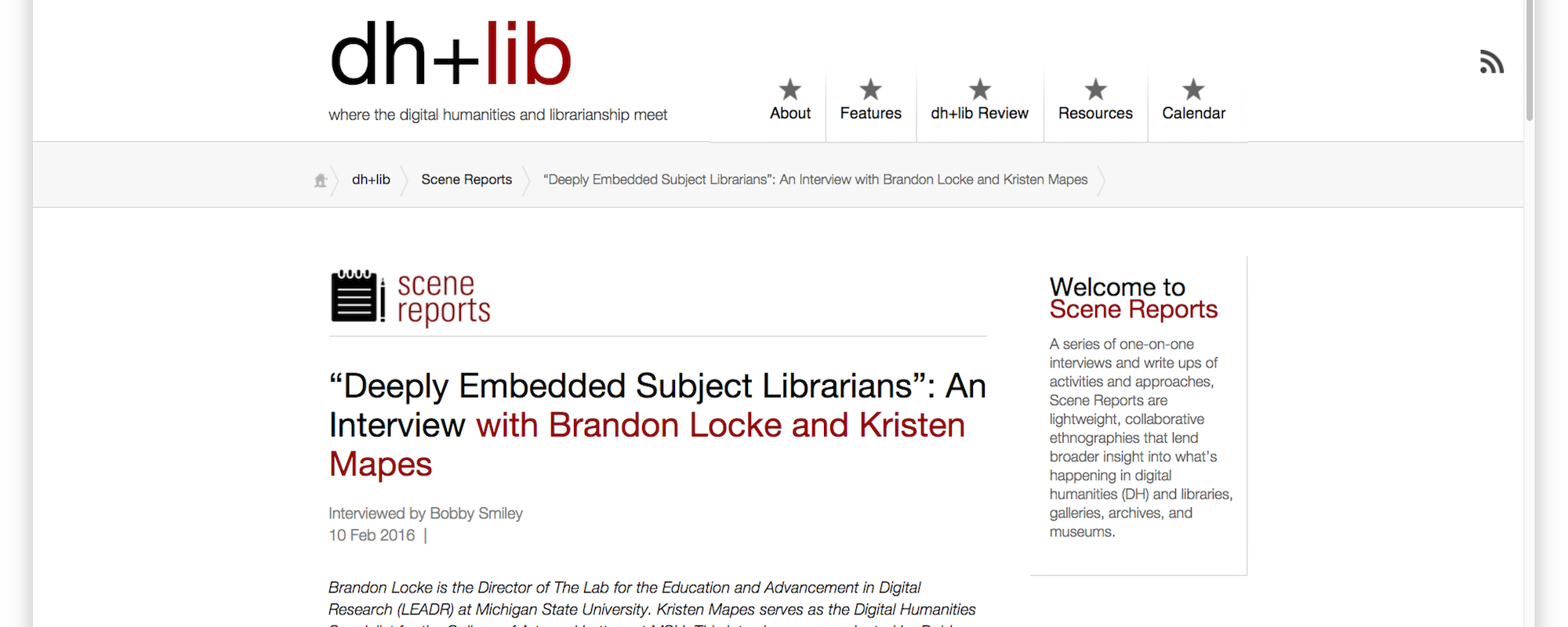
    MSU Libraries’ own Bobby Smiley interviewed Brandon Locke (Director of LEADR) and Kristen Mapes (Digital Humanities Specialist, CAL) about their roles within the world of MSU Digital Humanities. The interview was featured as a Scene Report on the DH+Lib website (part of the American Library Association), which showcases work at the intersection of libraries and digital humanities. Read the article: “Deeply Embedded Subject Librarians”: An Interview with Brandon Locke and Kristen Mapes

  • MSUDH Workshop: Text Analysis with Natural Language Toolkit

    MSUDH Workshop: Text Analysis with Natural Language Toolkit

    Here are the materials from the workshop:

    bit.ly/nltkguide

    bit.ly/nltkcmds

    go.cal.msu.edu/nltkslides

    —–

    Join us on March 23, 2016, 3 to 5pm for an introduction to NLTK tools and Python data.

    Instructors: Devin Higgins (MSUL), Kristen Mapes (CAL)

    Description: This workshop will provide an introduction to using Python programming and the Natural Language Toolkit (NLTK) to prepare and analyze text. The workshop will introduce Python data types, and provide an overview of NLTK text analysis tools. No prior programming experience required.

    Register here: http://bookings.lib.msu.edu/event/2262029


    Featured photo courtesy of: itp.nyu.edu/classes/roy2016/files/2015/02/PythonTextAnalysis.jpg

  • Opportunity for Grad Students: Summer Program Funding – Deadline EXTENDED to March 14

    Opportunity for Grad Students: Summer Program Funding – Deadline EXTENDED to March 14

    The College of Arts and Letters supports graduate student development by awarding registration for at least one student to attend a summer digital humanities training program. Students from ANY MSU program at any point in their graduate program are welcome to apply.

    Application Components:

    • Name of course you would like to attend (at DHSI, HILT, DHOxSS, ESU, etc)
    • 300 word proposal for attendance
    • Names & email of 2 faculty recommenders (no letters needed)
    • Curriculum Vitae

    Student(s) awarded with registration will be expected to share their experience with the MSU Digital Humanities community by:

    • writing one blog post in advance of the program
    • writing one blog post following the program, and
    • leading a workshop during the Fall DH program series

    Applications will be accepted at go.cal.msu.edu/summerfunding  until Monday, March 14, 5:00pm

    For more information, please contact: Kristen Mapes, kmapes@msu.edu

    Image from Day of Digital Humanities 2013, http://dayofdh2013.matrix.msu.edu/maker/wp-content/uploads/sites/225/2013/04/nosferatu.jpg

  • LOCUS: Access in a Digital Environment – REMOTE ACCESS OPTION

    LOCUS: Access in a Digital Environment – REMOTE ACCESS OPTION
    Due to the inclement weather, nasty roads, and various school/work cancellations, we are offering a remote join option for today’s LOCUS: Access in a Digital Environment. We will livestream the session via Zoom. Instructions for using Zoom are included below. The livestream will not be recorded, but there will be audio and screencast recordings of the talks available on our website in a few weeks.
     
    **Zoom instructions**
    Join from PC, Mac, iOS or Android: https://msu.zoom.us/j/4764783057
    ***
     
    This mini-symposium will take place on February 24th at 3pm in the library’s REAL classroom (3 West). 
     
    For this LOCUS, we have partnered with the Experience Architecture Program and the Museum Studies Program as the topic of access is of particular import to those fields.  Find out more under the LOCUS tab here.
     
    Please register to attend here
     
     
    Description:
     
    While more websites and digital experiences are created, we must ask questions about access. We are looking forward to presentations that engage with one or more of the following issues:
    • Who are the multiple audiences for websites, online collections, or mobile apps?
    • How do the affordances of various digital environments impact the notion of access?
    • What assumptions are made about user ability to interact with these digital environments?
    • What design decisions are made to encourage successful navigation in these environments?
    • What constitutes successful navigation of a digital environment?
    • How can different modes of engagement facilitate use for diverse communities?
    We are especially receptive to hearing about works in progress relating to research, teaching, or any other type of work that wrestles with the challenges of access in the digital environment.
     
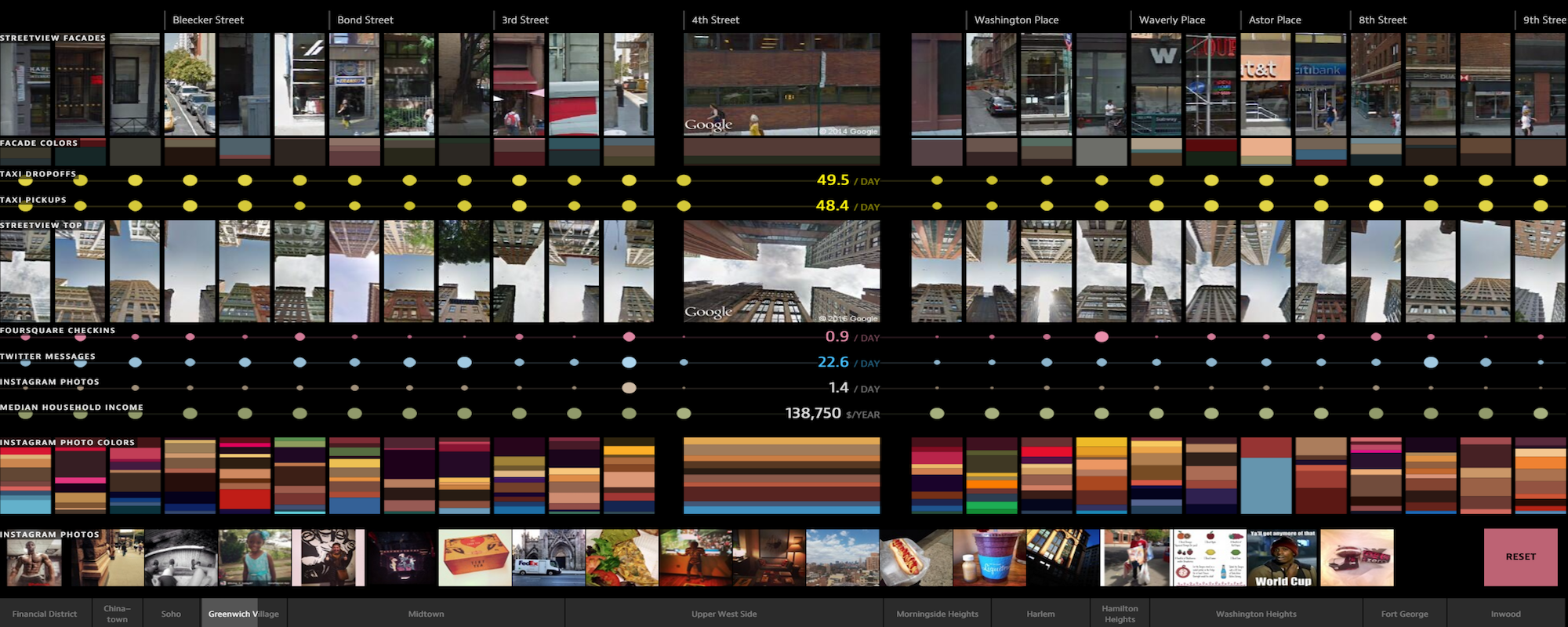
    Image from Lev Manevich’s project “On Broadway”, http://www.on-broadway.nyc/app/#
  • Summer Study Abroad in London 2016

    Summer Study Abroad in London 2016

    At the beginning of this Summer–May 20th through June 18th–students will explore changes in the arts & humanities by immersing themselves in the culture of London, one of the creative capitals of the world. The trip includes hands-on workshops and the ability to view plays, performances, museums, and galleries. They’ll also get to visit Manchester and Liverpool. This experience is a fun way for them to earn a general education requirement and fulfill electives toward the Digital Humanities minor.

    Find out more at: dh.cal.msu.edu/studyabroad or the Office of Study Abroad’s site for the program 

    The deadline to apply was March 1, 2016

    This program is sponsored by Michigan State University’s College of Arts and Letters.

    Featured Image:”St. Paul’s Cathedral Long Exposure” courtesy of Flickr user @David D’Amico

  • MSUDH Workshop: Interactive Data Visualization with R

    MSUDH Workshop: Interactive Data Visualization with R

    Join us on February 10th, 3:00-5:00pm, in the MSU Main Library’s REAL Classroom (3 West)! Are you interested in data visualization? Are you interested in making your data visualizations interactive and shareable on the web? If the answer to both is yes, this is the workshop for you. During the workshop you will be introduced to the R programming language and use it to make web based interactive data visualizations.

    Instructors: Thomas Padilla (MSUL)

    Register here: http://classes.lib.msu.edu/view_class.php?class_id=151

    “Visualization of International Migrant Stock” photo courtesy of Flickr user asheshwor. 

  • MSUDH Workshop: Github and Git for Humanists

    MSUDH Workshop: Github and Git for Humanists

    Join us on January 20th, 3:00pm to 5:00pm, in the MSU’s main library’s REAL classroom for the spring semester’s start to the Michigan State University Digital Humanities Workshop Series. Curious about Github and Git? Want to learn how to use them to manage data, code, digital projects, and collaborative document editing? During this workshop we will provide a low barrier introduction to Github and Git that will show you their potential value and offer some hands on experimentation. The instructors for this workshop are Megan Kudzia and Thomas Padilla. register here: http://classes.lib.msu.edu/view_class.php?class_id=153

    See the slides for this workshop here.

    photo: “GitHub Shows Border, Color Changes” courtesy of Flickr user J. Nathan Matias.