• Workshop: D3.js for Interactive Data Visualization

    Workshop: D3.js for Interactive Data Visualization

    For those who missed the workshop on December 4, there is a recording available, as well as the workshop tutorial and notes!

    Workshop materials available:

    Friday, December 4, 2015

    12:00-3:15pm

    MSU Main Library, 3-West Instruction Room

    Free + snacks and coffee will be provided.

    RSVP at go.cal.msu.edu/d3js

    Sponsored by the College of Arts and Letters Digital Humanities Program, Social Science Data Analytics, and MSU Libraries.

    Instructor: Emily Dolson

    D3 (which stands for Data Driven Documents) is a Javascript library that enables you to display data in a flexible way. Since it’s a Javascript library, these visualizations can easily be shared either offline or via the internet. The option to add interactive elements to your visualization lends itself to making your data easy for others to explore. During this workshop we’ll cover the basics of using d3.js to visualize data. No prior web programming experience required (we’ll teach you the necessary Javascript and html), but this workshop is aimed at people with some programming experience.

    Flyer for d3 javascript workshop

    Header image from http://greencracker.net/wp-content/uploads/2013/11/final-cafe-press-dimensions-1106.jpg

  • DH Library Office Hours

    DH Library Office Hours

    Thursdays from 12:00-1:30 in the Main Library,
    Collaborative Technology Lab, W101C

    Have a question or idea about Digital Humanities? Come chat with the DH librarians!

  • LOCUS: Visualizing and Narrating Space

    LOCUS: Visualizing and Narrating Space

    This mini-symposium will take place on November 18th at 3pm in the library’s REAL classroom (3 West). For more information regarding the LOCUS talks, including the program, you can click here or you can visit the “next” sub-tab located under LOCUS.

    LOCUS is a series of presentations from people at MSU doing work in Digital Humanities.

    LOCUS Presentations are:
    – Descriptions of works in progress
    – Descriptions of completed projects
    – Demonstrations of a method, tool, or resource

    Register to attend at http://classes.lib.msu.edu/view_class.php?class_id=147 [Registration is encouraged but not required]

    featured image courtesy of: http://stanford.edu/group/toolingup/rplviz/images/rplviz.png

  • Darwin’s Semantic Voyage

    Darwin’s Semantic Voyage

    Join us for an invited talk, “Darwin’s Semantic Voyage: Exploration and Exploitation of Victorian Science in the Reading Notebooks”.

    Speaker: Colin Allen, Provost Professor, Department of History and Philosophy of Science, Indiana University

    Date: 10/23/2015
    Time: 12:00-2:00
    Location: Main Library, Room W444

    Description: During the 23 years between his voyage on the Beagle and publication of The Origin of Species, Charles Darwin meticulously documented the books he read. His Reading Notebooks thus enable the study of inputs to his creative process between 1837 and 1860.  We located digitized full texts of 670 of his nonfiction readings (390 of which he classified as work-related reading) and applied topic modeling to them. We then used the semantic space of the topic models in a novel way to measure the distances that Darwin traveled between books.  These measurements permitted us to investigate the trade-off he made between reading within a given domain and switching to new domains. Our analysis shows that Darwin’s behavior shifts from exploitation to exploration on multiple timescales, and that at the longest timescale these shifts correlate with major intellectual epochs of his career. Furthermore, contrasting his reading order with the publication order of the same texts, we find Darwin’s consumption of the texts is more exploratory than the culture’s production of them.

    Cosponsored by MSU Libraries, Philosophy Department, and the Digital Humanities Program in the College of Arts and Letters.

  • Pedagogy in a Digital Age

    Pedagogy in a Digital Age

    Please consider taking part in the first LOCUS symposium of the semester – “Pedagogy in a Digital Age”.

    CFP extended to 10/2! 

  • HASTAC 2015 at MSU

    HASTAC 2015 at MSU

    Michigan State was delighted to host the HASTAC 2015 conference! See hastac2015.org for videos of a number of sessions and for further information.

  • James Coltrain, 3D Reconstructions, Road to HASTAC Speaker Series, May 1

    James Coltrain, 3D Reconstructions, Road to HASTAC Speaker Series, May 1

    Join us for a Road to HASTAC Speaker Series talk on “New Possibilities for Historical Reconstructions with Unity 3D and Azimuth” given by James Coltrain of University of Nebraska, Lincoln

    Dr. Coltrain will give at talk on Friday, May 1, 10:00-11:30am in 255 Old Horticulture, and he will give a workshop on May 1, 1:00-2:30pm in 112 Old Horticulture. Registration for the workshop is strongly encouraged leadr.msu.edu/3dworkshop

    This talk will focus on current issues facing the use of historical 3D reconstructions in digital humanities projects, and Azimuth 3D, a web application for displaying scenes built in the Unity 3D online game engine.  Scholars using 3D content continue to face a number of challenges, including the annotation, publication, peer review, and sharing of 3D content.  The Azimuth project seeks to address some of those challenges, providing an open web application that uses existing workflows to let scholars organize, annotate, and present 3D research alongside other digital humanities data sources in a shared space.  The presentation will feature an early demo of the Azimuth platform, as well as examples of how new Unity features for web publishing, lighting, and materials will affect future historical reconstructions.


    Featured image, “Survey for VMBMA” courtesy of Flickr user @IDIA_Lab


  • Reading Group: Ethnicity & Race in Digital Humanities, Wed, Apr 15, 12pm

    Reading Group: Ethnicity & Race in Digital Humanities, Wed, Apr 15, 12pm

    Join us on Wed, April 15 from 12-1pm (Location: Espresso Royale) for the final DH Reading Group of Spring 2015.

    Ellen Moll will lead a discussion on ‘Ethnicity and Race in Digital Humanities’ based on the following articles.  Don’t worry – they each rather short. Please read as many of the articles as possible in advance of the discussion, but also feel welcome to attend even if you haven’t had a chance to read it all!

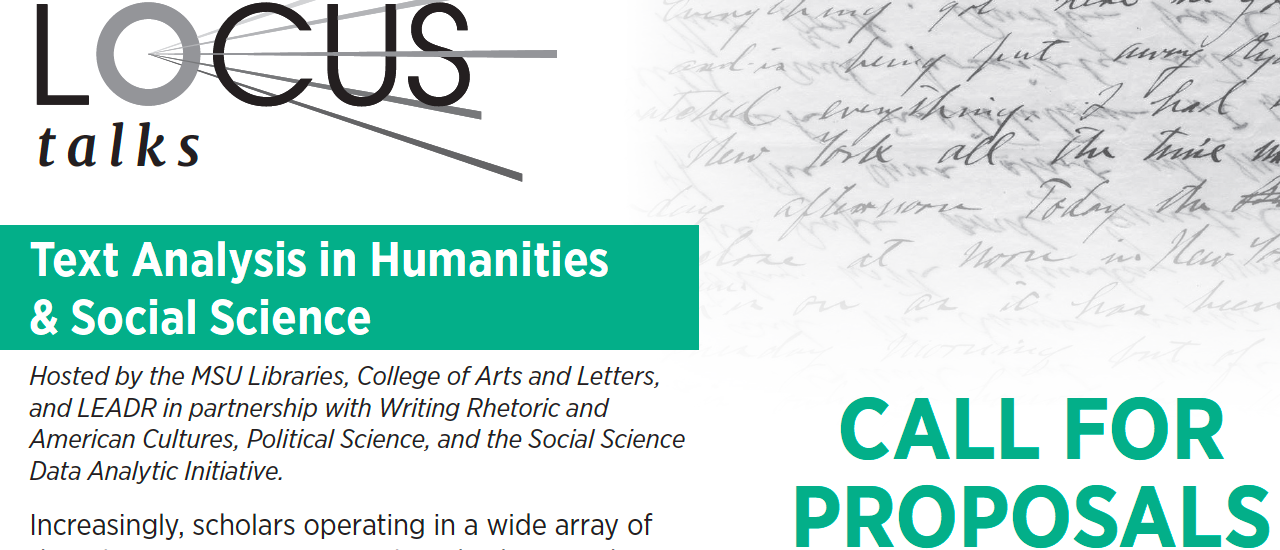
  • LOCUS: Text Analysis in Humanities & Social Science, CFP EXTENDED to 4/3

    LOCUS: Text Analysis in Humanities & Social Science, CFP EXTENDED to 4/3

    LOCUS is a new series of presentations from people at MSU doing work in DH. The second is Apr 9, 3pm. Click here for more info.

    LOCUS: Call for Participation (full information found at digitalhumanities.msu.edu/locus/next)

    Partners: Writing Rhetoric and American Cultures, Political Science, and the Social Science Data Analytic Initiative

    Submit Proposal( CFP Closes – 3/31/2015  4/3/2015)dts@mail.lib.msu.edu
    Register (space is limited)  – http://classes.lib.msu.edu/view_class.php?class_id=125

    Date: 4/9/2015
    Time: 3:00-5:30
    Location: Main Library, 3 West, REAL Classroom

    Increasingly, scholars operating in a wide array of disciplines use computational methods to study digital texts. These digital texts include but are not limited to journal articles, professional proceedings, government documents, novels, websites, and social media (Twitter, Facebook, among others). How can the content of these sources be collected and analyzed to infer the underlying structure and dynamics of human intent or behavior? What computational hurdles and opportunities exist to fruitfully utilize this digitized information in the context of (inter)disciplinary questions?  What leverage does digital text as a medium offer vs. its analog antecedents?  To what extent do computational methods align, complement, or diverge from methods used to study analog text? This LOCUS will gather scholars together to explore these questions in the context of specific research projects and/or pedagogical applications.

    LOCUS Presentations are:
    – 7-10 minutes presentation time
    – Present on works in progress
    – Present on completed projects
    – Demo a method, tool, or resource
    – Share “the seed” of an idea

    Submission Guidelines:
    – 300-500 words describing your presentation
    – Highlight the connection between technology/digital method(s) and research and/or pedagogy

  • DH Reading Group: Topic Modeling

    On January 28th, we had the first meeting of Michigan State University’s DH Reading Group. There was a good turn out to discuss topic modeling. Topic modeling involves algorithmic methods for organizing, sorting, and utilizing large corpuses of information. These topics can be modeled over time as well as in relation to other topics. They are not restricted to texts but can also be used for images, sounds, and other media structures.

    We read and discussed the following articles:

    Megan Brett’s article offers an easy-to-follow introduction to topic modeling. David Blei’s articles are well written, providing more in-depth discussion of topic modeling from a statistical perspective. Schmidt’s article offers some words of caution in the use of topic models in the humanities.

    There were a number of points we lingered on in the reading group. We considered how topic modeling is based on a conjectured model of what documents consist of, namely a certain combination of numerous topics/themes. The algorithms used to discover those latent (“hidden”) variables vary. The most common algorithm in much DH work now is the latent Dirichlet allocation (LDA). There are multiple solutions to those algorithms. Thee software package MALLET, for example, uses Gibbs sampling, but that is not the only solution. Especially after reading Schmidt’s article, we considered the numerous of variables that influence the results of topic modeling.

    We all more or less agreed that we do not have a strong enough understanding of Bayesian probability, the statistical basis of topic modeling. We hope to start a reading group on that important topic next Fall in conjunction with the Social Science Data Analytics Initiative here at MSU.

    -A. Sean Pue (@seanpue), Associate Professor, Department of Linguistics and Germanic, Slavic, Asian, and African Languages, Michigan State University