Digital & Community Publishing Collective
Summer 2018 Seed Grant Funding Report
Report submitted by Kate Birdsall and Emily Jenkins
The Digital & Community Publishing Collective (DCPC) at MSU is a new initiative that will centralize support for a broad range of publishing activities, including a monthly magazine, a literary journal,  scholarly journals, a community of feminist filmmakers, a collaborative fandom, a blog, and a zine. The collective will offer publication resources for students and organizations at Michigan State University and for members of Greater Lansing and mid-Michigan communities.
The DCPC will utilize its unique position within the Department of Writing, Rhetoric, and American Cultures at MSU to provide meaningful experiences for undergraduate and graduate students that arch over digital and print publications. The commitment of the DCPC to bring faculty, students, writers, readers, and community members together expands MSU’s visibility as an institution committed to digital humanities, research, writing, and undergraduate/graduate education.
The DCPC was able to begin research and content strategy during the summer of 2018 thanks to a summer seed grant awarded to the director of DCPC, Dr. Kate Birdsall, by DH@MSU. Birdsall is an Assistant Professor at MSU in the WRAC Department.
DH@MSU summer seed grants are available through the Digital Humanities Department at MSU. Without the help of this grant, the DCPC would have been unable to begin important research over the past summer. This memo details how the DCPC used the grant over the summer months of 2018 to begin work on establishing the collective in the MSU and Lansing communities.
The funding was primarily used for:
- Performing a landscape analysis
- Researching the most effective structure for the DCPC
- Researching similar initiatives or collectives at other universities
The rest of this report will describe in detail the outcomes of these objectives.
Landscape Analysis
The first step taken by the DCPC during summer 2018 was to perform a landscape analysis. This analysis would inform the DCPC of other similar publishing collectives run through universities, and would also help the DCPC begin to make decisions about what these collectives are doing well and what the DCPC could potentially replicate or build on as it becomes more established.
Three interns were hired for summer 2018 by Director Dr. Kate Birdsall. All three of these interns contributed to the landscape analysis.
The results from the landscape analysis revealed that no other organization is doing exactly what the DCPC aims to accomplish. The two projects that have missions the most closely aligned with the DCPC that are also housed through MSU are the iVerse Lab and the Family Communication and Relationships Lab.
The iVerse Lab is run through the Communication Arts and Sciences Department at MSU. This lab works to provide faculty and staff opportunities for research, publication, innovation, and community outreach. The six main branches of the lab’s objectives are: virtual reality design, virtual reality development, research studies, create activities, game design development, and UX design and playtesting. The director of the iVerse Lab is Dr. Taiwoo Park, an Assistant Professor at MSU in the Department of Media and Information.
The Family Communication and Relationships Lab is also run through the Communications Arts and Sciences Department at MSU. This lab is a collaboration between MSU and the University of Washington. The lab functions as a hub for research and publication for both universities involved. The directors of this lab are Dr. Elizabeth Dorrance Hall, an Assistant Professor in the Communications Department at MSU, and Dr. Kristina M. Scharp, an Assistant Professor in the Department of Communication at Washington University.
While these two labs are similar to the DCPC in that they provide publication opportunities for students and faculty, they do not include the community in the same way the DCPC will. As a community-focused publishing collective, the DCPC will provide a space for a diverse range of people, places, and communities to participate and foster connectivity through digital humanities, research, writing, reading, and undergraduate/graduate education.
DCPC Structure
Determining the structure of the DCPC was another important goal for the summer 2018 DCPC team. In order to run smoothly and be an efficient and effective publishing collective, the DCPC must have an organized internal structure. Some of the models searched include internship models, MSU organizational models, classroom models, and non-academic publishing collective models.
Three interns were hired for summer 2018 by Director Dr. Kate Birdsall. Two of these interns contributed to the structure research and design of the DCPC.
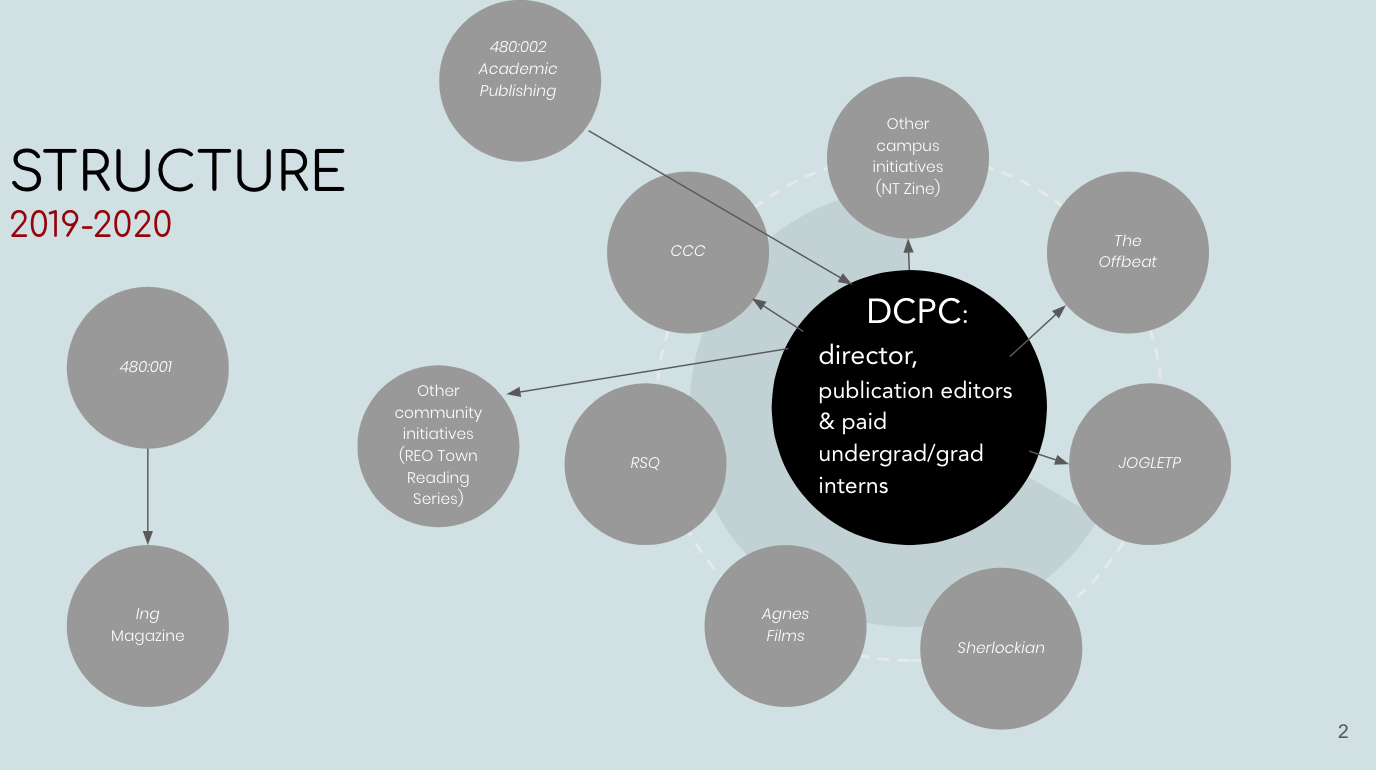
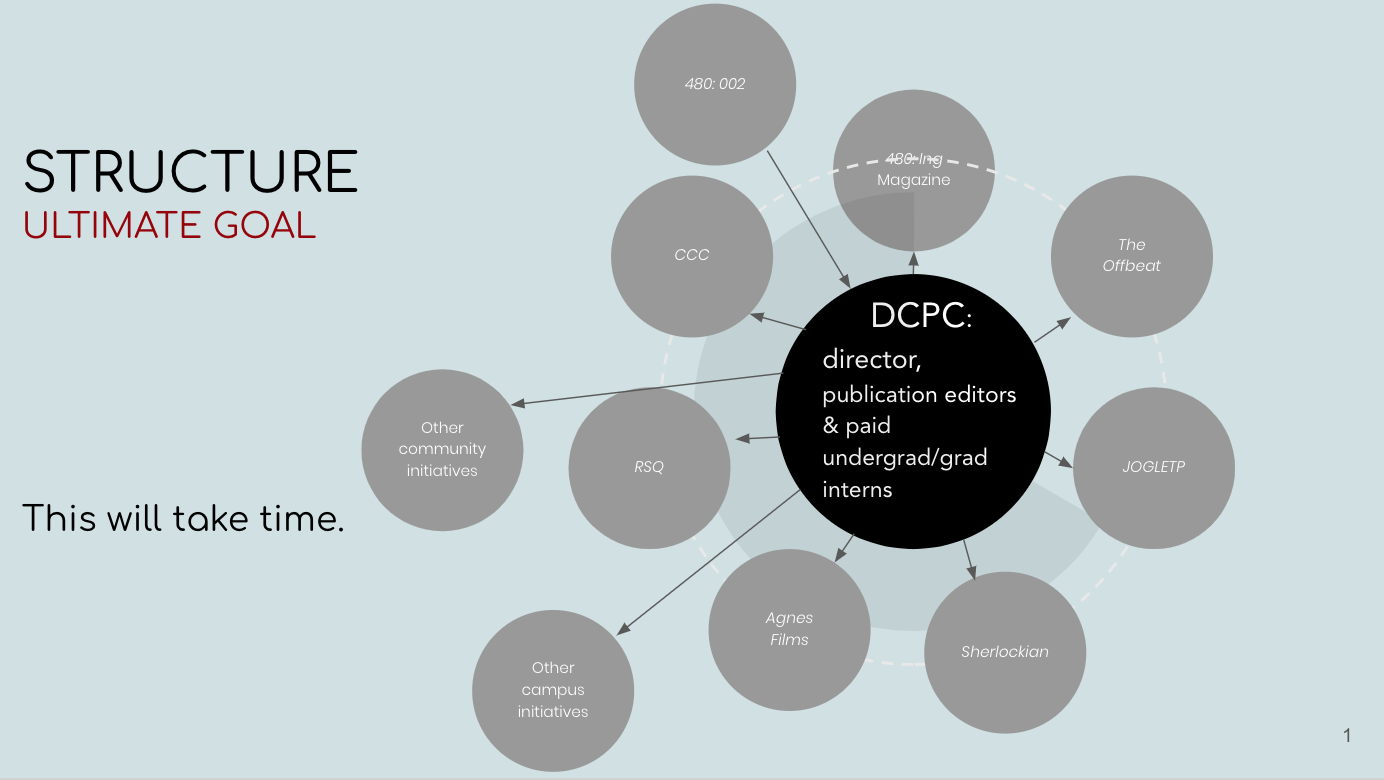
The DCPC recognizes that developing a complete organizational structure will take time. However, it has created two models that will eventually come to fruition as the DCPC grows.
This is the projected model of the DCPC’s structure for the 2019-2020 academic year:
This is the projected model of the DCPC’s ideal structure, which will take time to obtain:
Research
Performing extensive research about other similar initiatives, structures, and information about publishing collectives was also necessary during summer 2018.
Three interns were hired for summer 2018 by Director Dr. Kate Birdsall. One of these interns contributed to the research.
Search terms utilized during summer 2018 include: “university publishing collective,” “Wayne State publishing collective,” “University of Minnesota Press,” “publishing collective university,” “Lansing MI writing,” and “university publishing.”
The sources collected include scholarly journal articles, books, and the websites of other university presses. This research has helped the DCPC learn more about the publishing industry and how it is being executed at other institutions. It has also inspired many ideas for the mission, structure, and organization of the DCPC.
Other research done by the DCPC includes interviews with prominent individuals at other publishing collectives. The interview completed during summer 2018 was with Dr. Joanna Ruocco, who is a member of the Board of Directors at FC2, a publishing collective housed by Wake Forest University. Dr. Ruocco gave the DCPC valuable information about branding, networking, student involvement, board structure, and meeting structure. This research was not only helpful to the DCPC, but could also serve as the starting point for the development of a relationship or partnership between the DCPC and FC2.
While the in-depth interviews have not been completed yet, other prominent figures in the publishing business have been contacted and are currently in conversation with the DCPC. The institutions that have connected with the DCPC include: University of Minnesota, Wayne State University, LKA Publishing, Capital City Writers, and Michigan State University. The interviews once completed will supplement the research performed during summer 2018.
Looking Ahead
During the summer of 2018, the DCPC was able to make significant progress by performing an extensive landscape analysis, designing the internal structure of the collective, and researching the practices of other publishing institutions while making steps toward developing partnerships with these institutions.
Dr. Kate Birdsall is currently working with two student interns to develop a content strategy, continue the research started during the summer, and launch a website. The soft launch for this website is currently planned for January 2019, with full implementation planned for fall semester 2019.
The DCPC wants to again reiterate its appreciation for the summer seed grant presented by DH@MSU. By being awarded funding for summer 2018, the DCPC was able to get a crucial start before fall semester, and is on track to begin publicizing the collective during spring semester 2019. The DCPC thanks the Digital Humanities Department at MSU for its support in establishing a publishing collective at MSU that will facilitate student, faculty, and community involvement in the digital humanities, research, writing, reading, and undergraduate/graduate education.